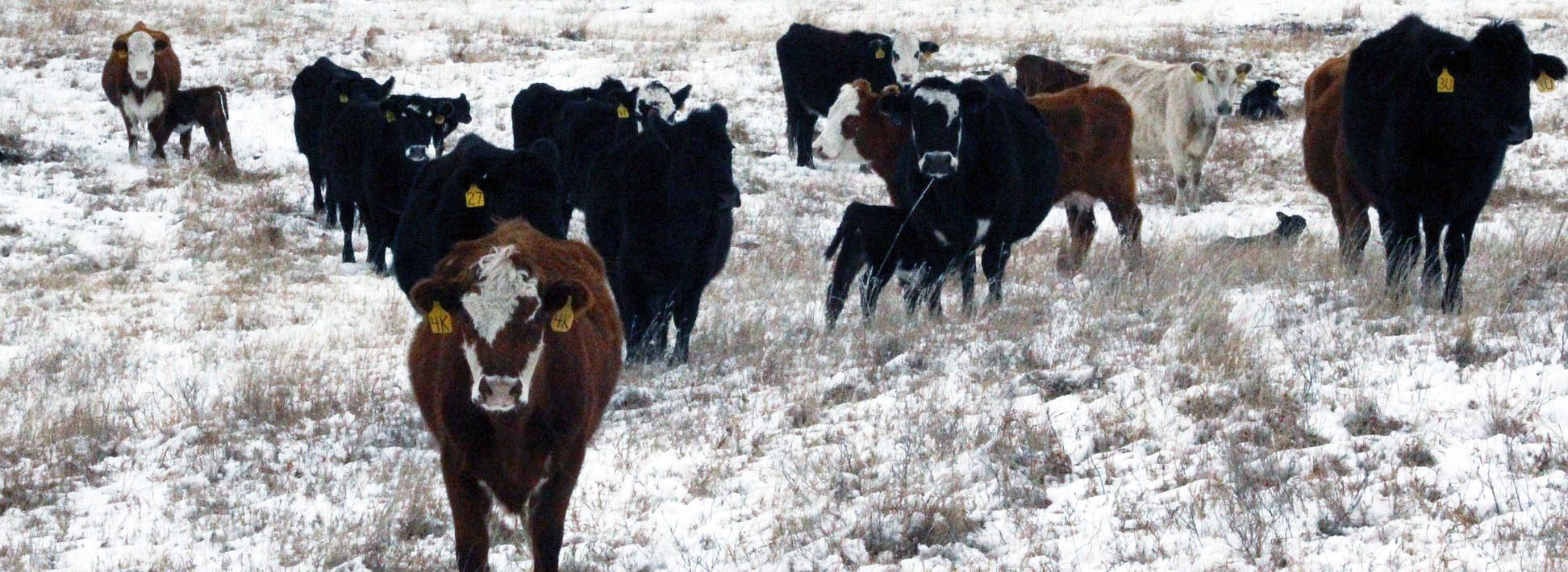
A crossbred breeding system can offer a heterosis advantage. | Download this photo
Cattle Chat: Economic advantage of crossbreeding systems
K-State beef cattle expert explains how heterosis can improve cow longevity
At a glance: K-State beef cattle geneticist Bob Weaber explains how a two-breed sire rotation can create daughters that have a maternal heterosis worth an additional $100-$150 per head in today’s market.
More information: Bob Weaber, 785-532-2281, bweaber@ksu.edu
Related: Beef Cattle Institute (podcast)
Jan. 23, 2024
By Lisa Moser, K-State Research and Extension news service
MANHATTAN, Kan. – Any dog owner will tell you that there is a decision to be made when selecting a new pet: Is it better to get a purebred dog or one that comes from a mixed genetic heritage?
For pet owners, the decision is more of a personal choice, but beef cattle producers make a similar decision, and there can be economic advantages offered by a crossbred animal, according to Kansas State University Beef Cattle Institute experts.
Speaking on a recent Cattle Chat podcast, beef cattle geneticist Bob Weaber said that maternal heterosis can offer a $100-$150 advantage in today’s market.
Maternal heterosis refers to the crossbred female’s increase in production over that of her parent breeds.
“The primary advantage of maternal heterosis is the extended lifetime productivity because crossbred cows last longer in the production system allowing them to have an additional calf in their lifetime as compared to a purebred female,” said Weaber, who also is head of the Eastern Kansas Research and Extension Centers.
Other advantages of maternal heterosis include reproduction, calf survivability, pounds of calf weaned and younger age at puberty. Weaber said because they have more calves in their lifetime, there is a decrease in replacement female costs to the herd.
According to Weaber, many commercial producers will follow a two-breed rotation in time, which means that they will change sires every few years.
“If you keep the replacement females from that mating in the herd, you can expect about one-half to two-thirds of the heterosis advantage of an F1 crossbred female,” Weaber said. He added that an F1 crossbred animal is the result of a mating between a sire and dam of two different breeds.
To learn more about the economics of crossbred programs, Weaber cites the beef sire selection manual, or a paper on Breed and Composite Selection that he has authored.
To hear the full discussion, go to the Cattle Chat podcast online or through your preferred streaming platform.
***

K‑State Research and Extension is a short name for the Kansas State University Agricultural Experiment Station and Cooperative Extension Service, a program designed to generate and distribute useful knowledge for the well‑being of Kansans. Supported by county, state, federal and private funds, the program has county extension offices, experiment fields, area extension offices and regional research centers statewide. Its headquarters is on the K‑State campus in Manhattan. For more information, visit www.ksre.ksu.edu. K-State Research and Extension is an equal opportunity provider and employer.