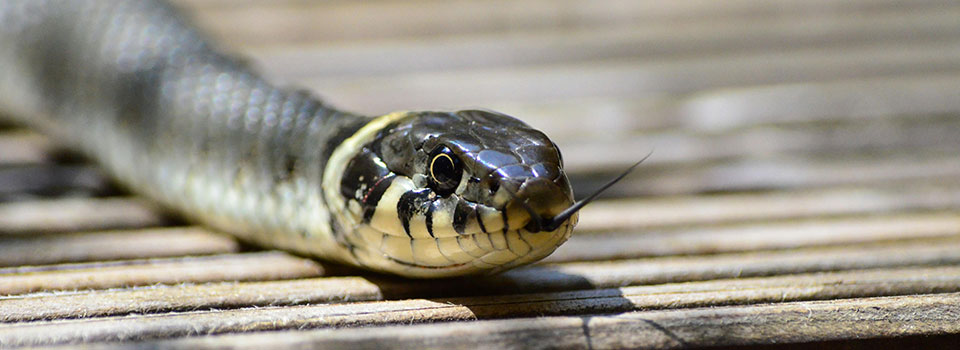
Snakes coming out of hibernation sometimes end up where people don't want to see them.
K-State wildlife expert: How to avoid negative encounters with snakes
Most snakes are not venomous; knowing how to identify species can help keep you safe
At a glance: Many people have an innate fear of snakes. K-State wildlife expert Drew Ricketts said that people should learn to identify snakes, “so that if you see one, you know whether or not it’s one you should be scared of.”
More information: Drew Ricketts, 785-532-1949, arickett@ksu.edu
Related: Snakes: Urban Wildlife Damage Control | K-State Wildlife and Outdoor Enterprise Management
April 23, 2024
By Pat Melgares, K-State Research and Extension news service
MANHATTAN, Kan. – Here’s a thought that will make a lot of people cringe: Snakes in your house.
This time of year, “snakes are coming out of hibernation,” said Drew Ricketts, a wildlife specialist with K-State Research and Extension, “and when they do that, they get pretty active because they’re hungry and they need to eat.”
“They are poking around and exploring and when that happens, they end up inside buildings or homes. That’s when I get a lot of excited phone calls and emails from folks about seeing snakes in places where they don’t want to see them.”
The odds are that the snake is not venomous, Ricketts said. There are 42 known species of snakes in Kansas, and only seven of those are venomous. One of those – the northern cottonmouth – hasn’t been spotted in close to 30 years.
“Their prey is typically going to be things like rats, mice and insects,” Ricketts said. “We have species that eat other snakes, including venomous snakes.”
Ricketts acknowledges that people have an innate fear of snakes. Still, he said that people should learn to identify snakes, “so that if you see one, you know whether or not it’s one you should be scared of.”
“The best thing to do is to give all snakes a lot of space,” Ricketts said. “One of the really surprising statistics that I’ve seen is that one-half of the people who are bitten by a venomous snake are actually handling that snake. So it’s a lot less common to have a negative encounter with the snake if you just turn around and walk the other way.”
When snakes choose to go where they’re not wanted – back to that thought of being in your home – there are options, according to Ricketts.
“You know, snakes can get in through pretty small spaces, and that’s one of the big challenges about avoiding snakes; even a fairly large snake can flatten their body out, so they could get through a space that is one-half inch tall by 1-2 inches wide,” Ricketts said. “And oftentimes, once they get into the house, they start following structure, so they follow walls as they move through the house.”
For those less frightened by snakes, one way to remove the unwanted visitor is – after identifying it’s not a venomous species – use a rod or similar tool to pin the head down, grab it behind the neck firmly, and release it outside.
Large glue traps are another alternative for those who are more snake averse, Ricketts said.
“When buying these, you want to get the one’s that say ‘for snakes’ on them,” Ricketts said. “We can place them up against a wall in the house and when the snake moves up along that wall, the glue trap catches them.”
To protect pets from being caught in the glue trap, Ricketts suggests placing glue traps behind furniture, desks, washing machines or other areas where domestic pets are not likely to roam.
Outdoors, Ricketts said homeowners can discourage snakes in the yard by reducing the presence of cover, such as rocks and landscaping pavers, brush piles, building material and tall vegetation.
“Keeping the yard mowed, not letting weeds accumulate, and cleaning the clutter that we may have out there can really help to keep snakes away,” Ricketts said.
More information on managing wildlife is available online from K-State’s Department of Horticulture and Natural Resources.
***

K‑State Research and Extension is a short name for the Kansas State University Agricultural Experiment Station and Cooperative Extension Service, a program designed to generate and distribute useful knowledge for the well‑being of Kansans. Supported by county, state, federal and private funds, the program has county extension offices, experiment fields, area extension offices and regional research centers statewide. Its headquarters is on the K‑State campus in Manhattan. For more information, visit www.ksre.ksu.edu. K-State Research and Extension is an equal opportunity provider and employer.