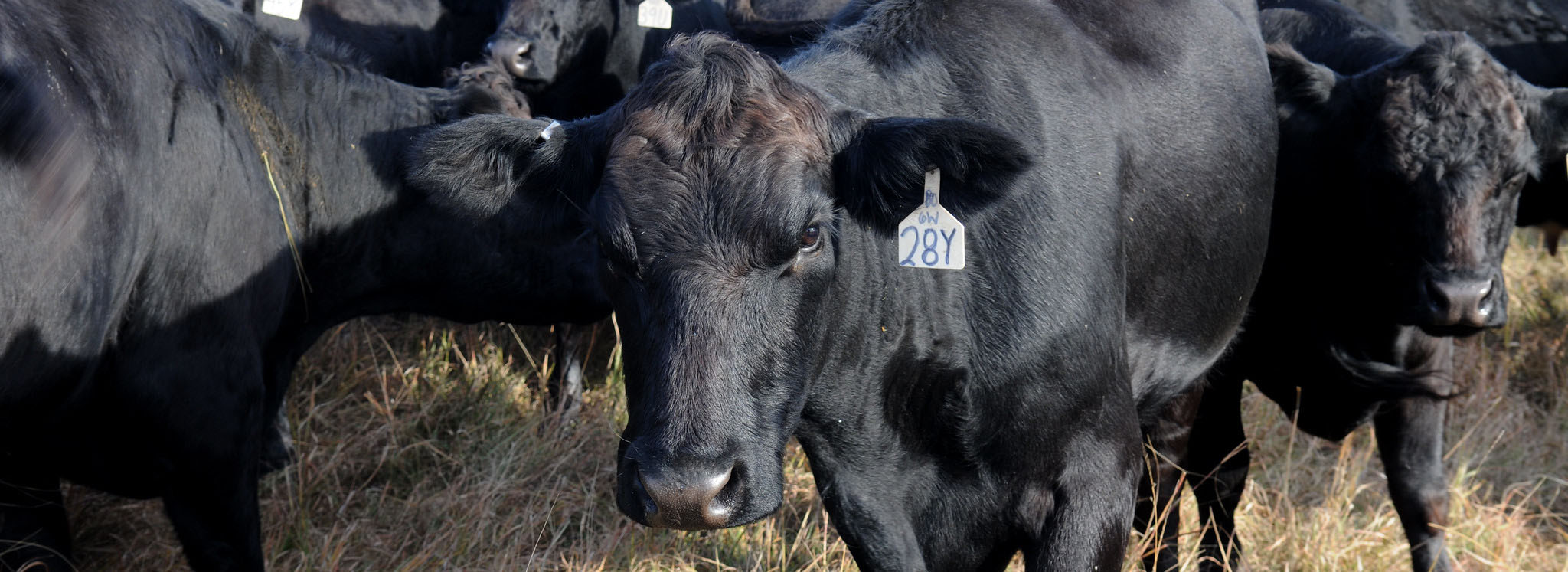
K-State veterinarian Bob Larson says cattle cannot transmit lumpy jaw or wooden tongue to each other. Groups of animals only contract the diseases when consuming the same coarse grasses. | Download photo
Cattle Chat: Look out for lumpy jaw and other facial diseases
K-State beef cattle veterinarians describe lumpy jaw, wooden tongue and cancer eye
At a glance: Wooden tongue and lumpy jaw – diseases that affect older cattle – become more prevalent as grasses and forage mature. K-State veterinarians share their causes, treatments and discuss another facial disease: cancer eye.
More information: Brad White, 785-532-4243, bwhite@vet.k-state.edu; Bob Larson, 785-532-5700, rlarson@vet.k-state.edu
Related: Beef Cattle Institute Cattle Chat
July 30, 2024
By Jacob Klaudt, K-State Research and Extension news service
MANHATTAN, Kan. – As grasses within a pasture mature, various physical changes occur, which impact the cattle grazing them. For instance, older plants dry out and lose nutritional value, but also develop coarse stems – making cattle more susceptible to injuries involving their face and eyes.
On a recent episode of the Cattle Chat podcast, Kansas State University veterinarians recommend producers watch for lumpy jaw and wooden tongue as their pastures start getting “stemmy.”
“Green, growing grass isn’t likely to cause these problems,” said K-State veterinarian Bob
Larson. “Lumpy jaw and wooden tongue happen when the tissues of the mouth are damaged on rough textured forages.”
In the case of wooden tongue, damaging incidents to the mouth allow for germs that live within the animal to cause an infection.
“It’s not really something that cattle get from other cattle. It’s caused by bacteria that are normally in the mouth and throat area,” Larson said.
K-State veterinarian Brad White adds: “Coarse feeds and grasses can damage the mucous membranes and cause lesions.”
Cattle with wooden tongue display obvious physical symptoms, according to Larson and White.
“Their tongue gets large and tends to hang out of their mouth, making eating difficult. They look like they are panting or drooling,” Larson said.
“It gets stiff, swollen and painful,” White said. “You do not very often see an animal – a cow especially – sticking their tongue out of their mouth; they’re not doing it to play. They are doing it because their tongue won't go back in.”
Like wooden tongue, cattle contract lumpy jaw through the bacteria that inhabit their mouths.
“After an injury, (bacteria) gets into some of the other tissues of the mouth,” Larson said. “What's dangerous about that one is it can invade bone. If that happens, it becomes difficult to cure.”
Larson said when producers discover lumpy jaw and wooden tongue in their earlier stages, cattle have a better chance of recovering.
“A lot of times these cases will be treated intravenously,” he said. “This is pretty effective at bringing those two syndromes back to normal but contact your local veterinarian before making any treatment decisions.”
When examining an animal’s mouth and face for lumpy jaw and wooden tongue, Larson suggests that producers monitor the eyes as well for squamous cell carcinoma, or cancer eye.
If this affliction goes untreated, cattle may face the same fate as their lumpy jaw and wooden tongue-infected counterparts.
“Cattle can get a cancer of the eye – often in their third eyelid. If you treat it early with surgical removal of that area, those animals respond well and can go ahead and have multiple years of productive life after that,” Larson said.
However, “If that cancer spreads and it involves the bones of the head, that is not going to get better, and it is time to think about euthanasia just from an animal welfare standpoint.”
To hear the full discussion, listen to Cattle Chat on your preferred streaming platform.
***

K‑State Research and Extension is a short name for the Kansas State University Agricultural Experiment Station and Cooperative Extension Service, a program designed to generate and distribute useful knowledge for the well‑being of Kansans. Supported by county, state, federal and private funds, the program has county extension offices, experiment fields, area extension offices and regional research centers statewide. Its headquarters is on the K‑State campus in Manhattan. For more information, visit www.ksre.ksu.edu. K-State Research and Extension is an equal opportunity provider and employer.