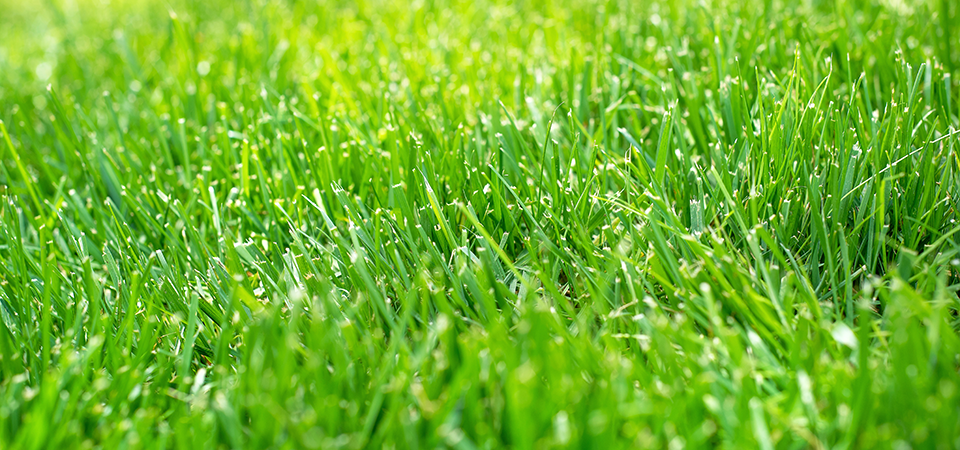
Tall fescue grass is the most popular variety grown in Kansas.
Newer grass varieties can help boost cool-season lawns this Fall
K-State horticulture expert shares tips on what to look for when purchasing seed
At a glance: As summer’s heat cools into fall, homeowners have an opportunity to refresh their home lawns. K-State horticulture expert Cynthia Domenghini says there are some good choices for over-seeding or replacing cool season grasses.
More information: Cynthia Domenghini, Cdom@ksu.edu
Photo: Cynthia Domenghini
Related: K-State Horticulture Newsletter | Kansas Garden Guide | Planting a Home Lawn | Turfgrass Selection | Fertilizing Kansas Lawns
Aug. 15, 2024
By Pat Melgares, K-State Research and Extension news service
MANHATTAN, Kan. – As summer’s heat cools into fall, homeowners have an opportunity to refresh their home lawns. And Kansas State University horticulture expert Cynthia Domenghini says there are some good choices for over-seeding or replacing cool season grasses.
The most popular cool-season grass in Kansas has been a tall fescue variety known as K-31, but even that old standby is giving way to higher-quality choices.
“There are a myriad number of newer varieties with improved color, density and finer leaf texture,” Domenghini said. “Most of these newer varieties are very close to one another in quality. We recommend a regional blend of tall fescue cultivars that are commonly available in local garden centers and hardware stores.”
Domenghini said varieties more commonly sold in big box stores often don’t perform well in Kansas because they often contain cultivars that don’t tolerate the state’s stressful weather conditions.
To pick a reliable cultivar, Domenghini advises paying attention to the percentage of ‘Crop Seed’ and ‘Weed Seed’ listed on the label. “Anything over 0.01% of either of these is not recommended” for Kansas lawns,” Domenghini said.
“Though K-31 may still be a good choice for large, open areas where weeds and a lighter green color can be tolerated, the newer cultivars will give better performance for those who desire a high-quality turf,” she said.
Domenghini added that Kentucky bluegrass is becoming a more common choice for home lawns. Kentucky bluegrass is not as heat and drought tolerate as tall fescue and warm-season grasses, but is reliable in areas like northeast Kansas where there is sufficient annual rainfall.
“It is also grown under irrigation in northwest Kansas where the higher elevation allows for cooler summer night temperatures,” Domenghini said.
K-State Research has published a list of the highest rated Kentucky bluegrass cultivars for Kansas. That publication breaks down more than two dozen cultivars for high-quality lawns where visual appearance is the prime concern; and ten others for low maintenance and limited watering.
Domenghini said high maintenance lawns are those that receive irrigation to prevent stress and receive at least three applications of fertilizer per year. Lawns under a low-maintenance program receive limited watering and fertilization, typically 1-2 pounds of nitrogen per square feet per year.
“Obviously a low-input lawn will not be as attractive as a higher input lawn, but you can expect the recommended cultivars to look fairly good in the spring and fall, while going dormant in the summer,” Domenghini said.
Domenghini and her colleagues in K-State’s Department of Horticulture and Natural Resources produce a weekly Horticulture Newsletter with tips for maintaining home landscapes and gardens.
Interested persons can subscribe to the newsletter, as well as send their garden and yard-related questions to Domenghini at cdom@ksu.edu, or contact your local K-State Research and Extension office.
***
Sidebar: Question of the Week
What can I do to encourage my hydrangeas to bloom more fully?
Here are some common reasons why hydrangeas fail to bloom:
- Bigleaf hydrangeas prefer light shade or filtered sun. Too much shade can hinder blooming. Too much sun can cause stress for the plant.
- Pruning at the wrong time can remove buds for the next year and prevent blooming. This varies by species and cultivar. Some cultivars develop buds on past season’s growth, while others develop on new growth.
- Well-drained soil is essential for plant health. Compacted soil can prevent the plants from receiving moisture even if you are providing enough water. Over- and under-watering will impact the development of flowers and the overall plant health.
- Too much nitrogen fertilizer will support leaf development, but not flowers. Fertilizers with more phosphorus will support flower growth.
Also, winter temperature is commonly a problem with hydrangea blooms. If there is a cold snap and no snow insulating the plants – along with inconsistent weather – the buds that developed in the fall can be damaged, which impacts the spring bloom.
A late spring frost can also cause problems. If you think this is likely the problem, you can try wrapping the plants as we head into winter to provide protection.
 -- Cynthia Domenghini, K-State horticulture expert, Cdom@ksu.edu

K‑State Research and Extension is a short name for the Kansas State University Agricultural Experiment Station and Cooperative Extension Service, a program designed to generate and distribute useful knowledge for the well‑being of Kansans. Supported by county, state, federal and private funds, the program has county extension offices, experiment fields, area extension offices and regional research centers statewide. Its headquarters is on the K‑State campus in Manhattan. For more information, visit www.ksre.ksu.edu. K-State Research and Extension is an equal opportunity provider and employer.