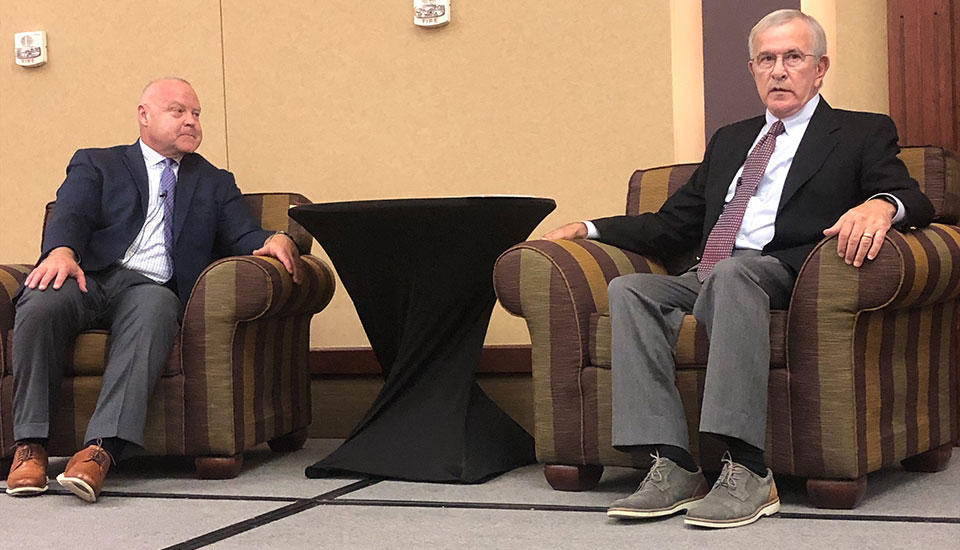
Noted agricultural economist Nevil Speer (left) moderates a discussion with former U.S. Secretary of Agriculture Mike Johanns Oct. 6 during the Henry C. Gardiner Global Food Systems conference at Kansas State University. | Download photo
Johanns: Using available technology is key to resolving world hunger
Former Secretary of Agriculture highlights Gardiner Global Food Systems conference at K-State
At a glance: Former U.S. Secretary of Agriculture Mike Johanns said speeding up the adoption of available technology is key to feeding the world's hungry and slowing poverty, during the Henry C. Gardiner Global Food Systems conference Oct. 7.
Related: Henry C. Gardiner Global Food Systems lecture series
Oct. 8, 2024
By Pat Melgares, K-State Research and Extension news service
MANHATTAN, Kan. – Former U.S. Secretary of Agriculture and Governor of Nebraska Mike Johanns said using available technology in farming is a critical part to feeding a world population that is predicted to reach nearly 10 billion people by the year 2050.
“We are on a collision course in terms of being able to feed the people of the world unless we can free up the technology that is being developed today,” said Johanns, speaking Oct. 7 during the Henry C. Gardiner Global Food Systems conference at Kansas State University.
“We can feed the world – including those 700 million (who currently live in the world’s most impoverished regions) – if our ranchers and farmers are allowed to use it.”
Johanns said U.S. companies are investing in technology to make food more abundant and accessible, but expense and the amount of time to fully implement the technology becomes a barrier. He notes that the great American agronomist Norman Borlaug – known as the Father of the Green Revolution in the United States – long ago declared that the world has the technology available or in the research pipeline to sustain a population of 10 billion people.
“So, I said, ‘Whoa…wait a second here.’ You mean we have technology that takes people from starvation to feeding themselves, but the question is whether our farmers and ranchers will be allowed to use that?” Johanns said
“I’m going to say something here that probably will irritate every governmental official in the country, but it needs to be said. Governmental policies are hurting the poor.”
Johanns said that due to government rules and regulations – both in the U.S. and in foreign countries -- some products take as much as 10-12 years to get to the market. One study on the impact of delays in Chinese approvals of biotechnology crops predicted the value of U.S. corn was $1.8 billion to $5 billion less than if the technology had been accepted by that country.
“If you look at technology, it’s there, it’s available and it’s been tested,” he said. “And yet you run into these periods of times when the technology faces endless requirements to get out there. That is a trade barrier. It’s just a story that doesn’t get told enough.”
During his tenure as Secretary of Agriculture, Johanns opened or expanded access to 40 international markets and is credited with establishing agricultural breakthroughs as a member of the U.S. negotiating team for the Doha Development Round, aimed at improving trading prospects of developing countries.
Johanns conducted 32 international trips to advance trade, aid and food safety as a representative of the United States.
While slow adoption of technology is a trade barrier, there are many others, which vary by industry, Johanns said. But regardless of the reason, he’s certain it’s the most vulnerable that are the victims.
“In 1990, 20 developing countries increased their share of local exports from 16% to 30%, and their poverty rate declined in the same period from 30% to 10%. That’s a remarkable success story,” Johanns said.
“If you really want to look at the world and how to stop terrorism and feed hungry bellies, you need to think about fair trade. Trade changes things.”
Also on Oct. 7, Craig Gundersen – the Snee Family Endowed Chair for the University of Baylor’s Collaborative on Hunger and Poverty – gave an impassioned talk on alleviating food insecurity in the United States, and the critical role of meat.
Gundersen noted that attacks on the meat industry hurt local businesses, farmers and ranchers, and those most vulnerable to food insecurity. Gundersen said food insecurity often increases due to inflation, a disability and misconceptions about the value of meat products.
That evening, scientist Peer Ederer, founder of an international company named GOALSciences, was the keynote speaker for the 11th Henry C. Gardiner Global Food Systems lecture. His talk was titled Scientific Evidence Behind the Role of Livestock and Meat Production in a Global Society.
He provided scientific evidence for livestock production based on four areas:
- Nutrition. Despite assumptions that eating red meat can be detrimental to health, Ederer said 30 years of nutrition research proves differently. “On the contrary, meat and dairy are actually protective of our good health,” he said.
In a wide-ranging study involving 250,000 people in every region of the world, scientists found that a healthy diet of pure fat dairy (two ounces per day) and unprocessed red meat (three ounces per day) was beneficial to health. In countries where residents don’t eat red meat – Ederer cited the examples of Pakistan and Egypt -- the rate of metabolic disease and Type II diabetes were unusually high.
- Ecology. Grazing animals are critical to maintaining the ecological balance in all regions of the world. Ederer pointed to the example of Idaho’s Snake River Valley, once an abundant agricultural region, but now a lonely desert of non-arable land due to the lack of grazing, ruminant animals.
- Economy. “If I have a kilo of wheat in my hand, should I eat that wheat or should I be feeding it to a cow and then consume the milk from that cow?” Ederer asked the audience. From an economic standpoint, he said, it’s better to feed the grain to the animal and benefit from the added nutrients humans get from the food product.
“Your Kansas economy,” Ederer said, "is providing the food that people eat in the cities, but it’s not only providing grains. You’re providing animal-source foods, because if you provide only grains, then you end up like Pakistan or Egypt where people are getting sick. Civilization is only possible because we’re building it on the foundation of animal agriculture; that’s what economics tell us.”
- Methane. Over the past 800,000 years, Earth has experienced many variations in temperatures, and nearly identical fluctuations in methane levels. But in the past 150 years, methane levels have risen drastically – from 700 parts per billion in the atmosphere, to 2,000 ppb. “The fact that we have these 2,000 parts per billion in our atmosphere is a problem; we broke something in our atmosphere in the past 150 years that caused this,” Ederer said.
But he notes that blaming animal agriculture is “a rush to judgment. To be looking at livestock emissions solely is surely not right. It’s only been in the last couple years that we’re starting to see empirical data (and) observations that help us try to understand what’s going on in the atmosphere.”
“We don’t know yet how we can fix this problem because we don’t know yet what has gone wrong.”
The full transcript and archived video of Ederer’s lecture is available online from Kansas State University’s College of Agriculture.
K-State established the Henry C. Gardiner Global Food Systems lecture series to provide science-based education about world food issues. The series allows students, faculty, staff and Kansas citizens to interact with U.S. and international food industry leaders on topics of current interest.
The lecture series is funded by the Gardiner family of Ashland, Kan. Henry C. Gardiner, who passed away just days before the first lecture in 2015, was known as a visionary leader who dedicated his career to improving the beef industry through science and technology.
***

K‑State Research and Extension is a short name for the Kansas State University Agricultural Experiment Station and Cooperative Extension Service, a program designed to generate and distribute useful knowledge for the well‑being of Kansans. Supported by county, state, federal and private funds, the program has county extension offices, experiment fields, area extension offices and regional research centers statewide. Its headquarters is on the K‑State campus in Manhattan. For more information, visit www.ksre.ksu.edu. K-State Research and Extension is an equal opportunity provider and employer.