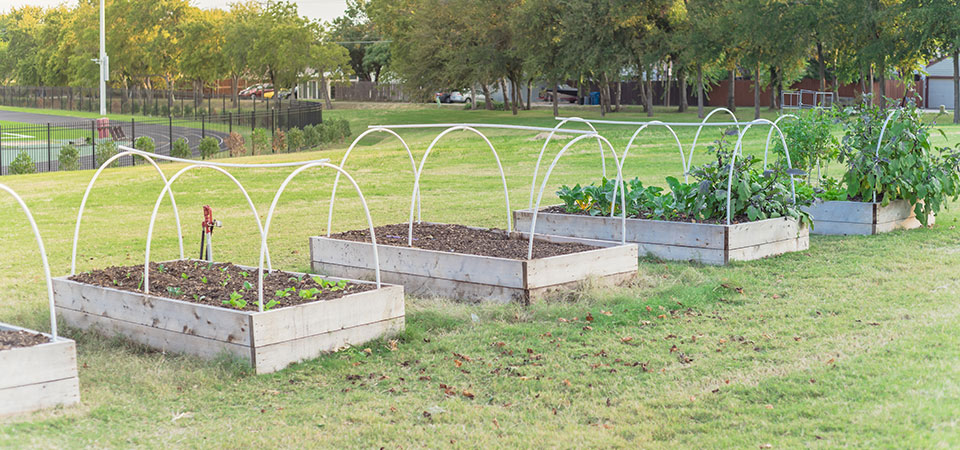
Low tunnels are one option for extending the garden season during the cold months.
Change in seasons may affect gardener’s mental health
K-State horticulture expert suggests season extenders to keep plants growing
At a glance: Cooler temperatures signal the end of the traditional outdoor gardening season. It can also lead to a condition known as seasonal affective disorder, a type of depression in which the symptoms correspond with the seasons.
More information: Cynthia Domenghini, Cdom@ksu.edu
Related: K-State Horticulture Newsletter
Oct. 10, 2024
By Pat Melgares, K-State Research and Extension news service
MANHATTAN, Kan. – For most people, putting summer’s hot temperatures in the rearview mirror is a welcome transition.
But as temperatures cool, it also signals the end of the traditional outdoor gardening season. It can lead to a condition known as seasonal affective disorder, or SAD, a type of depression in which the symptoms correspond with the seasons.
“Fall and winter can bring feelings of lethargy and moodiness to affected individuals,” Kansas State University horticulture expert Cynthia Domenghini said. “The reduction in hours of sunlight is suspected to be one factor influencing SAD. Other influences may be less time spent outdoors due to colder temperatures, resulting in more isolation and less socialization.”
Domenghini suggests season extension tools to continue growing crops outdoors. Season extension tools provide insulation, making it possible for plants to live beyond the typical growing season for the climate.
Some options include:
- Low tunnels. This is a row of plastic or wire hoops to support fabric that blankets the crops. The fabric is commonly made of spun-bonded polyester or polypropylene. Thicker fabrics are used to provide protection at lower temperatures.
- Cold frame. This resembles a small greenhouse and is often made of wood with framed windows. The small size makes the cold frame portable, so it can be placed of winter plantings, as needed. The top of the cold frame is often built at an angle to allow more light to enter when it’s positioned toward the sun.
- Milk jugs. Cut the bottom out of the jug and place the jug over plants. Secure the jug to the ground. There are any number of decorative options, if the gardener doesn’t like the sight of milk jugs across the garden.
“Cool season crops – including, but not limited to, radishes, lettuce and spinach – are great options for growing beneath a season extender,” Domenghini said.
For mental health, Domenghini also suggests maintaining a healthy diet and exercising (gardening counts!). However, she also recommends seeking professional help for diagnosis and treatment if you believe you are suffering from SAD.
Domenghini and her colleagues in K-State’s Department of Horticulture and Natural Resources produce a weekly Horticulture Newsletter with tips for maintaining home landscapes and gardens.
Interested persons can subscribe to the newsletter, as well as send their garden and yard-related questions to hortsupport@ksu.edu, or contact your local K-State Research and Extension office.
# # #
Sidebar: Question of the Week
We have a sloped landscape (40% grade) and are considering establishing a lawn. Will this work?
Maintainence is a primary concern with establishing a lawn at this percent grade because mowing becomes difficult at this angle. Additionally, water is going to drain away rapidly, rather than being absorbed in the soil. This will make establishing a thick, healthy lawn challenging and may give weeds the opportunity to take over.
Many problems in the lawn and landscape can be prevented by maintaining healthy plants. If you’re unable to establish a dense lawn, you are setting yourself up for a battle with other issues that may take advantage of the stressed turfgrass.
Some options to consider instead of a traditional lawn include growing native grasses or groundcover. These plants will not require mowing, and once established, will need minimal water.
If turgrass is still desired, Buffalograss could be considered since it requires minimal mowing. Fine fescues look nice when the tops lay down, so mowing would not be necessary. Regardless of which plants are selected, extra attention will be required during establishment to ensure they are receiving enough water.
 -- Cynthia Domenghini, K-State horticulture expert, Cdom@ksu.edu

K‑State Research and Extension is a short name for the Kansas State University Agricultural Experiment Station and Cooperative Extension Service, a program designed to generate and distribute useful knowledge for the well‑being of Kansans. Supported by county, state, federal and private funds, the program has county extension offices, experiment fields, area extension offices and regional research centers statewide. Its headquarters is on the K‑State campus in Manhattan. For more information, visit www.ksre.ksu.edu. K-State Research and Extension is an equal opportunity provider and employer.