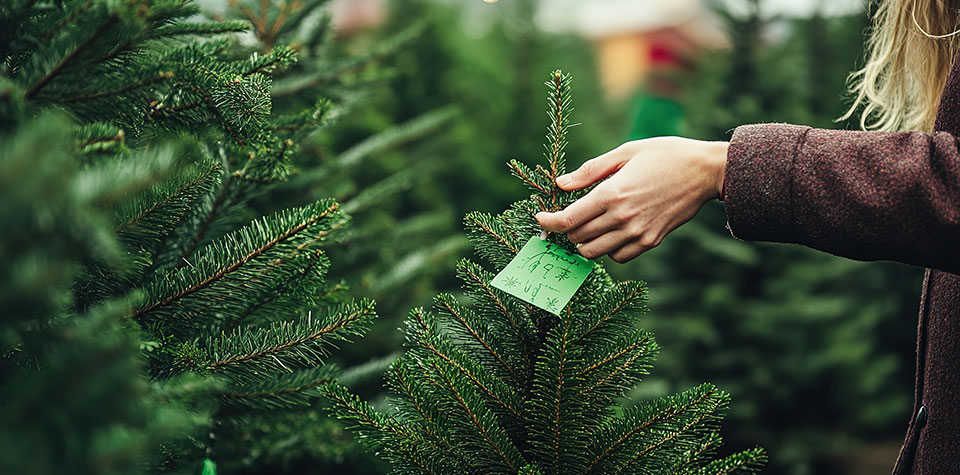
Evaluate a live Christmas tree closely before you buy it, says K-State horticulture expert Cynthia Domenghini.
K-State horticulture expert shares tips for choosing and caring for live Christmas trees
Tree safety starts when you pick one from the lot
At a glance: K-State horticulture specialist Cynthia Domenghini shares tips to keep in mind when purchasing a live Christmas tree.
More information: Cynthia Domenghini, Cdom@ksu.edu
Related: K-State Horticulture Newsletter | Conifer Trees for Kansas: A Guide to Landscape Evergreens
Dec. 3, 2024
K-State Research and Extension news service
MANHATTAN, Kan. — Kansas State University horticulture expert Cynthia Domenghini said there are three characteristics to avoid when selecting a live Christmas tree:
- Dull, gray-green needles.
- Dry, stiff and brittle needles.
- Needles drop from tree easily.
“Some commercial sites sell cut trees that have already been stored for several weeks, so evaluate these carefully before purchasing,” Domenghini said.
Once your tree is selected and transported home, re-cut the trunk about one inch above the base just before placing it in a stand. Domenghini said this will open up the plant tissues that enable the tree to pull in water. Place the trunk into the stand with water immediately after cutting.
“As with traditional houseplants, avoid placing your Christmas tree near heat sources or drafty windows and doors,” Domenghini said. “It is important to always keep water in the tree stand reservoir.”
If the cut end of the tree is exposed to air for several hours, it will begin to seal and will need to be re-cut again. Fresh cut trees tend to absorb a lot of water during their first couple of weeks, so check the water level at least every other day, Domenghini said.
“Living trees are a great option for homeowners who have space to add to their landscape,” Domenghini said. “It is also a good idea to dig the hole where the tree will be planted prior to when the ground freezes so it can be planted soon after the holidays.”
Living trees should only be kept indoors for a few days. Trees kept indoors too long will come out of dormancy and initiate new growth.
“If the tree is then moved outdoors during winter, it will not be hardy to the cold conditions and can suffer extreme damage or even death. At planting, water the tree and apply a layer of mulch to prevent the water from freezing,” Domenghini said.
Domenghini and her colleagues in K-State’s Department of Horticulture and Natural Resources produce a weekly Horticulture Newsletter with tips for maintaining home landscapes and gardens.
Interested persons can subscribe to the newsletter, as well as send their garden and yard-related questions to hortsupport@ksu.edu, or contact your local K-State Research and Extension office.
***

K‑State Research and Extension is a short name for the Kansas State University Agricultural Experiment Station and Cooperative Extension Service, a program designed to generate and distribute useful knowledge for the well‑being of Kansans. Supported by county, state, federal and private funds, the program has county extension offices, experiment fields, area extension offices and regional research centers statewide. Its headquarters is on the K‑State campus in Manhattan. For more information, visit www.ksre.ksu.edu. K-State Research and Extension is an equal opportunity provider and employer.