Buying firewood? Knowing heat values could aid your choice
Kansas forestry expert gives tips for choosing firewood
At a glance: Not all firewood is created equal. Knowing which varieties burn safely and produce more heat as well as drying it properly will help to maximize its use.
More information: David Bruton, 785-945-6147, dbruton@ksu.edu
Related: Managing Your Woodland for Firewood
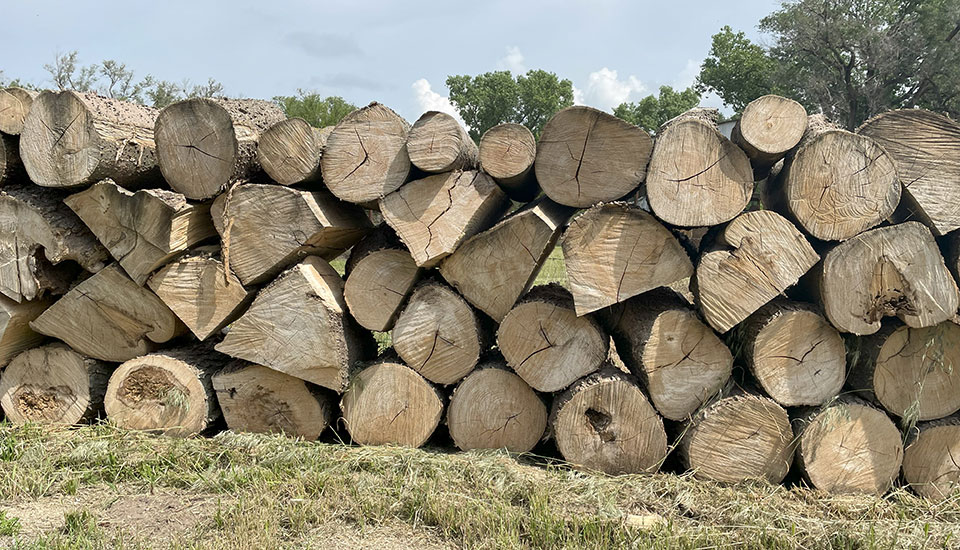
Firewood may need to be seasoned for up to three years to burn most effectively. (Photo courtesy of the Kansas Forest Service)
Dec. 4, 2024
By Pat Melgares, K-State Research and Extension news service
MANHATTAN, Kan. — Not all firewood is created equal.
That’s the word from Dave Bruton, a utilization and marketing forester with the Kansas Forest Service, who said the wood from some tree species produces more heat than others.
High on the list are red, bur and post oak species, which produce a heat value of 25 (measured in millions of British Thermal Units, or BTUs). In a list of many common types of firewood, Bruton said only Osage Orange (32.6), honey locust (25.6) and black locust (28.3) rate higher than the oaks.
But, he adds, Osage Orange is not always the best choice due to its tendency to spark – “do not use in an open fireplace,” he said – and black locust can be difficult to split.
Many elm varieties and hackberry rate high (all around 20) but elm can be difficult to split, as well.
Bruton said the Kansas Forest Service publication, Managing Your Woodland for Firewood, is a helpful resource for landowners interested in growing and harvesting firewood. The publication is available online.
For homeowners, Bruton advises buying firewood locally to prevent spread of pests such as the Emerald Ash Borer, an exotic beetle that has devastated tens of millions of ash trees in 30 states, according to the U.S. Department of Agriculture.
“Emerald Ash Borer has spread in Kansas primarily because of firewood,” he said.
Bruton added that drying – or seasoning – the wood is also key to how well it burns in the fireplace. He said firewood that has a moisture content between 15% and 20% is considered ‘seasoned’ and ready to burn.
“To speed the drying process, large pieces should be split, stacked above the ground on pallets or other supporting material, exposed to the sun, and stacked in an area with good air circulation,” Bruton said.
It can take between 1-3 years to adequately season firewood, so Bruton recommends that individuals cutting their own firewood “plan ahead and segregate wood into piles for future use.”
***

K‑State Research and Extension is a short name for the Kansas State University Agricultural Experiment Station and Cooperative Extension Service, a program designed to generate and distribute useful knowledge for the well‑being of Kansans. Supported by county, state, federal and private funds, the program has county extension offices, experiment fields, area extension offices and regional research centers statewide. Its headquarters is on the K‑State campus in Manhattan. For more information, visit www.ksre.ksu.edu. K-State Research and Extension is an equal opportunity provider and employer.