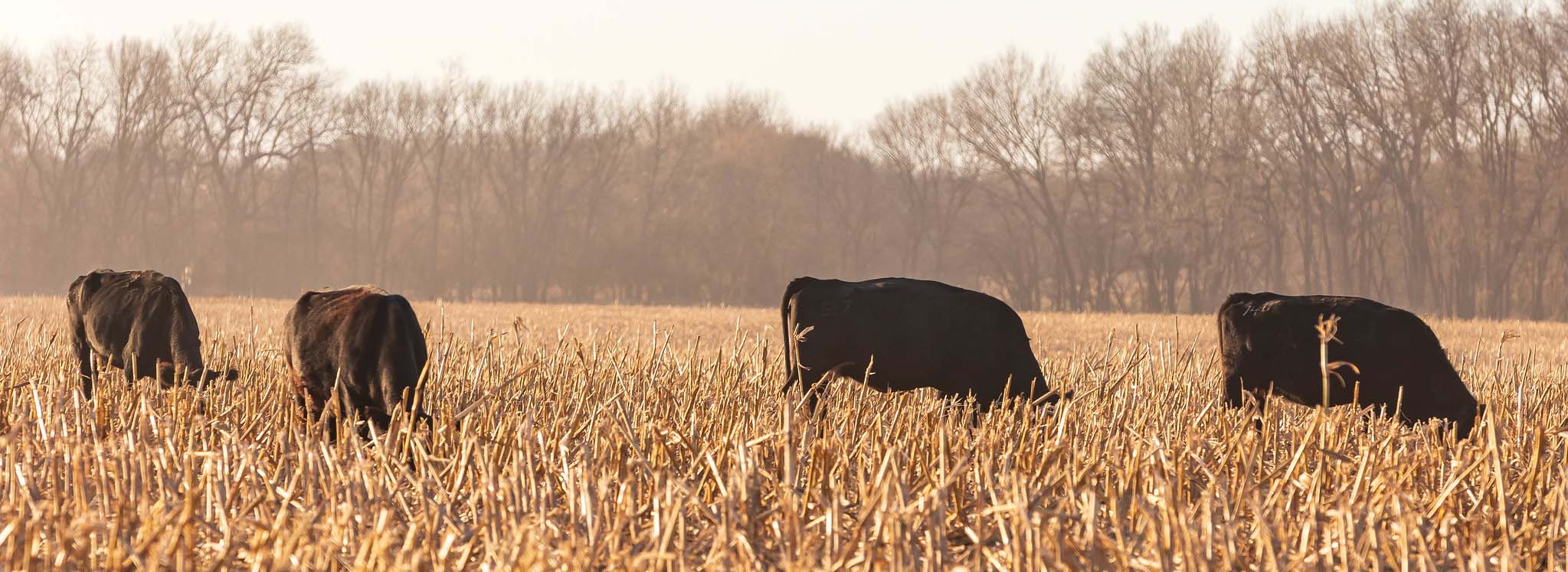
Cattle grazing crop stubble. | Download photo
Cattle Chat: Grazing crop stubble can extend feed resources
K-State beef cattle veterinarians offer tips for producers turning out the herd on crop fields post-harvest
At a glance: K-State beef cattle veterinarians offer tips for producers grazing the herd on crop stubble in the winter.
More information: Scott Fritz, scottfritz@k-state.edu, 785-532-0120; Bob Larson,785-532-4257, rlarson@vet.ksu.edu; Brad White, 785-532-4243, bwhite@vet.ksu.edu
Related: Beef Cattle Institute Cattle Chat
Jan. 14, 2025
By Lisa Moser, K-State Research and Extension news service
MANHATTAN, Kan. – Eating leftovers is a way for people to save money while still getting nutritious food. For beef producers, one way to extend the grazing days is to turn cattle out on crop fields after harvest, according to the veterinarians at the Kansas State University Beef Cattle Institute.
Addressing this topic on a recent Cattle Chat podcast were K-State veterinarians Brad White, Bob Larson and Scott Fritz, who specializes in veterinary toxicology.
“Crop stubble is a great feed resource for cattle, but it is a resource that will decrease in nutrient quality the longer the cattle are in the field,” Larson said. “When cattle are first turned out, there is often a lot of leaves on the plants, but over time cattle will strip those leaves off.”
Larson recommends beef producers monitor the grazing fields and offer supplements to the herd as needed.
White agreed, adding: “The cow herd will likely need to be supplemented with protein later in the winter.”
And while they agree that crop stubble can be a valuable feed resource, there are risks to be aware of, Fritz said.
“In a dry year, drought-stressed forages can accumulate nitrate and can poison the cattle, so it is important to do a field test in arid parts of the country,” he said.
By contrast, Fritz said overly wet fields also pose a risk.
“Cattle turned out on flooded fields can be exposed to mold growth that leads to mycotoxin issues,” he said.
Before turning the cattle out on the crop stubble, Fritz recommends walking through the field to assess the quality of the field and look for grain spills.
“One problem a lot of people overlook is a pile of corn that got spilled in the field when loading the grain cart. If a cow eats 20-30 pounds of grain, she will get acidosis, and if it is a pile of soybeans, the (opposite) happens and they can end up with a neurologic disease,” he said.
Along with inspecting the field for spills, Fritz recommends that producers also evaluate water sources and grass strips.
“Make sure that whether it is surface water or a dedicated underground source, it is functioning before the cows are turned out,” Fritz said.
White added: “It is a good idea to give the water source a flush through, so you know the cattle are getting clean, fresh water.”
The last thing to check for when inspecting the field is the grass strips that might be full of weeds. “When putting up the hot wire around the field, make sure there are no noxious plants in the grass strips,” Fritz said.
To hear the full discussion, listen to Cattle Chat on your preferred streaming platform.
***

K‑State Research and Extension is a short name for the Kansas State University Agricultural Experiment Station and Cooperative Extension Service, a program designed to generate and distribute useful knowledge for the well‑being of Kansans. Supported by county, state, federal and private funds, the program has county extension offices, experiment fields, area extension offices and regional research centers statewide. Its headquarters is on the K‑State campus in Manhattan. For more information, visit www.ksre.ksu.edu. K-State Research and Extension is an equal opportunity provider and employer.