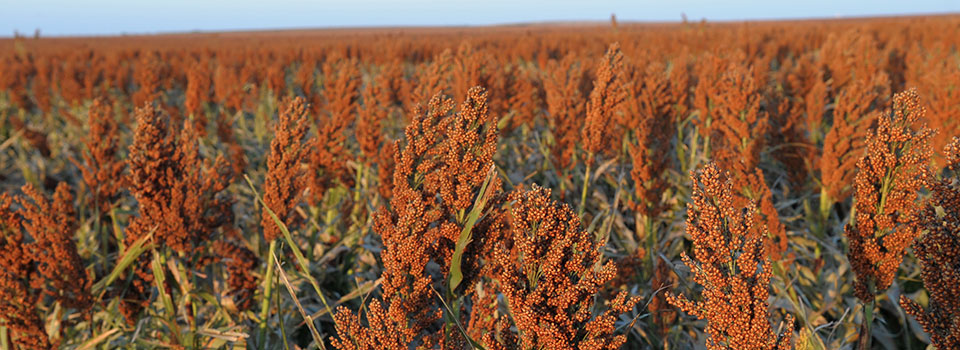
K-State's 2024 crop performance trials with grain sorghum indicated an across-the-state average increase of 13 bushels per acre.
Kansas grain sorghum yields spike despite record-high heat in 2024
K-State agronomists report higher average yields in annual performance trials
At a glance: K-State assistant agronomist Jane Lingenfelser, who coordinates the university's crop performance testing program, said the state’s grain sorghum yielded an average 65 bushels per acre – 13 bushels higher than the previous year.
More information: Jane Lingenfelser, 785-532-7251, jling@ksu.edu
Related: K-State Crop Performance Tests
Feb. 27, 2025
By Pat Melgares, K-State Research and Extension news service
MANHATTAN, Kan. – Compared to most other farm crops grown in Kansas, grain sorghum has a reputation for being tolerant to heat, and in 2024, that was a good thing.
The National Centers for Environmental Information reports that 2024 was the second warmest year on record in Kansas over the past 130 years, with an average daily temperature of 57.5 degrees Fahrenheit – 3.4 degrees above normal.
And yet, says Kansas State University assistant agronomist Jane Lingenfelser, the state’s grain sorghum yielded an average 65 bushels per acre – 13 bushels higher than the previous year.
“There were some issues, as usual, with stalk rots, depending on the production area,” Lingenfelser said. “Stalk rots occur when there are hot and dry conditions throughout the growing season, and the sorghum plant is weakened by environmental stresses.”
Lingenfelser coordinates the K-State crop performance testing program, which provides unbiased information on the performance of the major crops grown in the state under a wide range of climatic and management conditions.
She said that because of stalk rots, lodging was common in the 2024 grain sorghum trials. Also, chinch bugs proved to be problematic for developing sorghum seedlings and stands, especially in the western two-thirds of Kansas.
“The weather patterns of early hot and dry weather from mid-April to mid-May is very good for drying down wheat,” Lingenfelser said. “However, it also encourages chinch bugs to move away from that wheat…to the sorghum crop. Bug feeding, combined with drought stress, contributes to lodging of sorghum plants.”
Lingenfelser said sugarcane aphids also tend to migrate into Kansas from mid-July until its harvest in the fall, but K-State entomologist Jeff Whitworth reported no large-scale problems with sugarcane aphids in the state’s grain sorghum in 2024. Timely rains, especially precipitation late in the year, contributed to the overall success of Kansas’ grain sorghum.
Among some of the K-State testing locations in 2024:
- Belleville (Republic County) yielded an average 126 bushels per acre, after reporting a complete loss the year before.
- Manhattan (Riley County) yielded 113 bushels, up 17 from the previous year.
- Ottawa (Franklin County) yielded 125 bushels, down two bushels from a year ago.
- Hays (Ellis County) yielded 82 bushels, up 56 from last year.
- Assaria (Saline County) yielded 48 bushels, after reporting a complete loss the year before.
- Hutchinson (Reno County) averaged 118 bushels, down two from last year.
- Larned (Pawnee County) yielded 56 bushels, down “quite a bit from last year,” according to Lingenfelser.
- Colby (Thomas County) yielded 103 bushels, down about 30 from the previous year.
A complete listing of all of K-State’s trials with grain sorghum varieties is available now online from the Department of Agronomy. Results from the Kansas trials with corn, soybeans, sunflower and wheat can also be found on that site.
The annual crop reports will be available online soon from the K-State Research and Extension bookstore. The reports also will list the varieties that tested the best in each region of the state.
“The production factors this year, as usual, were weather-related stresses, so I always encourage producers to look at a variety of sources and years of data to find the product that fits best with their conditions and management,” Lingenfelser said.
More information also is available at local extension offices in Kansas.
***

K‑State Research and Extension is a short name for the Kansas State University Agricultural Experiment Station and Cooperative Extension Service, a program designed to generate and distribute useful knowledge for the well‑being of Kansans. Supported by county, state, federal and private funds, the program has county extension offices, experiment fields, area extension offices and regional research centers statewide. Its headquarters is on the K‑State campus in Manhattan. For more information, visit www.ksre.ksu.edu. K-State Research and Extension is an equal opportunity provider and employer.