Cattle Chat: Managing weight gain in cattle
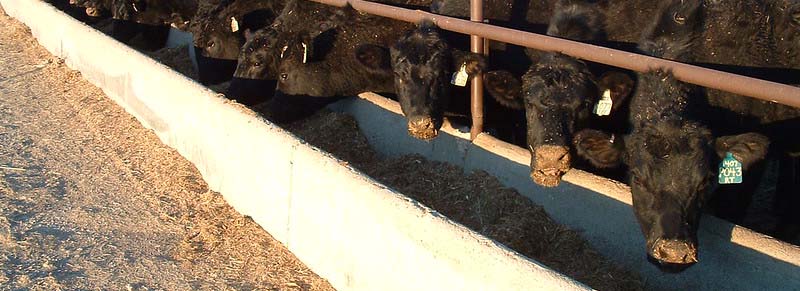
Cattle gain a higher amount of lean tissue early in the cattle feeding period and deposit more fat as they age, according to K-State beef cattle nutritionist Phillip Lancaster. | Download photo
K-State beef cattle share how cattle’s metabolism changes during the feeding period
At a glance: K-State beef cattle experts explain metabolic fluctuations in the way cattle put on weight throughout the feeding period.
More information: Phillip Lancaster, 785-532-6323, palancaster@vet.ksu.edu; Brian Lubbers, 785-532-4012, blubbers@vet.ksu.edu
Related: Beef Cattle Institute Cattle Chat
March 18, 2025
By Lisa Moser, K-State Research and Extension news service
MANHATTAN, Kan. – It is common knowledge that people’s metabolism slows as they age. Similarly, cattle also experience changes in their metabolism as their body ages, say the experts at the Kansas State University Beef Cattle Institute.
Speaking on a recent Cattle Chat podcast, the team of experts addressed a question from a listener about the relationship between the amount of time cattle spend in the feedyard growing to a weight of 1,400 pounds, and the average daily gain they experience during that time period.
“The daily growth or average daily gain of cattle decreases over time because of how the composition of the gain changes,” K-State beef cattle nutritionist Phillip Lancaster said. “Calves that are younger and lighter weight are going to deposit a higher portion of lean tissue for each pound of gain, and as they move closer to a processing weight, they will be adding a higher proportion of fat in each pound of gain.”
He said that lean tissue consists mostly of water and that makes the cattle more efficient with their feed consumption. Thus, cattle will gain weight at a slower pace as they get closer to their finished weight.
“An average daily gain of 2.5 pounds per day is a reasonable amount of gain, but it will be a different type of gain depending on where that animal is in the feeding period,” K-State veterinarian Brian Lubbers said.
The amount of gain can be measured by weighing the cattle at different points in the feeding period, Lubbers said.
“Just know that if the goal for the whole feeding period is an average daily gain of 2.5 pounds and they are only gaining that in the first period, they will be behind at the end of the feeding period,” Lubbers said.
To address that feeding challenge, Lancaster said, “just figure out the target gain for each of those weight periods and adjust the diet accordingly to meet the end goal.”
To hear the full discussion, listen to Cattle Chat on your preferred streaming platform.
***

K‑State Research and Extension is a short name for the Kansas State University Agricultural Experiment Station and Cooperative Extension Service, a program designed to generate and distribute useful knowledge for the well‑being of Kansans. Supported by county, state, federal and private funds, the program has county extension offices, experiment fields, area extension offices and regional research centers statewide. Its headquarters is on the K‑State campus in Manhattan. For more information, visit www.ksre.ksu.edu. K-State Research and Extension is an equal opportunity provider and employer.