K-State to discuss Future of Insect Farming
April 22 conference in Manhattan is available for free
At a glance: Could efforts to raise and breed insects help to feed the world? K-State entomologist Brian McCornack thinks they can, so much so that he’s part of a group that is raising awareness about the value of insect farming.
More information: Brian McCornack, 785-532-4729, mccornac@ksu.edu
Related: Future of Insect Farming (conference) | K-State Department of Entomology | Crop Insects of Kansas | Insects in Kansas
April 14, 2025
By Pat Melgares, K-State Research and Extension news service
MANHATTAN, Kan. – Could efforts to raise and breed insects – crickets, mealworms, black soldier flies and the like – help to feed the world?
Kansas State University entomologist Brian McCornack thinks they can, so much so that he’s part of a group that is raising awareness about the value of insect farming.
“Insect farming is the practice of raising and breeding insects as commodities, or to support other agrifood systems,” McCornack said.
McCornack said insects are rich in protein and essential amino acids, vitamins, and minerals, making them a viable nutritional supplement for livestock feed. Compared to traditional protein sources, insects require fewer resources (water and space), with high feed conversion efficiency and lower environmental impacts, aligning with efforts towards a more resource-efficient food and feed system.
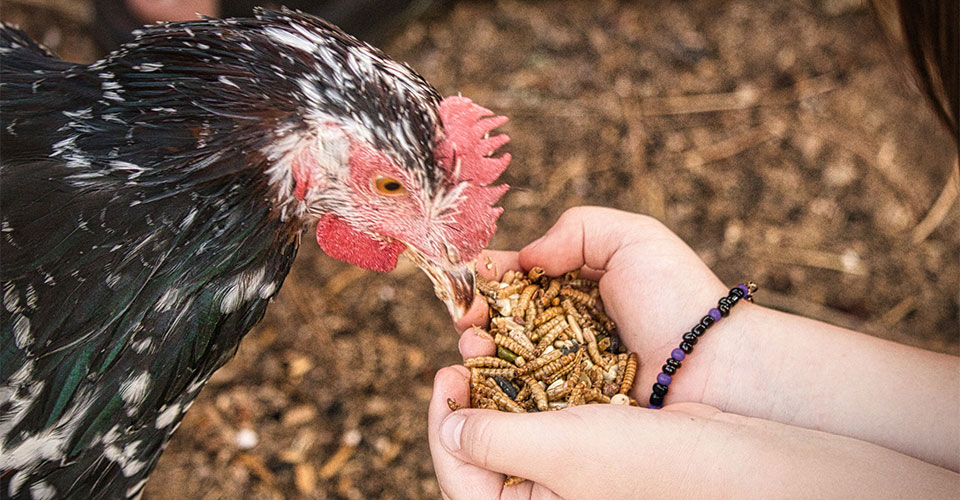
Typical uses of insects in agriculture include feed for pet animals, especially reptiles and birds; and as supplemental feed for poultry and aquaculture.
But, McCornack notes, “researchers also are discovering innovative ways to use farmed insects, such as extraction of products like lipids, and delivering treatments and therapeutics for livestock.”
K-State’s Department of Entomology is hosting a one-day, free conference in Manhattan on April 22 to uncover the value of insects to agriculture. Interested persons are asked to register online in advance for the conference, titled ‘Future of Insect Farming.’
“A worldwide concern is how to feed an increasing human population, which is predicted to reach 9 billion people by 2037,” McCornack said. “Insects can be used to convert low-value side streams and agricultural byproducts into high-value end products, such as high-protein, low-impact feed for livestock, poultry and fish.”
Insects, he adds, can break down agricultural waste into nutrient-rich compost that can be returned to the soil, supporting sustainable farming practices.
“We want people, especially agricultural producers, to know that we understand that the pressures on traditional agriculture are driving changes in food and feed practices,” McCornack said. “Insect farming offers practical, resource-efficient solutions to some of agriculture’s biggest challenges. Insect farming is a way to turn waste into value, create new revenue streams, and build more resilient food systems.
“It’s not about replacing traditional farming practices; it’s about adding new tools to the toolbox.”
McCornack says the April 22 conference aims to share knowledge, spark ideas and build connections that can lead to pilot projects or partnerships. Christos Athanassiou, a research professor from the University of Thessaly in Greece, will give a presentation on the Insect Farming Initiative set to begin at K-State in November.
“Ultimately, we want to help lay the groundwork for a more circular and vibrant agricultural economy in Kansas, one where insects play a supporting role in enhancing productivity, reducing waste and creating new business opportunities,” McCornack said.
Beyond feed and food, insects are versatile organisms, McCornack said. They can also be used in fertilizers and even industrial applications like biodegradable plastics.
“Their potential stretches far beyond what most people imagine,” he said. “As awareness grows, there’s an opportunity for rural communities and farmers to be at the forefront of a production system that’s both environmentally smart and economically promising.”
More information is available online at https://entomology.k-state.edu/insectfarming.
***

K‑State Research and Extension is a short name for the Kansas State University Agricultural Experiment Station and Cooperative Extension Service, a program designed to generate and distribute useful knowledge for the well‑being of Kansans. Supported by county, state, federal and private funds, the program has county extension offices, experiment fields, area extension offices and regional research centers statewide. Its headquarters is on the K‑State campus in Manhattan. For more information, visit www.ksre.ksu.edu. K-State Research and Extension is an equal opportunity provider and employer.