K-State swine team eyes ground breaking soybean meal research
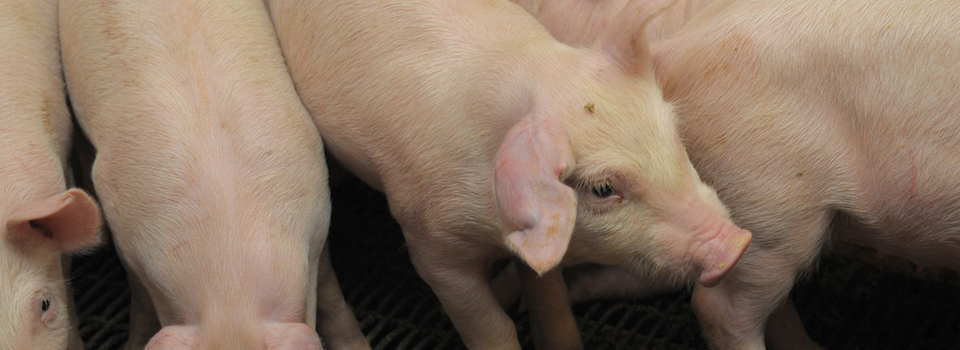
K-State researchers plan on studying the effects of anti-nutritional factors on soybean meal quality in the future, says K-State assistant research professor in swine nutrition Katelyn Gaffield. | Download photo
Gaffield shares how adding soybean byproducts back into meal affects nursey pigs
At a glance: K-State assistant research professor in swine nutrition Katelyn Gaffield explains the impacts of adding soybean byproducts into soybean meal on its quality.
More information: Katelyn Gaffield, 785-532-1239, gaffield@ksu.edu
Related: K-State Swine Extension
April 10, 2025
By Jacob Klaudt, K-State Research and Extension news service
MANHATTAN, Kan. – Swine producers commonly use soybean meal as one of the largest protein sources in diets, so over the years, researchers have examined soybean meal quality thoroughly.
However, K-State assistant research professor in swine nutrition Katelyn Gaffield said her research team took a new approach to investigating soybean meal quality by evaluating novel factors like the impact of adding back soybean byproducts into meal when feeding pigs.
“I studied this during my doctoral research with the team, and these are – specifically – the byproducts from oil refineries; we can get soybean gums or soybean soapstocks,” she said. “We conducted a large industry survey, and with the help of the United Soybean Board, we sampled from 15 different processing plants to look at the variation.”
The most interesting findings from the survey were how large variation was in color and viscosity, according to Gaffield, noting this piqued her team’s interest.
“When we evaluated those samples of gums and soapstocks, we found large differences in the fat content, which was important when adding it back to diets and the moisture content.”
Even though Gaffield saw an increase in fat in the soybean meal when those byproducts got added back, she did not observe a change in crude protein levels.
“Essentially, those plants add those byproducts back until they either hit their limit or until they're worried about getting too low of a crude protein content in the soybean meal,” she said.
With the thought that an increase in fat content and additional energy may benefit pigs instead of thinking that byproducts are a negative, Gaffield conducted a nursery study where soybean gums and soapstocks were incorporated back into soybean meal.
“Ultimately, we found little differences in growth performance when we fed the soybean gums or soapstocks to pigs,” she said. “So, this is a good finding for producers because it indicates that you don't have to worry about sourcing different soybean meals and whether byproducts must be included back.”
Additionally, Gaffield’s team discovered a slight positive increase in average daily gain due to higher levels of gums – especially in the late nursey period – due to the fact researchers believe that gums have a higher level of fat content in the byproduct itself.
“Maybe we are seeing a potential benefit to the energy and no concerns with sourcing it for your swine diet,” Gaffield said. “There may be a potential benefit if you add it at high enough inclusion levels, but we need to evaluate that further to say it has a definite improvement.”
Beyond average daily gain, fecal output was also monitored.
“We also saw no differences in the fecal dry matter, which indicated it wasn't negatively impacting their health or giving them gastrointestinal tract challenges,” Gaffield said.
Gaffield reminds producers, however, that these byproducts were added back at relatively low levels.
"We only added up to around 2% and so even though we saw those large variations in energy content; it's diluted out of the diet, so we didn’t see any negative effects there,” she said.
***

K‑State Research and Extension is a short name for the Kansas State University Agricultural Experiment Station and Cooperative Extension Service, a program designed to generate and distribute useful knowledge for the well‑being of Kansans. Supported by county, state, federal and private funds, the program has county extension offices, experiment fields, area extension offices and regional research centers statewide. Its headquarters is on the K‑State campus in Manhattan. For more information, visit www.ksre.ksu.edu. K-State Research and Extension is an equal opportunity provider and employer.