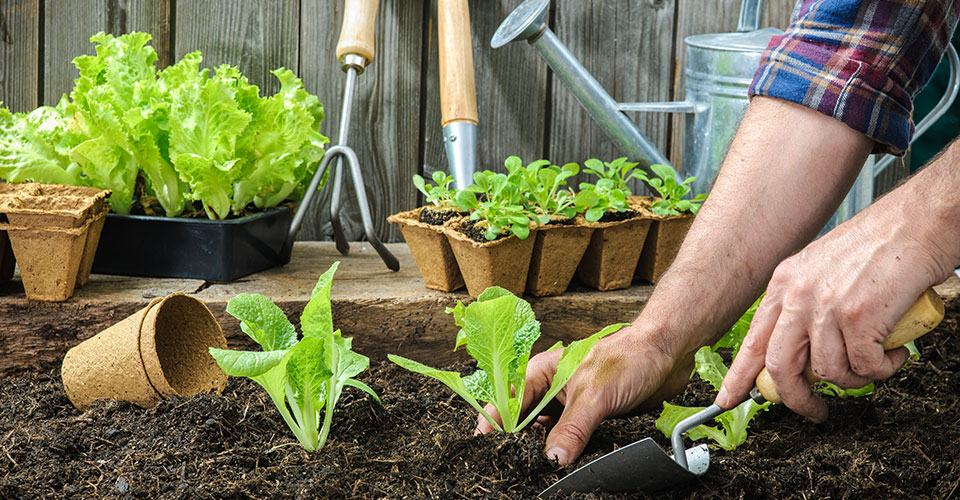
Lettuce is among the popular garden food that can be transplanted in April.
Transplants are ready for the garden, says K-State horticulture expert
Domenghini outlines tips for proper care
At a glance: K-State horticulture expert Cynthia Domenghini says transplants are likely ready for the garden, but before removing them from a more protected environment, they first need to acclimate.
More information: Cynthia Domenghini, Cdom@ksu.edu
Related: K-State Horticulture Newsletter | Kansas Garden Guide | Vegetable Garden Planting Guide |
April 3, 2025
MANHATTAN, Kan. – A note to all ambitious gardeners who started vegetable transplants indoors over the winter months: Your time has come.
Kansas State University horticulture expert Cynthia Domenghini says many transplants are likely ready for the garden, but before removing them from a more protected environment, they first need to acclimate.
“This process is called hardening off,” Domenghini said.
Two weeks before the transplant date, decrease the amount of water that the seedlings are given, she said. Gradually increase their exposure to the sun and wind, but avoid damaging winds, rain and temperatures.
When they’re ready for the garden, prepare the soil by breaking up hardened clots. Don’t work the soil when wet.
“Water the transplants just before transplanting,” Domenghini said. “Dig the hole for each plant slightly deeper and wider than the container it’s in. Position the plant in the hole and backfill to cover the entire root ball. Press the soil surface firmly around the stem of the plant. Starter fertilizer can be used at planting.”
Gardening calendar
The busy work is beginning for gardeners as temperatures turn mostly warm around Kansas, Domenghini said. In alphabetical order, she provides a listing of common garden foods that should be planted soon – if not already:
- Asparagus (crowns) – mid-March to mid-April.
- Beets (seed) – late March to early April.
- Bok choy (seed/transplant) – late March to early April.
- Broccoli (transplant) – late March to early April.
- Cabbage (transplant) – late March to early April.
- Carrots (seed) -- late March to early April.
- Cauliflower (transplant) -- late March to early April.
- Chicories (seed/transplant) -- late March to early April.
- Collards (seed/transplant) -- late March to early April.
- Kale (seed/transplant) – mid-March.
- Fennel (seed) – mid-March to early April.
- Kohlrabi (seed) – mid-March to early April.
- Lettuce (seed) – mid-March to early April.
- Leeks (transplant) – mid-March.
- Mustard (seed) – late March to early April.
- Onion (sets/plants) – mid- to late March.
- Parsnips (seed) – mid-March to early April.
- Peas (seed) – mid-March.
- Potatoes (seed) – mid-March to early April.
- Radish (seed) – mid- to late March.
- Rhubarb (crowns) – March to April.
- Rutabaga (seed) – mid- to late March.
- Spinach (seed) – mid- to late March.
- Swiss chard (seed/transplant) – late March to early April.
- Turnip (seed) – mid- to late March.
Domenghini and her colleagues in K-State’s Department of Horticulture and Natural Resources produce a weekly Horticulture Newsletter with tips for maintaining home landscapes and gardens.
Interested persons can subscribe to the newsletter, as well as send their garden and yard-related questions to hortsupport@ksu.edu, or contact your local K-State Research and Extension office.
***
Sidebar
Question of the Week: Where can I find gardening information specific to my region?
I’m so glad you asked! K-State Research and Extension has talented extension agents across the state ready and willing to support you in a variety of areas. Our horticulture agents are in tune with local resources, weather and all things gardening for your area of the state. They are also great at responding to questions in a timely manner.
Find your local extension agents by visiting this link: www.ksre.k-state.edu/about/statewide-locations.html.
 -- Cynthia Domenghini, K-State horticulture expert
***

K‑State Research and Extension is a short name for the Kansas State University Agricultural Experiment Station and Cooperative Extension Service, a program designed to generate and distribute useful knowledge for the well‑being of Kansans. Supported by county, state, federal and private funds, the program has county extension offices, experiment fields, area extension offices and regional research centers statewide. Its headquarters is on the K‑State campus in Manhattan. For more information, visit www.ksre.ksu.edu. K-State Research and Extension is an equal opportunity provider and employer.