Clearing up confusion on CAFOs
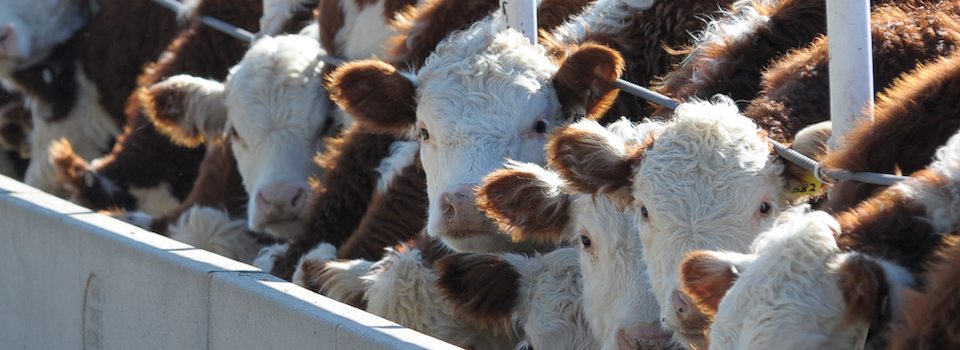
Kansas State University extension livestock specialist Joel DeRouchey says while Kansans see new CAFO construction from time to time, other areas expand or remodel facilities rather than build new. | Download photo
K-State livestock specialist discusses concentrated animal feeding operations
At a glance: K-State extension livestock specialist Joel DeRouchey shares information on concentrated animal feeding operations, their environmental footprint and the regulations they raise livestock under.
More information: Joel DeRouchey, 785-532-2280, jderouch@ksu.edu
Related: Agriculture Today
May 2, 2025
By Jacob Klaudt, K-State Research and Extension news service
MANHATTAN, Kan. – Since their implementation many decades ago, concentrated animal feeding operations have continued to sustain meat and dairy industries by providing a steady flow of livestock for food chains for home and consumers abroad.
Contrary to popular belief, Kansas State University extension livestock specialist Joel DeRouchey recently said on the Agriculture Today radio program that CAFOs present a more efficient opportunity to raise livestock with less stress on the environment.
“CAFOs are strictly permitted to have full containment of all rainwater and runoff that reaches a pen surface, and the same goes for cleaning pen surfaces,” he said. “Manure must be stored in a contained area until it's moved out to fields for spreading.”
In Kansas, any facility with an animal unit capacity of 300 or greater must register with the Kansas Department of Health and Environment. Additionally – regardless of size – any facility that presents a significant water pollution potential must obtain a permit as determined by KDHE.
CAFOs include cattle and small ruminant feedlots, confined large indoor and outdoor swine and poultry operations and dairy facilities that meet the criteria as a CAFO. Once a CAFO is designated for a site, it has both state and federal requirements under which it must operate.
“Feedlot cattle over 700 pounds would be considered a single animal unit, 700 pounds and less is a half and cattle such as a lactating dairy cow would be considered 1.4,” DeRouchey said. “These figures relate to their feed intakes and the amount of manure produced per body weight.”
While CAFOs can get a bad rap due to their ability to house many animals in one location, DeRouchey said they face some of the most stringent regulations for environmental protection, which is good for surrounding land and water quality.
“Once you look through what's regulated, how CAFOs handle manure, how it's applied and the regulations and inspections involved from both the state and potentially the Environmental Protection Agency, you see why these operations are in business,” he said.
To ensure compliance with these rules, CAFOs undergo periodic on-site KDHE state inspections, a permit renewal every five years, where producers update their paperwork and nutrient management plan with any changes to the operation.
“An essential part of that is developing a new five-year nutrient management plan, and it says what’s going to occur with the application of manure to the agronomic crop ground surrounding the facility,” DeRouchey said. “With soil tests and manure samples taken, new projections are completed to ensure that the manure produced on those operations fits all the acreage.”
Before CAFO construction, assessments occur based on the species housed in the CAFO, looking at criteria like geography. For example, in feedlots, rainwater drainage containment, manure storage areas, and agronomic manure application plans rank as some of the most crucial considerations.
“Most feedlots operate with lagoon systems to catch the runoff from the pen surfaces themselves,” DeRouchey said. “These assessments determine their location, the soil types, compacted soil liners that don’t allow seepage of the lagoon nutrients and the overall footprint layout.”
“It’s known that large or small operations create odor and dust from livestock,” he said. “To minimize those, feedlot owners often look at where they can potentially put up windbreaks against the prevailing winds coming off of those facilities and how that will impact the surrounding area.”
Owners routinely clean pen surfaces as well on the outdoor facilities because the top layer of manure can turn into dust if it's there too long, and that can carry odor from the CAFO to surrounding areas.
***

K‑State Research and Extension is a short name for the Kansas State University Agricultural Experiment Station and Cooperative Extension Service, a program designed to generate and distribute useful knowledge for the well‑being of Kansans. Supported by county, state, federal and private funds, the program has county extension offices, experiment fields, area extension offices and regional research centers statewide. Its headquarters is on the K‑State campus in Manhattan. For more information, visit www.ksre.ksu.edu. K-State Research and Extension is an equal opportunity provider and employer.