K-State wildlife specialist: Let wildlife be wild
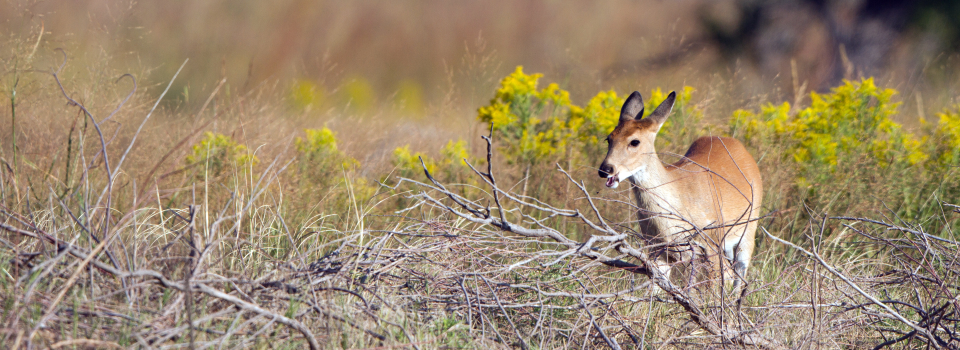
K-State wildlife specialist Drew Ricketts says even people with the best intentions may be harming wildlife by removing them from natural habitats.
Interfering with wildlife may lead to a variety of consequences, possibly legal
At a glance: Kansas State University wildlife specialist Drew Ricketts explains why it’s best to leave wildlife alone.
More information: Drew Ricketts, 785-532-1949, arickett@ksu.edu
Related: K-State Extension Wildlife Management
May 5, 2025
By Jacob Klaudt, K-State Research and Extension news service
MANHATTAN, Kan. – While that fawn lying alone in a patch of thick vegetation might seem vulnerable and in trouble…odds are, it’s not.
Kansas State University wildlife specialist Drew Ricketts said many species of wildlife, like white-tailed deer, have adapted to hide and hold entirely still when young, which makes it common for people to think they've been abandoned.
“Most likely that critter was left there by its mom, and she's off forging nearby,” he said. “If we pick that deer fawn up and try and take it home, we're taking it away from where it's supposed to be and where it has the best chance of surviving.”
Not only can those who intervene possibly upset natural animal processes, but they also risk contracting several diseases that wildlife carry.
“Pretty well all species that folks might encounter out on the landscape can carry diseases that can be passed to humans,” Ricketts said. “Raccoons, foxes, coyote pups – all can carry canine distemper virus, while foxes and coyotes also could have parvovirus.”
Human-wildlife interactions expose domestic pets to the numerous zoonotic diseases wildlife can transfer.
“There are ectoparasites like mange mites and ticks, and lots of wildlife have parasitic worms too,” Ricketts said. “Another concern is that we could bring avian influenza virus home right now if we deal with waterfowl.”
Beyond health concerns, Ricketts reminds those who enjoy wildlife that legal issues may arise if found possessing them without proper licensing.
“It’s not legal in Kansas for citizens who do not have a wildlife rehabilitator license to have wild animals,” he said. “That fine can be up to $1000, so if you want to possess those wild critters, you should become a wildlife rehabilitator.”
Sometimes, those who like observing wildlife anthropomorphize with them; that is, think about animals as though they have the same feelings and experiences as humans. However, Ricketts said they simply do not.
“Even if we don't do that, if we have pets and those sorts of things, it can be easy to see wild animals though they are pets,” he said. “It’s important to remember that they're not, and we need to leave them alone because most of them are not very easy to make into pets either.”
Yet, injured animals that are threatened or endangered wildlife species may be reported to and accepted by a rehabilitation facility.
“If you do encounter those sorts of species, reach out to the Kansas Department of Wildlife and Parks, so that you can get some instruction from them about what to do with that animal,” Ricketts said.
More information about wildlife reporting and endangered species is available online through the Kansas Department of Wildlife and Parks.
***

K‑State Research and Extension is a short name for the Kansas State University Agricultural Experiment Station and Cooperative Extension Service, a program designed to generate and distribute useful knowledge for the well‑being of Kansans. Supported by county, state, federal and private funds, the program has county extension offices, experiment fields, area extension offices and regional research centers statewide. Its headquarters is on the K‑State campus in Manhattan. For more information, visit www.ksre.ksu.edu. K-State Research and Extension is an equal opportunity provider and employer.