Timely rains are good for state’s crops, but could it have been too much?
Standing water heightens risk of damage to corn, soybeans
At a glance: Steady rains that fell on many parts of Kansas in late May highlight a delicate balancing act for the state’s farmers. Is it possible that some fields got too much water?
More information: Tina Sullivan, tsullivan@ksu.edu
Related: Kansas Wheat Variety Guide | Corn Production Handbook | Soybean Growth and Development Guide | K-State Mesonet | K-State Plant Diagnostics Lab
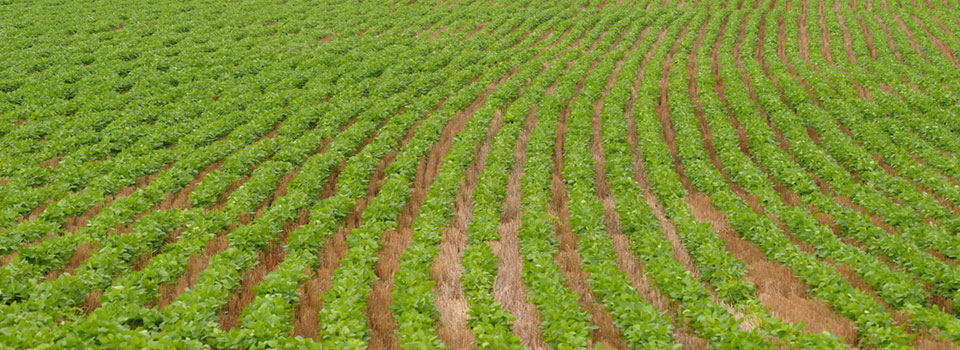
Cooler temperatures and rain, such as what most of Kansas is experiencing in late May, increases the chances of soil-borne disease in some crops, said a Kansas State University agronomist.
May 30, 2025
By Pat Melgares, K-State Research and Extension news service
MANHATTAN, Kan. – Steady rains that fell on many parts of Kansas in late May highlight a delicate balancing act for the state’s farmers.
On one hand, rain is the lifeblood of agriculture. Many livestock ponds received a timely boost while crop producers – especially wheat growers – needed the rain to increase their chances of a bountiful harvest later this year.
But Kansas State University agronomist Tina Sullivan notes that in some cases, crops can get too much water.
“Saturated soils and standing water can be a concern to corn,” Sullivan said, noting that persistent, wet conditions can be a breeding ground for crop disease.
At this point of the season, much of the state’s corn crop is in the V5 stage, when the plant is 8-12 inches tall but the growing point remains below the soil. “It still has some protection below ground,” Sullivan said.
She added that young corn plants “can really only tolerate a few days of full submersion” before it becomes more likely that there will be negative impacts to yield later in the season.
Soybeans, much like corn, can handle being underwater for a short period, but Sullivan said the longer they sit submerged – especially in cooler weather – the more likely that crop will sustain damage.
“Plants need to breathe, particularly their root system,” Sullivan said. “The more it’s submerged, the less the roots can take up oxygen.”
Cooler temperatures, such as what most of Kansas is experiencing in late May, increases the chances of soil-borne diseases, Sullivan said. One of particular concern for soybeans is Pythium root rot, while in warmer temperatures Phytophthora and Rhizoctonia root rots occur.
“Seed treatments offer protection, but after a couple weeks of submerged or constantly saturated soils, the protection is no longer effective,” she said. .
“If you think you have a soybean seedling disease or other issue, always feel free to reach out to your local K-State Research and Extension office, or get in touch with our diagnostics lab in K-State’s Department of Plant Pathology.”
Farmers need to wait until standing water recedes before checking for crop damage. For soybeans, Sullivan said the best check is to split the stem at the tip and look at the growing point.
“Healthy growing points will be firm, white or cream-colored,” she said. “A soft, dark spot indicates injury within that plant.”
Sullivan recently spent time touring Kansas on the state’s annual wheat tour. She said many experts are predicting an average 40-45 bushels per acre for Kansas wheat this year.
“But that was not considering at the time if we were going to get a rain or not,” said Sullivan, indicating yields could be even better than the original prediction. “Throughout the state, we’ve seen a good amount of rain. Is that going to really make the wheat yield? We’ll have to wait and see.”
More information on Kansas weather and its impact on agriculture is available online through the Kansas MesoNet, a network of weather stations around the state.
***

K‑State Research and Extension is a short name for the Kansas State University Agricultural Experiment Station and Cooperative Extension Service, a program designed to generate and distribute useful knowledge for the well‑being of Kansans. Supported by county, state, federal and private funds, the program has county extension offices, experiment fields, area extension offices and regional research centers statewide. Its headquarters is on the K‑State campus in Manhattan. For more information, visit www.ksre.ksu.edu. K-State Research and Extension is an equal opportunity provider and employer.