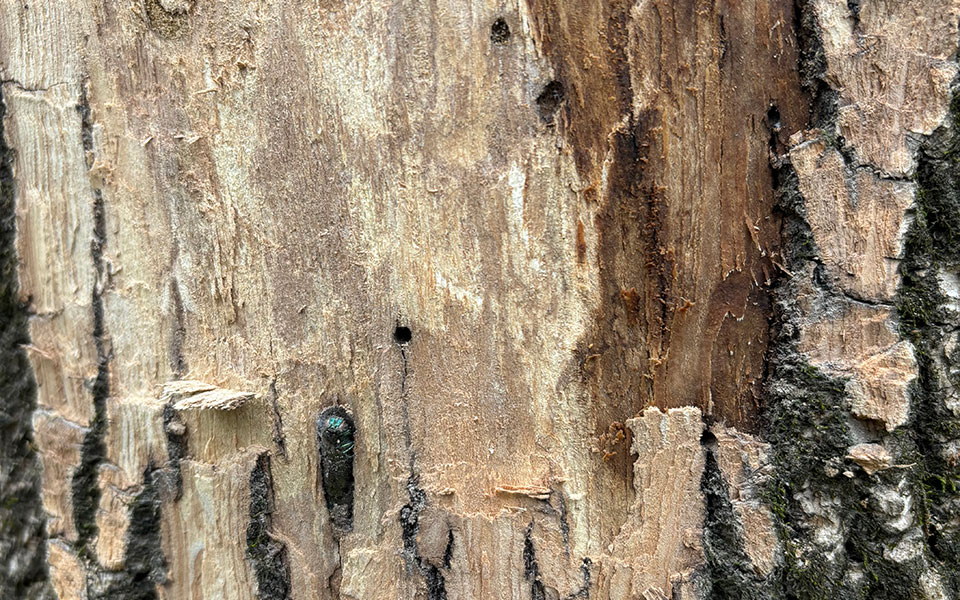
The emerald ash borer threatens urban and rural forests by killing North American ash species and their cultivars. (Photo courtesy of Kansas Forest Service)
Kansas officials confirm emerald ash borer in Linn County
Latest discovery marks 16 Kansas counties with destructive beetle
At a glance: The Kansas Forest Service and the Kansas Department of Agriculture have confirmed the presence of the Emerald Ash Borer in Linn County, marking the 16th county in Kansas confirmed to have the invasive insect.
More information: Shad Hufnagel, smh8877@ksu.edu, 785-532-3300
Photos: Emerald Ash Borer damage | Emerald Ash Borer in Kansas (Map)
Related: Recommended Trees (Kansas) | Kansas Certified Arborists | Reporting EAB (Kansas Department of Agriculture) | Reporting EAB (Kansas Forest Service) | Emerald Ash Borer spread in Kansas (map)
May 1, 2025
By Pat Melgares, K-State Research and Extension news service
MANHATTAN, Kan. – The Kansas Forest Service has confirmed the presence of the emerald ash borer within the Marais des Cygnes National Wildlife Refuge near Pleasanton, the first confirmed sighting found in Kansas this year.
KFS, working with the Kansas Department of Agriculture and K-State Research and Extension, confirmed an adult insect specimen on April 24. Officials say the pest had been suspected in the area for several years, but only recently have they found a verifiable physical specimen, which is required to make the detection official.
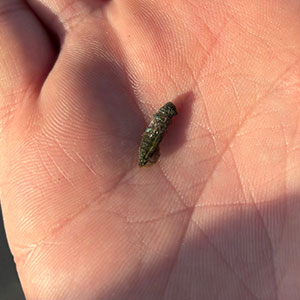 “Although we are pleased to have confirmed ongoing suspicions, the detection of emerald ash borer in Linn County marks another step in the insect’s steady spread across Kansas,” said Shad Hufnagel, the forest health program coordinator with the Kansas Forest Service.
At right: Emerald ash borer
The emerald ash borer is an exotic, invasive beetle from eastern Russia and northeastern Asia that likely was brought to the U.S. in infested packing material. The beetle threatens urban and rural forests by killing North American ash species and their cultivars.
KFS officials note that at least 70 million ash trees have already been destroyed due to the emerald ash borer, and as many as 9 billion North American ash trees will eventually be functionally rooted out and destroyed from the continent.
The discovery in Linn County makes 16 Kansas counties in which the emerald ash borer has been confirmed, including Wyandotte (2012), Johnson (2013), Leavenworth (2014), Douglas (2015), Jefferson (2015), Atchison (2016), Doniphan (2017), Shawnee (2017), Miami (2019), Jackson (2019), Brown (2022), Osage (2022), Franklin (2023), Lyon (2024) and Nemaha (2024).
Forest officials say landowners should learn the signs and symptoms of emerald ash borer in their ash trees, including thinning canopies. As the feeding progresses, trees may begin to sucker (a process called epicormic sprouting) where branches appear near the trunk or lower canopy.
Eventually, small D-shaped holes may appear in the bark. According to Hufnagel, host trees will often decline over the course of a few years as the larvae stage of the insects feed on the vascular tissue of the affected trees.
Landowners are encouraged to create a replacement plan for the ash trees on their property to ensure a continually healthy canopy as ash trees decline. A landscape with many types of trees is more resilient to insect, disease and environmental threats that exist or could occur in the future.
“With this detection, it is important to encourage property owners to begin assessing which ash trees they wish to retain as untreated specimens will likely succumb to future infestations,” Hufnagel said.
Those seeking treatment or removal of ash trees in a county where the insect has already been detected should consult an arborist. A listing of certified arborists in Kansas is available online.
Landowners, especially those in counties where the insect has not been detected, are encouraged to report suspected cases of emerald ash borer to the Kansas Department of Agriculture, or to the Kansas Forest Service.
All Kansans are reminded of the recommendation to avoid bringing firewood from another state or county where emerald ash borer has been previously detected. Use local sources for firewood.
The Kansas Forest Service, in partnership with K-State Research and Extension, continues to offer workshops and educational training in counties with detected populations of emerald ash borer, as well as those communities not yet affected by the pest.
More information on resources about treatment of infected trees is available online from the Kansas Forest Service.
***

K‑State Research and Extension is a short name for the Kansas State University Agricultural Experiment Station and Cooperative Extension Service, a program designed to generate and distribute useful knowledge for the well‑being of Kansans. Supported by county, state, federal and private funds, the program has county extension offices, experiment fields, area extension offices and regional research centers statewide. Its headquarters is on the K‑State campus in Manhattan. For more information, visit www.ksre.ksu.edu. K-State Research and Extension is an equal opportunity provider and employer.