Study: Egg shells, lighting add protective shield for dry-cured pork
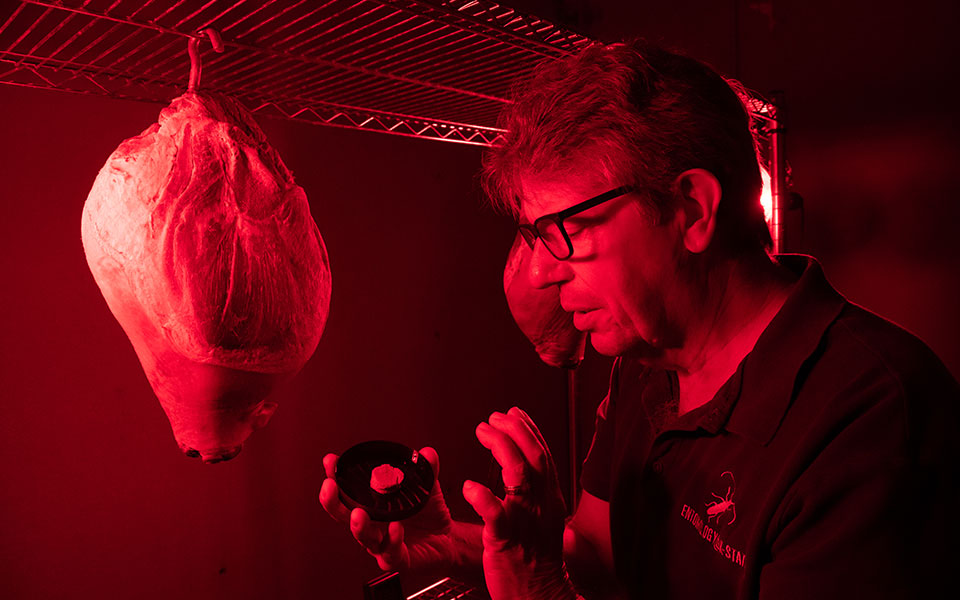
K-State entomologist Tom Phillips has tested the ability of UV light to repel mites, which could be a way to protect dry-cured ham. (Photo courtesy of K-State Department of Entomology)
K-State entomologist builds on work to develop products that repel mites in stored food
At a glance: A K-State entomologist says that pesticides being developed at a nano-scale and ultraviolet lighting are new allies in protecting the world’s $1.4 billion dry-cured pork industry against damaging mites.
More information: Tom Phillips, 785-532-6154, twp1@ksu.edu
Related: K-State Department of Entomology
June 11, 2025
By Pat Melgares, K-State Research and Extension news service
MANHATTAN, Kan. – A Kansas State University entomologist says that pesticides being developed at a nano-scale and ultraviolet lighting are new allies in protecting the world’s $1.4 billion dry-cured pork industry against damaging mites.
Tom Phillips, a professor in the university’s Department of Entomology, and several of his colleagues recently found that tiny nano-particles created with ground egg shells may prevent infestations of foods by the ham mite, a tiny 8-legged relative of spiders and ticks.
“In our tests, we were able to prevent mites from laying eggs on pieces of aged hams,” Phillips said.
Phillips’ work is the most recent development in a project that has spanned more than two decades, working with university colleagues at Mississippi State and Oklahoma State. Earlier this year, the team received $629,709 from the U.S. Department of Agriculture to continue studies that began in the early 2000s as part of the Methyl Bromide Transition program.
For many years, ham mites were controlled with methyl bromide, a fumigant that is safe to durable food products. But in 1989, it was one of several substances listed in the Montreal Protocol, an international treaty to phase out the use and production of substances responsible for depletion of the Earth’s ozone layer.
Methyl bromide is no longer approved for commercial use in the United States.
Phillips’ work has been driven by finding effective alternatives to protect stored products, particularly such stored foods as dry-cured hams, which can be particularly susceptible to mite contamination because they are hung and dried for as long as two years.
Nearly 10 years ago, Phillips and his colleagues published work in which they described the effectiveness of spraying food-grade propylene glycol to protect dry-cured hams from ham mites, which can lay 3-5 eggs per day and increase their populations exponentially if not controlled.
Their current work includes capitalizing on K-State’s emerging leadership in agricultural nanotechnology, a branch of science and engineering devoted to designing, producing and using particles of matter that are measured in nanometers.
For perspective, a single human hair is approximately 80,000 to 100,000 nanometers wide.
K-State nano-entomolgist Amie Norton designed the egg shell-based pesticide that Phillips used in his tests. Norton and other K-State researchers have previously reported success in using nanoparticles to kill mosquito larvae.
“The mode of action for these nanoparticles is still not clear, so it will be very interesting to study more,” Phillips said. “We’ll be studying it more closely with mites. We haven’t gone beyond using egg shells, so learning more about the effect of metallic nanoparticles (such as gold or silver) will be interesting.”
In another part of the current work, Phillips tested whether mites were attracted or repelled to colors in the rainbow. Turns out, he says, mites have similar behavior as many insects: they are attracted to ultraviolet light and repelled by red light.
Phillips’ lab found that weak-energy UVA light was the attractive part, but UVC light is very strong and can quickly kill the ham mites.
“UVC light is, in fact, really dangerous; we wouldn’t want that around people,” Phillips said. “But it kills mites in a matter of minutes. The mite is so small and it goes through their bodies.”
Phillips said applying light for pest control could include using red light to keep mites off hams, and UVA light to attract mites to traps away from the hams.
“Applications with UVC would need to be carefully developed to be safe, but some ideas are being explored,” he said.
The multi-state team also continues work that seeks heating and cooling treatments, as well as food-safe pesticide sprays in dry-aging houses, and gas fumigation in safely sealed off-site containers.
***

K‑State Research and Extension is a short name for the Kansas State University Agricultural Experiment Station and Cooperative Extension Service, a program designed to generate and distribute useful knowledge for the well‑being of Kansans. Supported by county, state, federal and private funds, the program has county extension offices, experiment fields, area extension offices and regional research centers statewide. Its headquarters is on the K‑State campus in Manhattan. For more information, visit www.ksre.ksu.edu. K-State Research and Extension is an equal opportunity provider and employer.