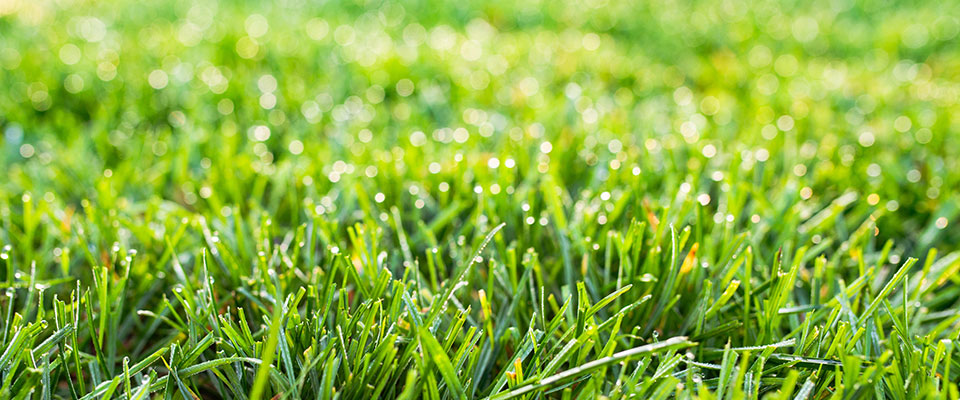
Watering early in the morning is one way to reduce the risk of brown patch in tall fescue lawns, says K-State horticulture expert Cynthia Domenghini.
Higher temps, humidity make lawns more susceptible to brown patch
Watering early in morning is one way to prevent fungus, says K-State’s Domenghini
At a glance: As many parts of Kansas and the Midwest brace for summer weather – that is, warmer nights and higher humidity – homeowners may need to adjust their strategy for watering tall fescue lawns.
More information: Cynthia Domenghini, Cdom@ksu.edu
Photo: Cynthia Domenghini
Related: K-State Horticulture Newsletter
June 19, 2025
K-State Research and Extension news service
MANHATTAN, Kan. – As many parts of Kansas and the Midwest brace for summer weather – that is, warmer nights and higher humidity – homeowners may need to adjust their strategy for watering tall fescue lawns.
Kansas State University horticulture expert Cynthia Domenghini says summer’s weather patterns often mean the amount of time grass blades stay wet increases, making them more susceptible to the disease, brown patch.
“Brown patch is primarily a leaf pathogen, but with a severe outbreak, the fungus can spread down into the crown and cause plant death,” Domenghini said. “However, depending on the weather, typically the turfgrass recovers within 2-3 weeks.”
The symptoms of brown patch can be similar to those of drought, Domenghini said. “But if you look closer at the grass plants, around the edge of the symptomatic area, and if you notice tan spots with a dark halo, then you may have brown patch.”
Brown patch exists in the soil. It cannot be eliminated from the lawn but is also not carried from one lawn to another, according to Domenghini.
She offered these tips to reduce the lawn’s susceptibility to brown patch:
- Water in the early morning, rather then the evening, and only as needed. This decreases the number of hours the grass blades stay wet.
- Fertilize according to recommendations for your lawn. Don’t fertilize when brown patch is active.
- When seeding, follow recommended rates.
- Grass growing beneath trees does not dry as quickly. Use a mulch ring around trees so that grass is not growing beneath the canopy.
“Fungicides can be effective to prevent brown patch, though the most commonly used products are expensive and typically only available in large quantities,” Domenghini said. “Preventative fungicides are recommended if you want a blemish-free lawn, beginning in mid-June through August, but this does get expensive.”
Domenghini and her colleagues in K-State’s Department of Horticulture and Natural Resources produce a weekly Horticulture Newsletter with tips for maintaining home landscapes and gardens.
Interested persons can subscribe to the newsletter, as well as send their garden and yard-related questions to hortsupport@ksu.edu, or contact your local K-State Research and Extension office.
# # #
Why are my tomatoes wilting?
 There are many reasons you may see your tomatoes wilting. Some are serious, others will self-correct. Look closely at the leaves for signs of fungus such as brown or black spots/lesions which can contribute to wilting.
Leaf roll can also occur when there are sudden changes in the weather, after cultivating the soil heavily, or after a heavy rainstorm. It is the plant’s response to environmental stress. To prevent this, keep the soil evenly moist, as much as possible, and avoid damaging roots while cultivating.
More information about common tomato problems is available online from the K-State Research and Extension bookstore.
-- Cynthia Domenghini, Kansas State University horticultural expert, cdom@ksu.edu
***

K‑State Research and Extension is a short name for the Kansas State University Agricultural Experiment Station and Cooperative Extension Service, a program designed to generate and distribute useful knowledge for the well‑being of Kansans. Supported by county, state, federal and private funds, the program has county extension offices, experiment fields, area extension offices and regional research centers statewide. Its headquarters is on the K‑State campus in Manhattan. For more information, visit www.ksre.ksu.edu. K-State Research and Extension is an equal opportunity provider and employer.