Cattle Chat: Maximizing pasture potential, the science behind multi-species grazing
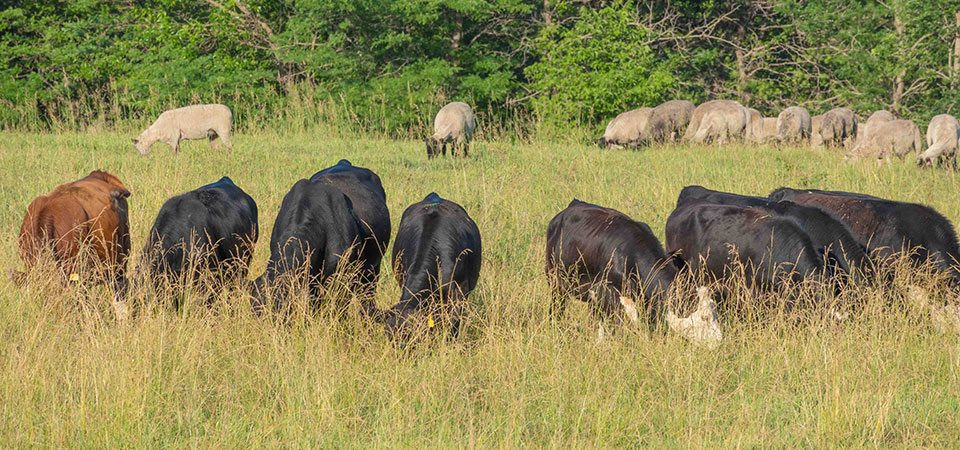
K-State beef cattle experts reveal strategic benefits and challenges of cattle co-grazing. | Download photo
K-State beef cattle experts reveal strategic benefits and challenges of cattle co-grazing
At a glance: Kansas State University veterinarians say co-grazing cattle and sheep can improve pasture efficiency, soil health and parasite control. Producers considering this strategy should plan for species-specific needs like fencing, nutrition and pasture capacity.
More information:
Brad White, 785-532-4243, bwhite@vet.k-state.edu
Phillip Lancaster, 785-564-7462, palancaster@vet-k-state.edu
Todd Gunderson, 785-532-4478, tggundy@vet.k-state.edu
Related: K-State BCI Cattle Chat Podcast
Aug. 5, 2025
By Chevy-Lynn Vaske, K-State Extension news service
MANHATTAN, Kan. — Sheep don’t graze like cattle — and that difference could be a major advantage. Kansas State University veterinarians Brad White and Todd Gunderson along with beef cattle nutritionist, Phillip Lancaster, say rotating both species on shared pasture may improve soil, forage use and animal health.
In the latest episode of K-State's Beef Cattle Institute Cattle Chat, the experts explored the benefits of multi-species grazing, a strategy that involves rotating cattle and sheep on the same pasture. The approach can improve forage use, enhance soil health and help interrupt parasite life cycles.
Gunderson noted cattle and sheep serve different roles in a grazing system.
“Sheep are more of a foraging species while cattle are grazers,” Gunderson said. “When you rotate cattle and sheep through the same pasture, they’re not going to eat the exact same plants, creating a synergistic effect.”
The experts also highlighted other advantages, including more complete pasture utilization and better soil aeration from animal movement. However, implementing a co-grazing system takes careful management.
“You need to make sure you’re accounting for both species when calculating animal unit days and carrying capacity,” Lancaster said. “It’s not simply additive.”
Lancaster added that nutritional needs differ between species and must be managed accordingly.
“Small ruminants, sheep specifically, are much more susceptible to copper toxicity and require careful management,” he said.
Something else to consider is proper fencing. White emphasized the importance of evaluating existing infrastructure before starting.
“Small ruminants require tighter fencing than cattle,” White said. “It’s important to carefully evaluate your fencing before implementing multi-species grazing strategies.”
The experts recommend co-grazing as a tool for improving pasture performance, but note it requires intentional planning and preparation from the producer.
To learn more, listen to the full episode of BCI Cattle Chat at ksubci.org.
***

K‑State Research and Extension is a short name for the Kansas State University Agricultural Experiment Station and Cooperative Extension Service, a program designed to generate and distribute useful knowledge for the well‑being of Kansans. Supported by county, state, federal and private funds, the program has county extension offices, experiment fields, area extension offices and regional research centers statewide. Its headquarters is on the K‑State campus in Manhattan. For more information, visit www.ksre.ksu.edu. K-State Research and Extension is an equal opportunity provider and employer.