TAPS Twilight Tours slated Sept. 4 and 8 in Garden City, Colby
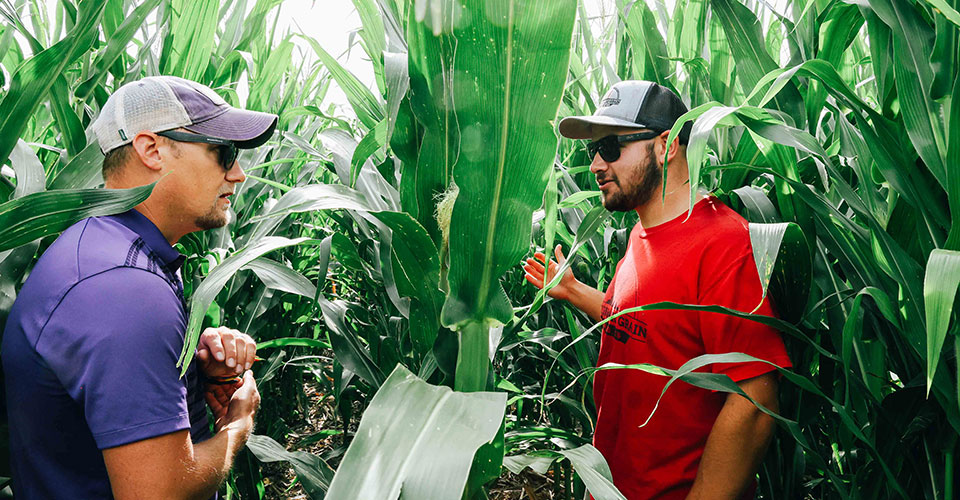
Daran Rudnick (left), K-State director of sustainable irrigation and co-founder of TAPS, and Alex Millershaski a Gray County farmer and TAPS participant, discuss strategies for managing water in Millershaski's corn plots. | Download this photo
Events showcase water-smart solutions, hands-on learning, and friendly competition
At a glance: K-State's Testing Ag Performance Solutions program is inviting farmers, agribusiness professionals, students, and community members to join two evenings of research, competition, and connection at the 2025 TAPS Twilight Tours in Garden City and Colby.
More information: Kelsey Stremel, stremelk@ksu.edu
Related: Field Day Plus (information and registration
Aug. 22, 2025
By Kelsey Stremel, K-State Extension news service
MANHATTAN, Kan. — The Kansas State University Testing Ag Performance Solutions (TAPS) program is inviting farmers, agribusiness professionals, students, and community members to join two evenings of research, competition, and connection at the 2025 TAPS Twilight Tours in Garden City and Colby.
Attendees will walk plots featuring 29 corn hybrids from nine leading seed brands, comparing how each responds to different plant populations and management strategies.
The tours demonstrate how variety selection and seeding rate — two of the most influential yield factors — work in real-world conditions, supported by precision irrigation, soil moisture monitoring, and other technologies that improve water-use efficiency.
The Garden City tour will be held Sept. 4 at the Southwest Research-Extension Center, and the Colby event is Sept. 8 at the Northwest Research-Extension Center. Both events are free to attend, with dinner provided. For more information and to register, visit www.k-state.edu/taps.
“Field days like the Twilight Tours let you see in real time how different strategies play out in the field,” said Renee Tuttle, K-State associate director of TAPS. “It’s powerful to compare the same hybrid under varying management approaches — all within the Q-Stable benchmark — and immediately see how those choices influence crop performance and water use.”
Forage sorghum has been added to the TAPS competition in Colby this year as the first-ever forage component, giving producers a firsthand look at an alternative crop that offers both high feed value and improved drought resilience.
Competitors must decide how to split their 10 inches of available water between corn and forage acres, then manage it strategically throughout the season — showing how forage sorghum’s lower water needs can make it a viable option for livestock producers and irrigators facing reduced allocations.
By comparing management strategies side by side, participants can see how this crop performs under local growing conditions, expanding the conversation about profitable, water-smart cropping systems in the High Plains.
The Sept. 4 stop in Garden City will also feature the second annual TAPS Farm Duel, a one-night-only event that combines the best of farming and football.
Created by TAPS faculty and team members, the fast-paced competition gives both current competitors and newcomers an insider’s view of the decisions that define the TAPS contests —showing how small choices can impact profitability, water use, and yield.
The evening will include dinner, door prizes, and a chance to watch the NFL season opener with friends and neighbors.
On Sept. 8 in Colby, the Twilight Tour will feature the TAPS High Roller Challenge, a lively evening blending grain marketing insight, games, giveaways, and a community meal. Attendees will tour the plots, explore the new forage sorghum trials, and see how TAPS competitors are combining genetics, plant population strategies, and technology to improve water-use efficiency and profitability.
TAPS field days are part of the land-grant tradition of bridging university research with on-farm application. They offer practical insights for making every drop of water count in the face of aquifer decline and evolving production challenges in western Kansas.
Whether you’re a farmer looking for new strategies, an ag professional staying on top of innovations, or a community member curious about the future of local agriculture, the Twilight Tours are designed for you.
***

K‑State Research and Extension is a short name for the Kansas State University Agricultural Experiment Station and Cooperative Extension Service, a program designed to generate and distribute useful knowledge for the well‑being of Kansans. Supported by county, state, federal and private funds, the program has county extension offices, experiment fields, area extension offices and regional research centers statewide. Its headquarters is on the K‑State campus in Manhattan. For more information, visit www.ksre.ksu.edu. K-State Research and Extension is an equal opportunity provider and employer.