Lawn Stressed? September is time for relief
K-State’s Domenghini shares tips for overseeding cool season lawns
At a glance: After periods of hot temperatures and sporadic moisture, overseeding can help restore cool season grasses to their former glory. K-State horticulture expert Cynthia Domenghini shares what homeowners should consider when overseeding their lawns.
More information: Cynthia Domenghini, Cdom@ksu.edu
Related: Tall Fescue Lawns
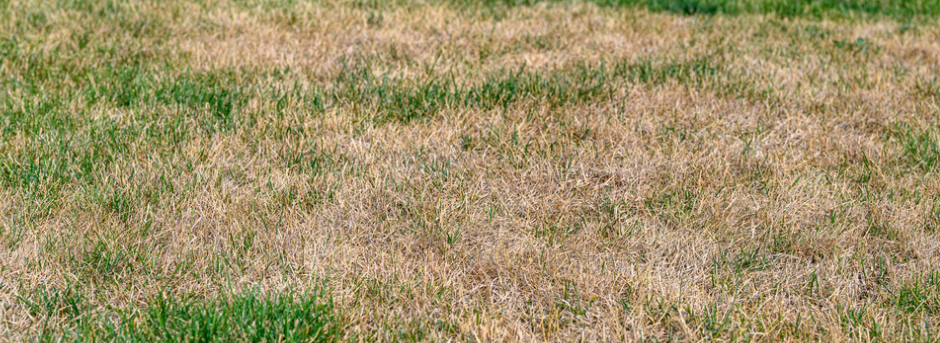
Start the overseeding process by mowing grass to a short length, said K-State horticulture expert Cynthia Domenghini.
Sept. 5, 2025
K-State Research and Extension news service
MANHATTAN, Kan. – Cool-season grasses, like the Kentucky bluegrass and tall fescue lawns common to many parts of Kansas, have had about enough of summer.
The state’s high temperatures and sporadic rainfall often cause cool-season varieties to become thin by summer’s end. September typically signals a good time to replenish those stands, said Kansas State University horticulture expert Cynthia Domenghini.
“Start by mowing the grass short (1 to 1 ½ inches) and removing the clippings,” she said. “This will make it easier to achieve good seed-soil contact and increase the amount of light that will reach the young seedlings.”
Then, she says, check the lawn’s layer of thatch – an organic layer of dead and living shoots, stems and roots that develops between the zone of green vegetation and the soil surface.
“Normally, we’d want ¼ inch of thatch or less when overseeding,” Domenghini said. “If the thatch layer is ¾ inch or more, it is usually easier to use a sod cutter to remove it and start over with a new lawn. A power rake can be used to reduce a thatch layer that is less than ¾ inch, but more than ¼ inch.”
Preparing the soil
Once thatch is under control, Domenghini said homeowners can use a hand rake to roughen up soil in small areas. For larger areas, she suggests either a verticut machine or core aerator.
“A verticut machine has solid vertical blades that can be set to cut furrows in the soil,” she said. “A slit seeder is a verticut machine with a seed hopper added so the soil prep and seeding operation are combined.”
By contrast, a core aerator literally punches holes in the soil, depositing the cores on the surface of the ground.
“Each hole produces an excellent environment for seed germination and growth,” Domenghini said. “Make 3-4 passes with the core aerator to ensure enough holes for the seed.”
A core aerator also reduces the amount of water needed to germinate the seed. Aeration increases the water infiltration rate, decreases compaction and increases the amount of oxygen in the soil.
“Of the three methods (for large areas), I prefer the slit seeder for obtaining good seed to soil contact,” Domenghini said. “However, if watering is difficult, core aeration may be a better option.”
Domenghini noted that fertilizer should be applied to the lawn at rates suggested on the bag, regardless of which overseeding method is used.
Domenghini and her colleagues in K-State’s Department of Horticulture and Natural Resources produce a weekly Horticulture Newsletter with tips for maintaining home landscapes and gardens.
Interested persons can subscribe to the newsletter, as well as send their garden and yard-related questions to Domenghini at cdom@ksu.edu, or contact your local K-State Research and Extension office.
***

K‑State Research and Extension is a short name for the Kansas State University Agricultural Experiment Station and Cooperative Extension Service, a program designed to generate and distribute useful knowledge for the well‑being of Kansans. Supported by county, state, federal and private funds, the program has county extension offices, experiment fields, area extension offices and regional research centers statewide. Its headquarters is on the K‑State campus in Manhattan. For more information, visit www.ksre.ksu.edu. K-State Research and Extension is an equal opportunity provider and employer.