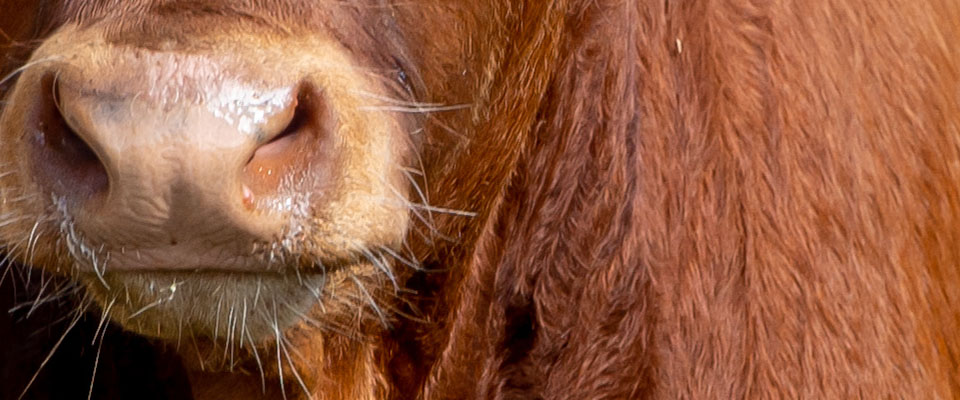
Early detection and consulting with a veterinarian are essential to protecting herd health from conditions such as anemia and others. | Download photo
Cattle Chat: Fatigue, unusual behavior may signal anemia in adult cows
K-State beef cattle experts provide insight on evaluating anemia in cows
At a glance: K-State beef cattle experts encourage producers to watch for weakness, aggression and pale mucous membrane as key signs of anemia in cattle. They suggest early detection and veterinary consultation are essential to protecting herd health.
More information:
Todd Gunderson, 785-532-4478, tggundy@vet.k-state.edu
Brad White, 785-532-4243, bwhite@vet.k-state.edu
Bob Larson, 785-532-4257, rlarson@vet.k-state.edu
Related: K-State BCI Cattle Chat Podcast
Sept. 16, 2025
By Chevy-Lynn Vaske, K-State Research and Extension news service
MANHATTAN, Kan. – When cattle start showing signs of fatigue, unusual behavior or pale coloring, it can be more than a passing concern. K-State beef cattle experts say these subtle changes may point to anemia — a condition that, if left unchecked, can affect the health and productivity of the entire herd.
“The primary signs of anemia include weakness, and cattle may become aggressive when approached,” K-State veterinarian Todd Gunderson said. “Producers should also check for pale mucous membrane, which is a strong indicator.”
Anemia can occur for several reasons, so Gunderson emphasized the importance of identifying the cause.
“It depends on the source of the anemia and the cause,” Gunderson said. “A hemorrhage, where the cow has lost a lot of blood, is one possibility. Red blood cell destruction is also common and often involves parasites, which can develop over just a few days. In rare cases, the cow may stop producing red blood cells, but that process takes a long time.”
According to the experts, certain breeds may show physical signs more clearly than others.
“In white-faced cattle, they can naturally have a pink hue to their nose, which is normal,” K-State veterinarian Bob Larson said. “But if the tissue is almost completely white, especially around the nose and eyes, that can be a sign of anemia.”
Veterinarians recommend monitoring cattle closely and consulting with a herd health professional if symptoms appear. Early intervention can improve recovery and prevent further health complications.
To learn more about this topic and more, listen to the most recent episode from the K-State BCI Cattle Chat Podcast.
***

K‑State Research and Extension is a short name for the Kansas State University Agricultural Experiment Station and Cooperative Extension Service, a program designed to generate and distribute useful knowledge for the well‑being of Kansans. Supported by county, state, federal and private funds, the program has county extension offices, experiment fields, area extension offices and regional research centers statewide. Its headquarters is on the K‑State campus in Manhattan. For more information, visit www.ksre.ksu.edu. K-State Research and Extension is an equal opportunity provider and employer.