K-State food scientist shares tips on canning frozen tomatoes safely
Gardeners have options when time is short after a bumper crop
At a glance: Freezing tomatoes and canning them later is a safe and convenient option when the harvest is bountiful and time is short, says K-State food scientist Karen Blakeslee.
More information: Karen Blakeslee, 785-532-1673, kblakesl@ksu.edu
Related: Rapid Response Center for food science (K-State) | Preserve it Fresh, Preserve it Safe: Tomatoes | You Asked It! newsletter | National Center for Home Food Preservation
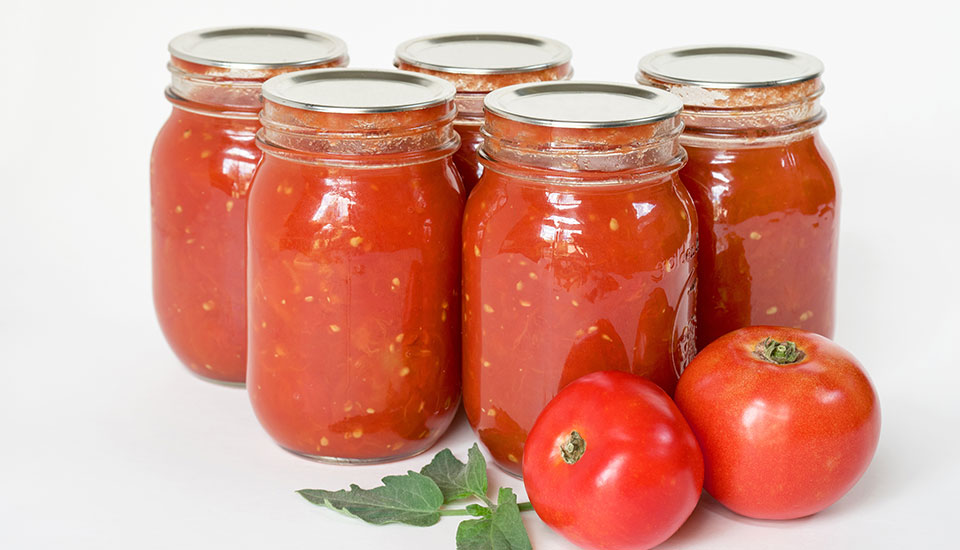
Previously frozen tomatoes are best used in canning recipes that call for sauces, juice or stewed products, says K-State food scientist Karen Blakeslee.
Sept. 29, 2025
By Pat Melgares, K-State Research and Extension news service
MANHATTAN, Kan. -- Kansas gardeners often face a common challenge at the end of a successful growing season: what to do with an abundant tomato harvest when time is short.
Karen Blakeslee, coordinator of Kansas State University’s Rapid Response Center, said freezing tomatoes is a safe and convenient option — especially when canning them right away isn’t possible.
“If a gardener has a bumper crop of tomatoes, it can be hard to preserve them by canning in a timely manner,” Blakeslee said. “Freezing them can help save them until a later date when time is available. Or, simply keep them frozen and add them to a hot soup or stew.”
Freezing tomatoes does not significantly affect flavor, Blakeslee said, but the texture does change.
“Tomatoes contain a lot of water and when frozen, that water expands and ruptures the cell walls that contain that water,” she said. “Then, when thawed, the tomatoes release a lot of liquid and the tomato structure collapses.”
Because of this, previously frozen tomatoes are best used in canning recipes that call for sauces, juice or stewed products — not for whole, halved or quartered tomato canning recipes.
Blakeslee emphasized that food safety should remain a top priority when canning tomatoes, whether fresh or frozen.
“When canning tomatoes, use research-tested recipes and methods to achieve safely canned products,” she said.
A critical step in the process is acidification, which involves adding acid to ensure the final product is safe to eat.
“A key reminder is tomatoes require acidification with either citric acid, bottled lemon juice or vinegar, to produce safe products,” Blakeslee said. “This must be done when water bath canning and pressure canning.”
As fall approaches and the first frost looms, gardeners may also look to harvest unripe or green tomatoes. Blakeslee said those, too, can be canned safely.
“Unripe or green tomatoes can be picked early when they start to change color,” she said. “Green tomatoes can be canned like ripe tomatoes using the same directions (as used for ripe tomatoes), including acidification.”
“Do not can tomatoes from dead or frost-killed vines. They can be eaten fresh or frozen in the freezer for later use.”
More detailed guidance and research-based recipes are available in the K-State Extension publication, Preserve it Fresh, Preserve it Safe: Tomatoes, or from the National Center for Home Food Preservation.
***

K‑State Research and Extension is a short name for the Kansas State University Agricultural Experiment Station and Cooperative Extension Service, a program designed to generate and distribute useful knowledge for the well‑being of Kansans. Supported by county, state, federal and private funds, the program has county extension offices, experiment fields, area extension offices and regional research centers statewide. Its headquarters is on the K‑State campus in Manhattan. For more information, visit www.ksre.ksu.edu. K-State Research and Extension is an equal opportunity provider and employer.