They may be spooky, but spiders are beneficial to the garden
K-State's Cloyd says many spiders feed on insects that can damage ornamental and vegetable crops
At a glance: K-State entomology expert Raymond A. Cloyd recommends that gardeners leave spiders alone because they feed on insect pests in flower beds and vegetable gardens.
More information: Raymond Cloyd, rcloyd@ksu.edu
Related: K-State Horticulture Newsletter | Kansas Garden Guide | Horticulture Resource Center
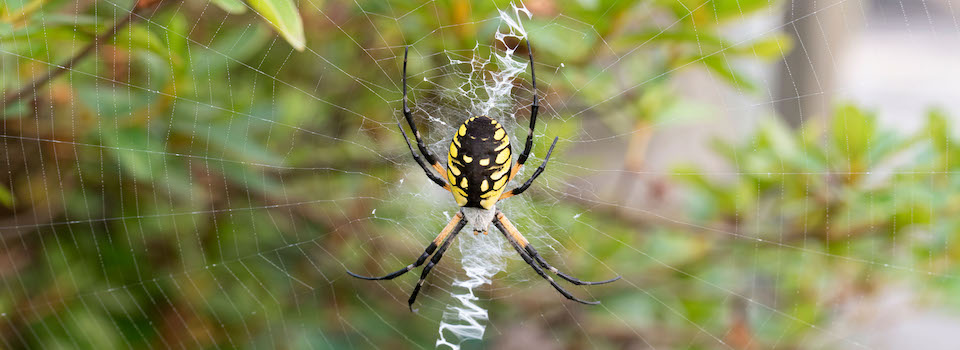
Spiders feed on insects that could harm flower beds and vegetable plants, says K-State entomology expert Raymond Cloyd.
Sept. 1, 2024
K-State Research and Extension news service
MANHATTAN, Kan. – Many people view spiders as pests, and the fear of spiders is one of the most common phobias among Americans. However, spiders are predators that feed on insect pests in gardens and landscapes.
Kansas State University entomology expert Raymond Cloyd says that spiders feed on insects that may damage ornamental and vegetable crops. Consequently, they should be left alone and encouraged to take up residence in gardens and landscapes.
“There are two common species of garden spiders in Kansas that are active during the day,” Cloyd said. “They are the yellow garden spider and banded garden spider.”
The yellow garden spider has a black abdomen with yellow markings and black legs with a yellow or red band, Cloyd said. The banded garden spider has continuous bands across the abdomen and legs, alternating white and dark with orange and black bands on the legs. Both spiders create large webs in gardens and landscapes.
Garden spiders rely on vibrations that move through the web to indicate that prey have been captured.
Cloyd recommends leaving garden spiders alone because they are beneficial and are not harmful to humans.
Cloyd and his colleagues in K-State’s Department of Entomology produce a weekly Extension Entomology Newsletter with information on managing insect and mite pests of landscapes and gardens.
Interested persons can subscribe to the free newsletter, as well as send their insect-related questions to Cloyd at rcloyd@ksu.edu, or contact your local K-State Research and Extension office.
***

K‑State Research and Extension is a short name for the Kansas State University Agricultural Experiment Station and Cooperative Extension Service, a program designed to generate and distribute useful knowledge for the well‑being of Kansans. Supported by county, state, federal and private funds, the program has county extension offices, experiment fields, area extension offices and regional research centers statewide. Its headquarters is on the K‑State campus in Manhattan. For more information, visit www.ksre.ksu.edu. K-State Research and Extension is an equal opportunity provider and employer.