K-State Forage conference set for Nov. 5 in Garden City
Organizers call forage ‘the backbone’ of state’s agriculture
At a glance: Kansas State University will bring together researchers, producers and industry experts on Nov. 5 to address the challenges and opportunities of raising forage in a limited-water environment.
More information: John Holman, 620-276-8286, jholman@ksu.edu
Related: K-State Forage Conference | Conference registration | Forage Sampling and Equipment | Summer Annual Forages: Selection and Production Characteristics
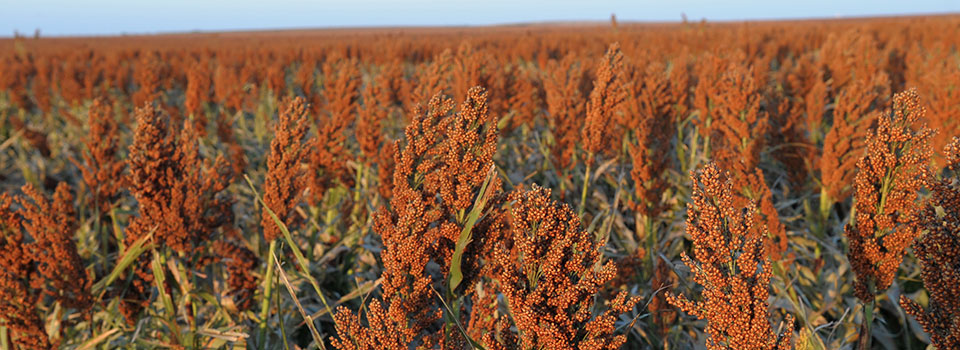
Annual forages -- such as sorghum -- are especially valuable in the High Plains because of their drought tolerance.
Oct. 16, 2025
By Kelsey Stremel, K-State Extension news service
GARDEN CITY, Kan. — Kansas State University will bring together researchers, producers and industry experts to address the challenges and opportunities of raising forage in a limited-water environment.
The K-State Forage Conference will be held Nov. 5 at the K-State Southwest Research-Extension Center in Garden City. The one-day event will run from 8:30 a.m. to 4 p.m. and is free to attend.
Sessions will deliver fast-paced, practical updates on forage management, soil health, fertility, risk protection and marketing, with time for questions and peer discussion. Lunch is provided thanks to conference sponsors High Plains Farm Credit, American AgCredit, and the Kansas Forage & Grassland Council.
“Forage is the backbone of western Kansas agriculture,” said John Holman, K-State cropping systems agronomist. “Our cattle industry depends on reliable hay and silage production, and this conference is designed to provide the research-based information producers can trust—especially when every acre and every inch of water counts.”
Kansas produced more than 5 million tons of hay in 2022 grown on 2.4 million acres, ranking third among all states, and forage contributes more than $536 million annually to the state’s economy.
According to the Kansas Department of Agriculture, forage production supports nearly 6,700 jobs and generates $546.9 million in economic output statewide.
Holman noted that annual forages -- such as forage sorghum, sudangrass, triticale and wheat -- are especially valuable in the High Plains because of their drought tolerance, and flexibility for grazing, hay or silage. Some hybrids can be ready to graze within 4-6 weeks of planting, providing timely feed sources throughout the year.
“These crops allow producers to fill forage gaps and adapt to changing water availability,” Holman said. “But they also come with challenges, so understanding management strategies is critical.”
The list of conference sessions, as well as presenters, includes:
- Annual forage economics — John Holman.
- Soil impacts of haying, grazing and cover crops — Augustine Obour, K-State soil scientist.
- Managing prussic acid in forages — Scott Staggenborg, seed and product development consultant.
- Alfalfa production update — Romulo Lollato, K-State extension wheat and forages specialist.
- Forage fertility management — Logan Simon, K-State southwest area agronomist.
- Insurance and price protection tools — Jenny Ifft, Flinchbaugh Agricultural Policy chair.
- Invasive grass management — Keith Harmoney, K-State range scientist.
Holman said additional sessions are planned on summer legumes, seeding rates, and a Kansas Livestock Association industry update.
More information is available online, and from local extension offices in Kansas.
***

K‑State Research and Extension is a short name for the Kansas State University Agricultural Experiment Station and Cooperative Extension Service, a program designed to generate and distribute useful knowledge for the well‑being of Kansans. Supported by county, state, federal and private funds, the program has county extension offices, experiment fields, area extension offices and regional research centers statewide. Its headquarters is on the K‑State campus in Manhattan. For more information, visit www.ksre.ksu.edu. K-State Research and Extension is an equal opportunity provider and employer.