Cattle Chat: Factors influencing herd expansion decisions
K-State beef cattle experts encourage producers to balance opportunity with management and long-term planning
At a glance: K-State beef cattle experts highlight that while higher cattle prices may signal opportunity, national trends show limited herd expansion. They emphasize that successful growth depends on careful financial planning, carrying capacity and maintaining herd reproductive efficiency.
More information: Jacob Warner, 785-532-1460, jasonwarner@ksu.edu
Brad White, 785-532-4243, bwhite@vet.k-state.edu
Bob Larson, 785-532-4257, rlarson@vet-k-state.edu
Scott Fritz, 785-532-0120, scottfritz@vet.k-state.edu
Related: BCI Cattle Chat podcast
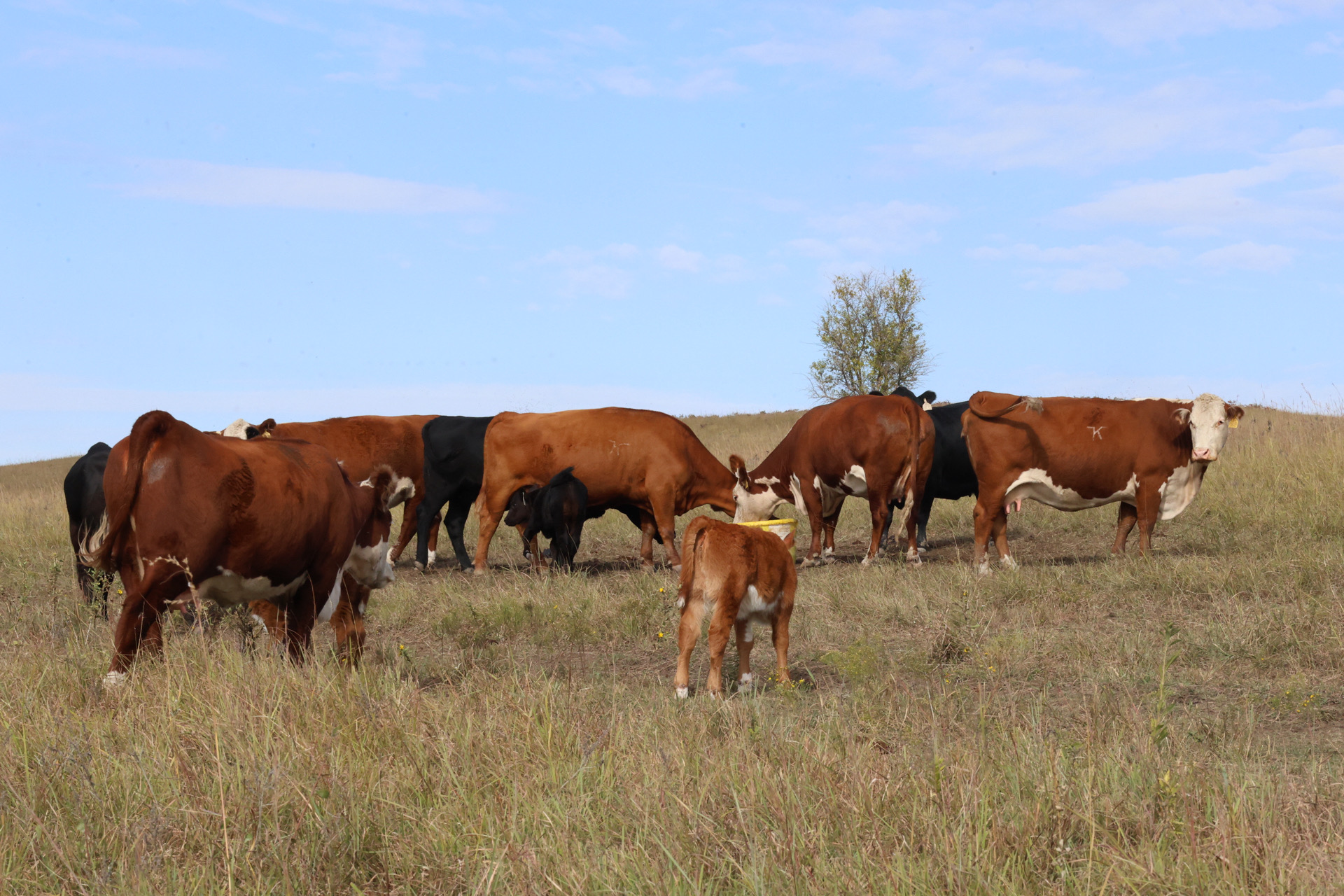
K-State beef cattle experts highlight that while higher cattle prices may signal opportunity, national trends show limited herd expansion. | Download photo
Oct. 14, 2025
By Chevy-Lynn Vaske, K-State Extension news service
MANHATTAN, Kan. – As cattle producers across the country evaluate opportunities for herd expansion, Kansas State University beef experts say careful management and long-term planning remain essential for making sound business decisions, even while market signals are shifting.
On a recent episode of the Beef Cattle Institute’s Cattle Chat podcast, experts discussed the challenges and considerations surrounding herd expansion in today’s market.
Jason Warner, K-State cow-calf specialist, said that despite stronger cattle prices, national trends show limited herd growth. “Relative to cattle on feed numbers, we are not seeing a lot of herd expansion at this point,” Warner said.
Veterinarian Scott Fritz noted that for some producers, the current market conditions make expansion less appealing. “It doesn’t sound like a good business deal to buy high and sell low,” Fritz said.
Market fluctuations are part of the industry’s natural cycle veterinarian Brad White said.
“It balances out,” White said. “A long-term perspective is essential when evaluating opportunities like herd expansion.”
Veterinarian Bob Larson echoed that sentiment, saying producers should avoid short-term reactions to market changes. “Five years from now, the current prices may not seem too bad — you just never know,” Larson said.
When considering expansion, White posed the question many producers are asking: “If you were a cow-calf producer, what would you do?”
Larson advised producers to start with the basics — understanding the ranch’s carrying capacity and ensuring herd productivity. “Marry forage well and stock appropriately,” Larson said. “Make sure your cows get bred. Check bull fertility and body condition before breeding, because it never goes out of style to have a highly reproductive herd.”
Warner encouraged producers to carefully evaluate their financial position and land resources. “Know what your production costs are and consider what you expect feeder calf prices might be in the future,” he said. “Also, consider your current cow-to-land ratio to ensure your resources can support herd expansion.”
The experts agreed that while herd expansion may be tempting in a strong market, sustainable growth depends on reproductive efficiency, forage management and economic planning.
To hear the full discussion, listen to the most recent episode of the BCI Cattle Chat podcast.
***

K‑State Research and Extension is a short name for the Kansas State University Agricultural Experiment Station and Cooperative Extension Service, a program designed to generate and distribute useful knowledge for the well‑being of Kansans. Supported by county, state, federal and private funds, the program has county extension offices, experiment fields, area extension offices and regional research centers statewide. Its headquarters is on the K‑State campus in Manhattan. For more information, visit www.ksre.ksu.edu. K-State Research and Extension is an equal opportunity provider and employer.