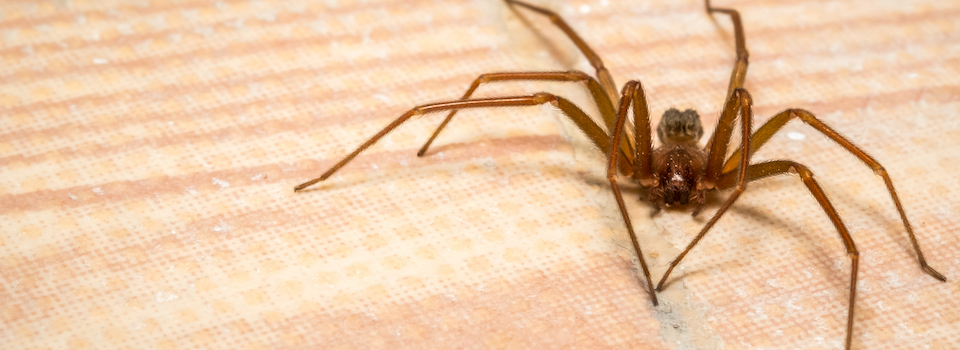
K-State entomologist Jeff Whitworth says the brown recluse (shown above) and other spiders common to Kansas are likely to be in hiding by mid-October.
Spiders for Halloween? Not likely, says K-State entomologist
Species common to Kansas likely to go into hiding soon
At a glance: If someone tries to scare you this Halloween with a spider, it's a trick. K-State entomologist Jeff Whitworth says four species commonly found in Kansas are likely to be in hiding by the end of October.
More information: Jeff Whitworth, 785-532-2371, jwhitwor@ksu.edu
Related: Brown Recluse Spiders | Kansas structural Pests
Oct. 9, 2025
K-State Extension news service
MANHATTAN, Kan. – They’re creepy and they’re kooky, mysterious and spooky. And all together ooky…
Kansas State University entomologist Jeff Whitworth adds another scary warning: “And they’re watching you with multiple eyes and fangs made for sucking blood.”
But unlike the Addams Family of 1960s television fame, spiders are likely to be gone by Halloween.
Whitworth says four spider species common to Kansas are likely to be in hiding within the next few weeks.
Two species commonly found in the home that are of most concern to humans because of their venom – the brown recluse and black widow – are ready to go into winter hibernation. Whitworth said those two species are rarely seen from mid-October to mid-March.
The brown recluse is identified by a signature dark line that resembles a violin on its back, with the neck of the violin pointing to the rear of the spider. The bite of a brown recluse releases a hemotoxin that affects a person’s blood cells. A bite from a brown recluse may require medical attention.
“The brown recluse is nocturnal, thus they are most active at night when they crawl around searching for food,” Whitworth said. “As daylight returns, they crawl into any dark place close by, which is often in a shoe or clothing, if left on the floor. That is the reason that most bites occur; the spider is threatened when you put the item on.”
The adult female black widow is more elegant looking, typically a very shiny black with a reddish, hourglass shaped mark on their abdomen. The bite of a black widow releases a neurotoxin that affects the nervous systems of humans and animals.
“The black widows are web builders,” Whitworth said. “Thus, they are usually encountered in some out-of-the-way corner of a garage, shed, basement or similar place. They usually are not out wondering like a brown recluse.”
Two less-venomous spiders more common in farm fields or open areas include the orb spider and the garden spider.
The orb spider is typically a big, brown, round spider that weaves intricate webs.
“You will often see webbing, but not the spider,” Whitworth said. “The webbing catches insects, and then the spider comes out in the evening to feed on what they’ve caught” and repair the web, if needed.
Another common field spider, the garden spider, also is very large, and typically dark green or black and yellow with long legs. Farmers often run into garden spiders when walking between fields because they’ll use corn or sorghum or large weeds to build their webs, “and by this time of year, most spiders are at their largest and thus have constructed large webs for catching prey,” according to Whitworth.
“If they feel threatened in their web, they will vibrate the web, but if that doesn’t work, they usually drop to the ground and hide,” he said.
But like the brown recluse and black widow, orb spiders and garden spiders are likely to be out of sight by the time the scariest holiday of the year rolls around.
“We are just about to run out of being scared by spiders, and just before Halloween,” Whitworth said, “because the adult field spiders are going to lay their eggs and then go away. The brown recluse and black widow are going into hibernation and won’t be back until March or April.”
Whitworth said that even though the brown recluse and black widow are better known to be dangerous, “all spiders are venomous.”
“Most spider bites don’t affect humans too much, but you just never know,” he said. “I always caution people not to play with spiders.”
***

K‑State Research and Extension is a short name for the Kansas State University Agricultural Experiment Station and Cooperative Extension Service, a program designed to generate and distribute useful knowledge for the well‑being of Kansans. Supported by county, state, federal and private funds, the program has county extension offices, experiment fields, area extension offices and regional research centers statewide. Its headquarters is on the K‑State campus in Manhattan. For more information, visit www.ksre.ksu.edu. K-State Research and Extension is an equal opportunity provider and employer.