Kansas Profile – Now That’s Rural: Mike and Maria Gillespie, passive house
At a glance: Mike Gillespie grew up in the 1970s when the nation’s energy crisis made him energy conscious. After a military career, he retired to Riley County and sought to build a passive house that is highly energy efficient. With help from a Manhattan architect, Gillespie and his wife have built a passive house that has cut their heating bills to their lowest amount ever.
More information: Ron Wilson, rwilson@ksu.edu, 785-532-7690
Photos: Ron Wilson | Mike and Maria Gillespie
Website: Huck Boyd National Institute for Rural Development
Oct. 22, 2025
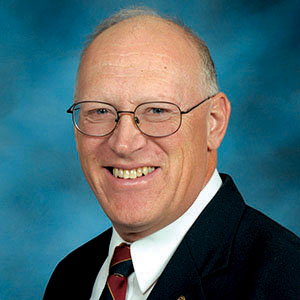
By Ron Wilson, director of the Huck Boyd National Institute for Rural Development at Kansas State University
“I want to heat my house with a candle and cool it with an ice cube,” the man said with a smile.
While that may not be achievable, it is possible to significantly reduce energy use in our homes and buildings. Today we’ll learn about a rural Kansas homeowner who is working with a team of professionals to achieve great progress in energy efficiency.
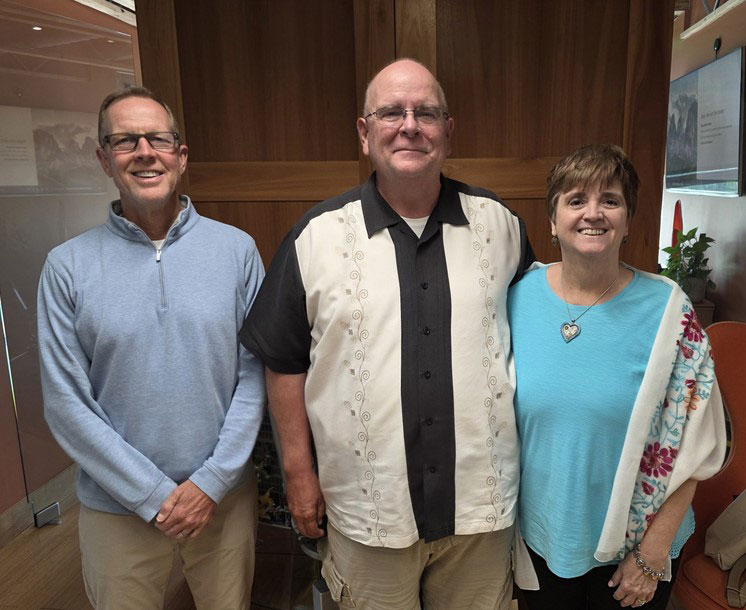 Last week we learned about passive houses and a western Kansas craftsman who is manufacturing special energy-conserving windows for such homes. Among his customers are Mike and Maria Gillespie, who have a passive house in Riley County.
At right: Tracy Anderson, Mike and Maria Gillespie | Download this photo
Mike grew up in Wichita, attended Wichita State, and had a career in the Army where he met Maria, a self-described Army brat. Gillespie grew up during the energy crisis of the 1970s and became very energy conscious as a result.
“I’ve been an energy nerd since the ‘70s,” Gillespie said with a smile. He even built his own solar screens to conserve energy in the family home. During his Army tours of duty overseas, he observed energy efficiency measures in Europe and Japan.
The Gillespies moved back to Kansas and bought land on which to retire near Randolph, close to the north end of Tuttle Creek Lake. His energy interests led him to learn about the passive house concept through which buildings are designed, situated, and constructed in a highly energy-efficient way.
He also connected with Manhattan architect Tracy Anderson of Anderson Knight Architects to see about designing a lake home.
“I knew about passive houses, but there wasn’t much demand in our region,” Anderson said. Gillespie and Anderson attended passive house training in Colorado.
High standards have to be achieved in order to be an official passive house. For example, “to be a passive house, you have to manage four things: Bulk water, air flow, vapor, and thermal conditions,” Gillespie said.
Meanwhile, the Gillespies acquired a nearby A-frame house that had been abandoned by a neighbor. “It was in terrible shape,” Gillespie said.
The Gillespies decided to see if they could remake that building into a true passive house. Anderson went to work. He first used software to model the energy efficiency of the building based on climate zone and orientation and created a design from there.
“The collaboration with Anderson Knight has been spectacular,” Gillespie said. Back 9 Development of Manhattan did the construction.
“They did a great job, as did Carlson Heating and Plumbing in Clay Center,” Gillespie said. Bank of the Flint Hills was the financing partner.
In March 2025, the Gillespie’s home was certified as a passive house by the international certifying agency. “We’re very happy,” Maria Gillespie said. “How (these features) perform is surreal. Our electric bills are the lowest they have ever been.”
“The tolerances for construction of a passive house are so precise,” Anderson said. “Our sliding glass doors weigh 300 pounds each, and Maria can open them with two fingers,” Gillespie said.
Anderson Knight is now designing another building for the Gillespies.
“If you build a group of architects, contractors and bankers who are familiar with this technology, that’s a contribution to the community,” Gillespie said.
“This has helped elevate other building processes,” Anderson said. “We’ve learned steps we can take to improve energy efficiency, without having to meet the standards for an official passive house. A few small changes can make a big difference. We’ve found ways to build buildings that can help residents live more comfortably and economically.”
It’s great to find this remarkable type of home in a rural community such as Randolph, population 159 people. Now, that’s rural.
For more information, see www.passivehouse.com. For information about Anderson Knight Architects, see www.weareaka.com.
Heating with a candle and cooling with an ice cube may not be achievable, but great gains are being accomplished in energy efficiency. We commend Mike and Maria Gillespie, Tracy Anderson, and all those involved with this passive house project for making a difference by applying such innovative technology.
They’ve put great energy into making houses more efficient.
Audio and text files of Kansas Profiles are available at www.huckboydinstitute.org/kansas-profiles. For more information about the Huck Boyd Institute, interested persons can visit www.huckboydinstitute.org.
***

K‑State Research and Extension is a short name for the Kansas State University Agricultural Experiment Station and Cooperative Extension Service, a program designed to generate and distribute useful knowledge for the well‑being of Kansans. Supported by county, state, federal and private funds, the program has county extension offices, experiment fields, area extension offices and regional research centers statewide. Its headquarters is on the K‑State campus in Manhattan. For more information, visit www.ksre.ksu.edu. K-State Research and Extension is an equal opportunity provider and employer.