Cattle Chat: Partnerships strengthen the beef industry
K-State beef cattle experts discuss bridging the gap between producers, consumers and the next generation of agricultural leaders
At a glance: Collaboration across state lines is helping strengthen the U.S. beef industry as organizations navigate higher costs, workforce changes and evolving consumer expectations.
More information:
Dave Maples, dmaples@kycattle.org
Brad White, 785-532-4243, bwhite@vet.k-state.edu
Scott Fritz, 785-532-0120, scottfritz@vet.k-state.edu
Related: Beef Cattle Institute Cattle Chat podcast
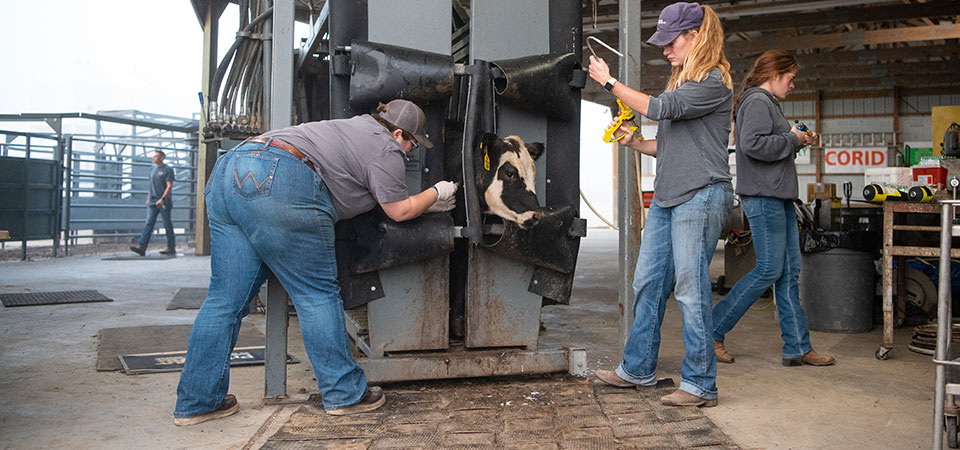
Partnerships in the cattle industry helps organizations and farms manage resources.
Nov. 4, 2025
By Chevy-Lynn Vaske, K-State Extension n
MANHATTAN, Kan. — Collaboration across state lines is helping strengthen the U.S. beef industry as organizations navigate higher costs, workforce changes and evolving consumer expectations, according to Dave Maples, executive director of the Kentucky Cattlemen’s Association, and K-State's beef cattle experts.
“The cost to run these organizations has just been harder — there are fewer dollars, so we have had to integrate and partner,” Maples said, speaking on a recent episode of Cattle Chat, a podcast produced by Kansas State University’ Beef Cattle Institute.
One example of that cooperation is a joint effort between Kansas and Kentucky to share a nutritionist who works with the Kentucky Cattlemen’s Association team. The partnership not only helps manage resources, but also broadens expertise across regions.
“You know, we kind of forget that the consumer pays for everything,” Maples said, emphasizing that the beef industry ultimately depends on consumer demand.
K-State veterinarian Brad White agreed, adding that the geography and population differences between the two states play a role in how cattle are raised and finished.
“Part of the reason we have feedlots here is because there aren’t a lot of people here,” White said. “And as much as people like to eat beef in Kansas, we aren’t the predominant customer from a population perspective.”
Through these partnerships, both Kansas and Kentucky are finding new ways to share information and support the next generation of beef professionals. Maples said that at Kentucky’s Eden Shale Farm, the team has been able to provide hands-on learning experiences for their nutritionist, allowing her to better connect with producers while working cattle and understanding their operations firsthand.
The conversation also turned to the importance of welcoming new people into agriculture. Leaders emphasized breaking down barriers for those without an agricultural background, helping them gain experience and appreciation for the work that goes into beef production.
K-State veterinarian Scott Fritz highlighted the role of social media in that effort, noting that younger generations increasingly turn to online platforms to learn about farming and ranching. “That’s an opportunity for producers to show what they do,” he said.
Maples encouraged producers to take that outreach a step further “My approach is to get everyone out to the operation,” he said.
White agreed, adding that many consumers are deeply interested in the passion farmers and ranchers have for raising livestock once they see it for themselves.
Together, the beef cattle experts encouraged cooperation, transparency and consumer engagement, which remain vital to the future of the beef industry.
To learn more about engaging consumers in a beef cattle operation, the Kentucky Cattlemen’s Association partnership or other topics, listen online to the Cattle Chat podcast.
***

K‑State Research and Extension is a short name for the Kansas State University Agricultural Experiment Station and Cooperative Extension Service, a program designed to generate and distribute useful knowledge for the well‑being of Kansans. Supported by county, state, federal and private funds, the program has county extension offices, experiment fields, area extension offices and regional research centers statewide. Its headquarters is on the K‑State campus in Manhattan. For more information, visit www.ksre.ksu.edu. K-State Research and Extension is an equal opportunity provider and employer.