Jumping Jiminy Crickets! Rainy Conditions May Have Boosted Kansas Cricket Population
 August 25, 2015
Photo and caption available
MANHATTAN, Kan. – First it’s the racket of 17-year cicadas. Now Kansans in some areas may be facing an influx of chirping crickets, aided by this year’s moisture that favors the insect’s survival and development, according to a Kansas State University specialist.
Bob Bauernfeind, an entomologist with K-State Research and Extension, said he has no official data, but anecdotally there appear to be more crickets than usual in parts of the state.
Crickets are part of a family of insects known as Gryllidae and are related to grasshoppers. The males make the chirping sound to attract females and to repel other males.
Bauernfeind said the insects are more of a nuisance than a threat, as they are not typically considered disease-carriers, but they can be responsible for creating holes and leaving stains on light-colored fabrics. It’s the hopping activity and sound that can make them annoying.
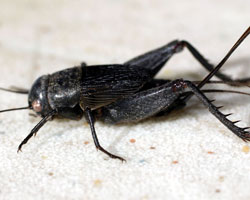
Crickets generally found in the United States are field crickets, although the name belies the fact that they are happy to enter homes when outdoor temperatures start to cool, and they’re drawn to a heat source. Field crickets are about 1 inch in length. Most are black, but some have a lighter appearance due to their copper-colored wings.
“Crickets are capable of detecting heat gradients and thus are drawn in. Once on the doorstep, they are a hop away from secretly moving in through any available crack, crevice or opening,” Bauernfeind said.
They are particularly drawn to the warmth on the south and west sides of homes and other buildings. Home and business owners wanting to prevent a cricket invasion should start by doing what they can to exclude them.
“Crickets, as well as other unwanted fall houseguests, such as boxelder bugs, multicolored Asian lady beetles, sowbugs (roly-polies) and spiders, gain entrance via any available crack, crevice or gap in a structure,” Bauernfeind said. “Sealing those portals of entry is the recommended method of exclusion.”
- Inspect and identify entry points.
- Check for cracks and gaps in areas such as foundations, ill-fitting doorways and garage doors, overhang louvers, chimney vents, roof ducts and outdoor faucets.
- Use caulk to seal cracks and crevices. Use weather stripping to make doorways and garage doors tightfitting, and metal screening over, under and behind other entry points.
If the infestation is large enough, the entomologist said, there are hundreds of insecticides labeled as effective against crickets. Outside perimeter or barrier treatments do not guarantee, however, that all potential invaders will be eliminated.
Bauernfeind said that although he considers his own home sound and sealed, he expects some “fall visitors” will likely make their way in.
-30-
Story by:
Mary Lou Peter
mlpeter@ksu.edu
K-State Research and Extension
For more information:
Bob Bauernfeind – rbauernf@ksu.edu or 785-532-4752
