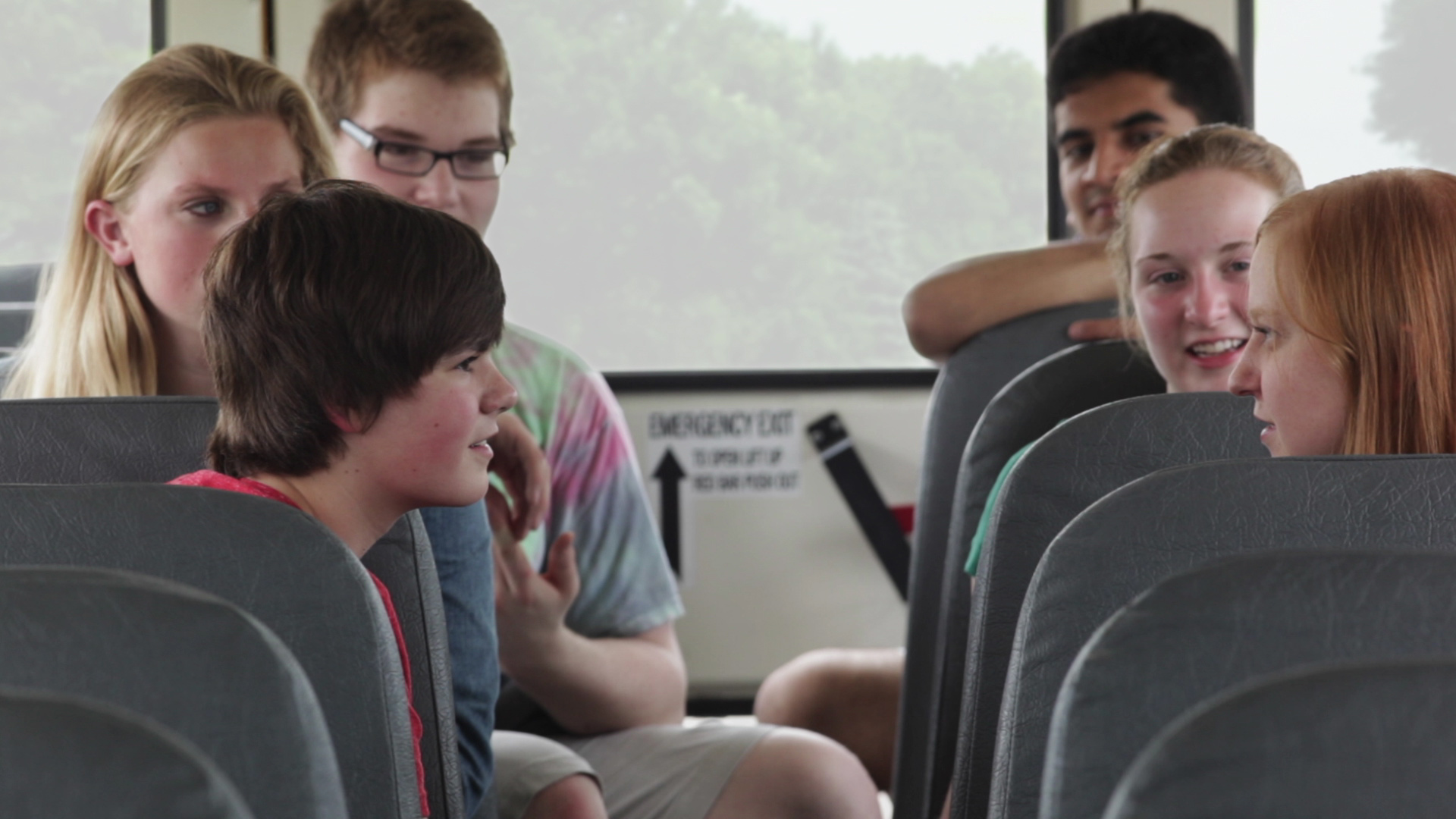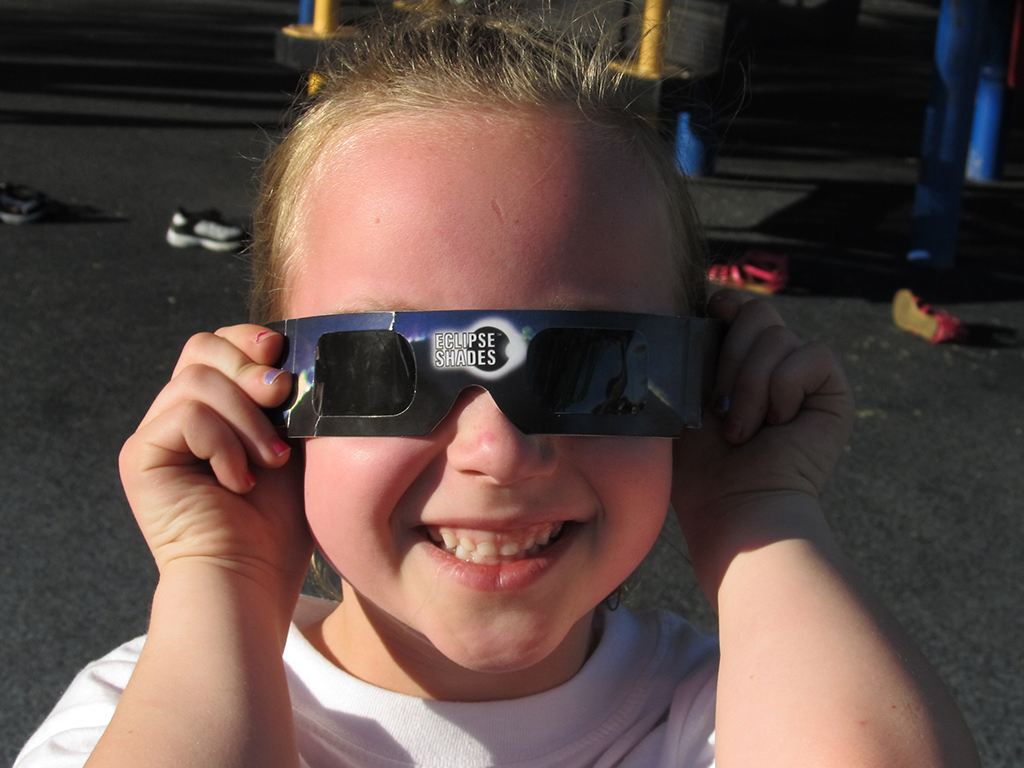
Abby viewed a solar eclipse in 2012 with her certified viewing glasses. Photo by Ken Lund from Las Vegas, Nevada, USA, via Wikimedia Commons.
Eclipse watching at the mercy of the weather
Anything is possible on Monday
August 18, 2017
MANHATTAN, Kan. — You plan, prepare, invest your time and money into the big event, and then it happens: it’s pouring rain on the day of your big outdoor wedding.
Sometimes, those things happen, and the wedding holds lessons for another once-in-a-lifetime event: Monday’s solar eclipse.
“It is so rare to have such a large area of our country covered by that totality,” said Kansas State University climatologist Mary Knapp of the path of totality that will stretch from Lincoln Beach, Oregon to Charleston, South Carolina, including northeast Kansas. “The unfortunate reality is that in many cases the ground view will not necessarily be perfectly clear. So, you could end up with a cloudy day and not have any visibility at all.”
Knapp said that the path of totality (the areas of the earth that will see the sun completely obscured by the moon) in this area runs through the southeast corner of Nebraska, the far northeast corner of Kansas, and just north of Kansas City. Many people are traveling to the path of totality, to either get in it or closer to it — but even if you stay put, you could see a good show.
“I had one Kansas resident who called to check and see what the probability of clouds were on this particular day, because for the last total eclipse in the 1970s he flew to Seattle to see it and basically got to watch a lot of clouds and didn't get to see the actual eclipse.”
“Most of Kansas is going to have something like 70 to 80 percent coverage, so you're going to see a good show anyway, if the sky conditions are good. How far you travel depends upon what your threshold of enthusiasm is for the event,” she said.
In this part of the country, time is on our side, she said. “Here in Kansas, the totality will be right around 1:00 p.m. CDT. The sun's going to be at its highest point in the sky, so we’re less likely to have trees or other things blocking our view of the sun.
“So if the clouds don't make an appearance, you've got a fairly good shot of getting a very nice view.”
It’s been said, written, shared and “liked” many times, but it bears repeating: Don’t look at the sun directly with unshielded eyes, and if you purchase any kind of eyewear for viewing the eclipse, make sure it’s properly rated. Whether paper or plastic, your eyewear should say that it meets the ISO 12312-2 (sometimes written as ISO 12312-2:2015) international safety standard. Glasses and filters that are ISO 12312-2 compliant not only reduce visible sunlight to safe and comfortable levels but also block solar UV and IR radiation.
“When you're in that dark phase of the eclipse, your eyes are dilated more than they normally would be,” said Knapp. “So your eyes, especially your retinas, aren’t as protected from the incoming radiation, that part of the light spectrum that we don’t see. You can get a very dangerous and damaging level of radiation without protective eyewear. Use appropriate protective gear or use an alternate method to look at the eclipse.”
It’s possible that the eclipse might not just be something we see — it might be something we feel, too.
“There are some reports of a temperature drop of as much as 10 degrees as you have that shadow engulf the sun — not just the two to two-and-a-half minutes of totality, but as the sun is gradually being obscured, and as the sun reappears.”
Knapp said that a number of Kansas Mesonet weather stations would be recording data at one-minute intervals during the eclipse, measuring temperature, relative humidity and even solar radiation levels.
All that being said… what’s the weather going to be like on Monday? Knapp does have data for the weather station at St. Joseph Missouri, and for the past four years, clear skies have been recorded for the date of Aug. 21.
“Of course,” she concluded, “past weather isn't any guarantee of what will happen this year!”