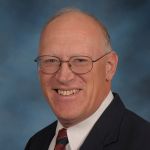
Livestock nutrition consultant Tim Brown is based in Westmoreland, Kansas, but has clients all over the world. Pictured are Brown (at left) and clients in Saudi Arabia.| Download this photo
Kansas Profile – Now That’s Rural: Tim Brown, nutritional consultant
May 23, 2018
By Ron Wilson, director of the Huck Boyd National Institute for Rural Development at Kansas State University
Let’s go to Inner Mongolia in China. A dairy operation is seeking to upgrade its nutrition program so as to improve milk production, production efficiency, and cow health. The expert who is here to help is a dairy feed nutrition consultant from halfway around the globe in rural Kansas.
Tim Brown is this nutritional consultant. He grew up in suburban Virginia with loose connections to production agriculture. He studied animal science at Virginia Tech and then considered graduate school.
“I was looking for a graduate program somewhere far away, at a university with a solid reputation,” Tim Brown said. Ultimately, he chose Kansas State.
Tim moved to Manhattan and studied ruminant nutrition under K-State animal sciences professor Ben Brent. Tim wanted to live out in the country, so he borrowed Dr. Brent’s car and went driving through the countryside looking for a place to rent. “When I would see an apparent vacant house, I stopped in nearby to inquire about it and people would tell me who might have a house to rent,” Tim said. “On more than one occasion, I was told, `We’re getting ready to sit down for a meal. Why don’t you join us?’ To myself I was thinking, `Boy, these Kansans are nice people,’” he said.
Tim earned his Ph.D. in ruminant nutrition. He also met and married his wife Sue. Tim worked 10 years at a branch experiment station in Louisiana and then taught at a college in Texas. In 2002, he accepted the offer of a position in industry.
“I was told I could live anywhere in the central U.S., so Sue and I decided to come back to Kansas,” Tim said. They found a place near Westmoreland. Sue later went to work for K-State’s Kansas Center for Agricultural Resources and the Environment.
Tim’s role was as a dairy feed nutrition consultant. He now performs a similar role for Landus Cooperative, a farmer-owned co-op headquartered in Iowa.
“The member-owners of the cooperative are mainly corn and soybean farmers,” Tim said. “They wanted to add value to their crops and they developed this novel technology which increases the effective protein level available to the cows. And the process is all natural. It uses no chemicals.”
This high value soybean-based feed became a premium product for Landus Cooperative. Tim wasn’t a salesman, but he used his scientific expertise to explain and help producers utilize the product.
Sue and Tim have a son Billy, who is also now a doctoral candidate in dairy science at K-State. After Billy went to college, Tim could take on more travel – and he did.
Tim’s work frequently involves going to the co-op’s customers. Since 2009, he has visited 33 states, from Arizona to Wisconsin and California to New York. The international demand for this product has also expanded. Tim has visited 33 different countries at least once, and several of those multiple times. Those travels have spanned the globe, and covered the alphabet from Argentina to Wales.
“I fly out of Manhattan whenever I can, or sometimes Salina or KCI,” Tim said. After each trip, he returns to his home near the rural community of Westmoreland, population 796 people. Now, that’s rural.
“My various career experiences have opened my eyes to the tremendous job opportunities for young people in agriculture,” Tim said. “There are so many wonderful employment options out there, in lots of aspects beyond production.”
“When I meet young ag students, I’m as envious as I can be,” he said. “Working in agriculture has made my life tremendously fulfilling, and I would love to be able to start all over and do it again. I know it will be just as rewarding for others.”
It’s time to leave Inner Mongolia, where nutritional consultant Tim Brown is working with a client on enhancing their dairy nutrition program. We commend Tim for making a difference by applying science to agriculture and helping feed the world.
And by the way: If you find a student out in the country looking for housing, invite him in for supper. A little kindness can go a long way.
Audio and text files of Kansas Profiles are available at http://www.kansasprofile.com. For more information about the Huck Boyd Institute, interested persons can visit http://www.huckboydinstitute.org.
------------------------------------------------
The mission of the Huck Boyd National Institute for Rural Development is to enhance rural development by helping rural people help themselves. The Kansas Profile radio series and columns are produced with assistance from the K-State Research and Extension Department of Communications News Media Services unit. A photo of Ron Wilson is available at http://www.ksre.ksu.edu/news/sty/RonWilson.htm. Audio and text files of Kansas Profiles are available at http://www.kansasprofile.com. For more information about the Huck Boyd Institute, interested persons can visit http://www.huckboydinstitute.org.