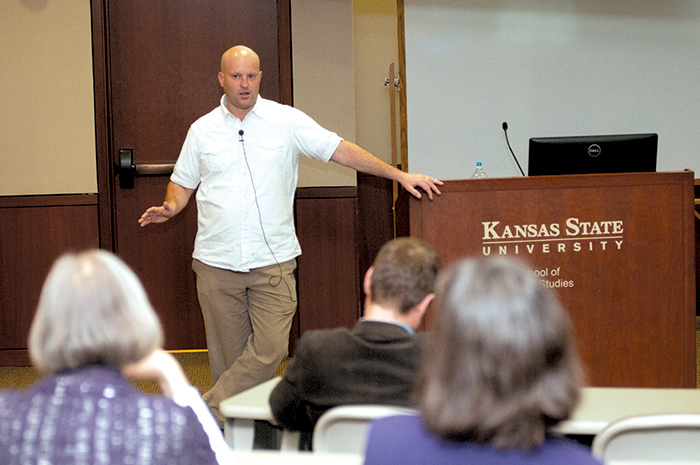
Nathan Smit, Kansas State University Global Campus 2019 Alumni Fellow, talks to students and staff on April 11, 2019, about design thinking and how he uses it in his role as a food innovator for Hormel -- and in everyday life. | Download this photo.
Food scientist responsible for Skippy P.B. Bites shares tips on design thinking
Global Campus 2019 Alumni Fellow’s unique path to success ran – virtually – through K-State
April 18, 2019
MANHATTAN, Kan. — Nathan Smit, K-State Global Campus’ 2019 Alumni Fellow spent part of last week inspiring students on the K-State campus.
While living and working in Minnesota, Smit earned his bachelor’s degree in food science and industry through K-State Global Campus in 2008 – a key to his advancement at Hormel Food Corporation.
During his April 11 presentation, "What's the Big Idea: Design Thinking and Innovation," Smit said despite impressing his employers and already holding a patent, he could not advance from his position as a lab technician. Once he earned his degree through K-State, he advanced to new positions, first on the food science side of product development and eventually to brand innovation.
He is now the senior innovation manager for Hormel and is responsible for introducing more than 30 new products in his career, including Skippy P.B. bites and Skippy P.B. and Jelly Minis.
“I’m really proud I went online and took the classes because I wouldn’t be able to do what I did here and learn what I have and realize my potential if I didn’t have the opportunity,” Smit said.
In 2017, Smit received the Learner Recognition Award from the National University Technology Network, which honors outstanding accomplishment by graduates who earned their degrees through distance education.
Smit recently completed a graduate certificate in design thinking and principles of innovation from Stanford University. He said the concepts of design thinking animate the work of his team at Hormel.
During his talk, he explained each of the steps in the design thinking process: empathize, define, isolate, prototype and test. For each step, he provided a concrete example.
One of his key points about design thinking is that it’s for everyone. “You don’t have to be a super-genius, you don’t have to be a food scientist,” he said. “You just have to be open to ideas, willing to follow the process and try new things.”
Kyanna Volkman, a current animal science business major, attended the session for her management class and said Smit’s design thinking model follows many of the concepts she has been learning. She appreciated the chance to see how those concepts can be applied and played out in the real world.
“In class you get the examples and see it on paper and see it on the PowerPoint, but here you’re seeing someone who has actually done these things that you’re learning about,” she said. “It’s more inspirational … it’s real.”