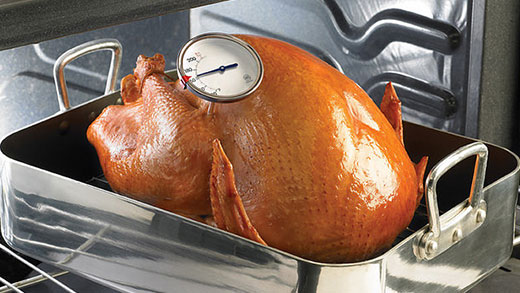
A food thermometer is the best way to make sure a turkey is cooked properly.
Turkey Talk: Picking the right bird and keeping holiday foods safe
K-State food safety specialist shares tips for enjoyable meals
November 18, 2019
MANHATTAN, Kan. – Cooking a turkey can be daunting enough, but Kansas State University food safety specialist Karen Blakeslee says that everything leading up to the bird going into the oven needs some thought, too.
For starters, how big of a turkey should you buy?
“Start with how many people you’re having over for dinner,” said Blakeslee, who is also coordinator of K-State’s Rapid Response Center. “If you’re going to buy a whole turkey, you need to figure about a pound per person. If you’ve got 15 people coming, you need a 15 pound turkey. If you want to have leftovers, then buy something bigger.”
If the turkey is especially large, consider whether your oven is big enough to fit the cooking pan, she adds.
“If you’re expecting 20-25 people, you’re going to need a very large turkey,” she said. “It may be better to buy two smaller turkeys, in which case you would still cook it like it was just one turkey in the oven.” Another option, she said, is to cook one turkey ahead of time and the other turkey on the day of dinner.
If buying a fresh turkey, Blakeslee suggests ordering that as soon as possible, “because your butcher shop is going to need to know what you need and when.” Fresh turkeys should be picked up one to two days before they are needed.
Most people, however, choose frozen turkeys at the grocery store, which will need to be thawed before cooking.
“The easiest way to thaw a turkey is to put it in the refrigerator,” Blakeslee said. “Put it on a cookie sheet or a large pan so that as it thaws and starts to drip, the pan will catch the drips.
“It usually takes 24 hours of thawing for every 4-5 pounds of turkey, but I would say it takes a bit longer. So if you have a 12 to 16 pound turkey, it’s going to take at least four days; I would add a couple extra days just to be sure it thaws.”
The turkey can also be thawed in a sink or large vessel using cold water. Blakeslee said to change the water every 30 minutes until the turkey is thawed. It could take as long as 10 hours, depending on the size of the turkey.
“You could cook it from the frozen state, but it’s going to take a lot longer,” she said. “This is a last resort and I don’t recommend doing that.”
A microwave could be used to thaw a turkey, but most are normally not large enough to hold a whole turkey. Blakeslee says it is never appropriate to let the turkey thaw on a kitchen counter.
“If you set it on the counter or put it in the sink and do nothing to it, the outside of that turkey warms up faster than the inside,” she said. “That temperature change can allow bacteria to grow. If bacteria is allowed to grow and multiply, it can get to the point where there is so much bacteria that cooking is not going to kill it all.
“Be smart about this, and take care of handling your turkey safely when you’re thawing it.”
Blakeslee shared additional tips for holiday meals:
- Make a plan for cooking side dishes. “I always think the oven needs to be reserved for the turkey,” she said. Some dishes can be cooked on a stovetop, in a slow cooker, or other appliance. Rolls, pies and other foods can be made in advance. Sometimes, guests are willing to bring a side dish.
- Use a food thermometer. The turkey should be cooked to an internal temperature of 165 degrees F. Don’t rely on a pop-up thermometer, which often is inserted only about 1 ½ to 2 inches. Blakeslee suggests testing for doneness in multiple spots, such as where the turkey leg meets the thigh, or perhaps in the breast area.
- Let it sit. Once the turkey is done, let it rest, covered, for at least 20 minutes. “The juice will redistribute throughout the turkey and you’ll have juicier meat,” Blakeslee said.
- Keep the meal simple. “There’s nothing wrong with using paper plates,” Blakeslee said. “The main purpose of Thanksgiving is sharing a meal together.”
- Store leftovers promptly. “It’s a good idea to refrigerate leftovers within two hours, which helps to prevent any potential bacteria from growing, and lowers the chance of foodborne illness,” Blakeslee said. Consider buying small containers to divide leftovers, or make ‘meal kits’ for an easy dinner. Leftovers should be used within 1-2 days after the original meal; otherwise freeze all leftovers. Reheat leftovers to 165 degrees F.
- Save the turkey bones. Blakeslee said she likes to put the bones in a pot and cook them with water to make broth. “That’s another way to get a little extra out of that whole turkey carcass,” she said. “Then, you can make soup. That’s one of my favorite things.”
For more tips, visit the K-State Research and Extension food safety website.