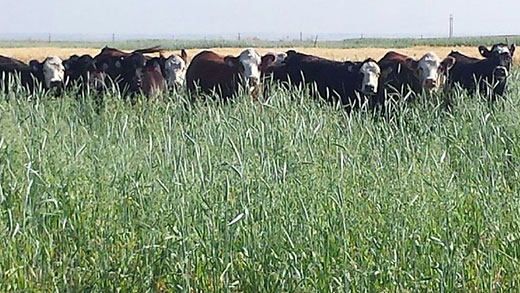
The 2019 Winter Forage Conference is set for Dec. 10 in Wichita, Kansas. | Download this photo.
Program to highlight extending the grazing season with cover crops and crop residues
Conference planned at Sedgwick County Extension Education Center
December 4, 2019
MANHATTAN, Kan. – How to best incorporate cover crops and crop residues into your forage program to extend the grazing season and lower costs, will be a focus at the upcoming Winter Forage Conference, Tuesday, Dec. 10, at the Sedgwick County Extension Education Center, 7001 W. 21st Street N., Wichita, Kansas 67205. Registration begins at 8:30 a.m. and the conference will run from 9:00 a.m. to 3:00 p.m., featuring multiple speakers, forage topics, and the Kansas Forage and Grassland Council Annual Meeting during the lunch hour.
“Extending the Grazing Season Using Cover Crops and Crop Residues,” will be presented by Jaymelynn Farney, southeast area beef specialist with K-State Research and Extension.
“In these tougher financial times, we’re seeing a lot of interest from Kansas cattlemen in extending the grazing season,” said Dale Helwig, Cherokee County extension agent. “Dr. Farney has great insights on how to do that and also incorporate the soil-enhancing benefits of cover crops.”
Each year, the Kansas Forage and Grassland Council (KSFGC) and Kansas State University team up to hold the Winter Forage Conference and KSFGC Annual Meeting. Other presentations will include, “Using Alfalfa in the Cattle Industry,” by Justin Waggoner, Southwest Area extension beef specialist, and an “Update on Old World Bluestem,” by Walt Fick, K-State agronomy professor.
A highlight of the conference and dovetailing with Farney’s presentation, will be a producer panel discussing "Grazing Techniques to Reduce Hay Cost.”
“Our presenters are some of the leading experts in Kansas, but it’s always great to hear from growers and grazers, on how they’re making things work on the farm or ranch,” said Roger Black, KSFGC president.
Conference registration is $60 per farm (plus $15 for each additional farm member), which includes the noon meal, access to the new KSFGC Newsletter, subscriptions to both Progressive Forage Grower and Hay & Forage Magazines, along with membership to KSFGC, the American Forage and Grassland Council, and the National Alfalfa and Forage Alliance. Admission is free for those who have renewed their KSFGC membership for 2020. Caps provided by the Sedgwick County Farm Bureau will be available to the first 48 through the door that morning.
Farmers and ranchers can register online, plus join the KSFGC along with the opportunity to pay the additional $15/person to assist with meal costs. Participants may pay at the conference but are asked to contact either Sedgwick County Extension at (316) 660-0153 or jseiler4@ksu.edu or Cherokee County Extension at (620) 429-3849 or dhelwig@ksu.edu by Tuesday, Dec. 3 to assist with planning and meal counts. However, walk-ins on Dec. 10 will be welcome. Contact Mark Nelson at Mark@ksfgc.org with questions or if interested in being a sponsor or vendor at the conference.
The Kansas Forage and Grassland Council serves as an umbrella organization providing education and programs to strengthen the forage industry in Kansas. Member dues support educational meetings, such as this conference, along with other forage initiatives such as the FFA Forage Proficiency Award, the State Fair Market Alfalfa Show and support for the KSU Forage Judging Team.