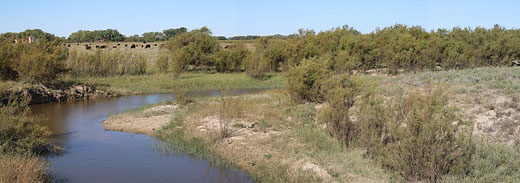
Tamarisk competes with native vegetation reducing available forage for livestock and reducing water quality.| Download this photo.
Reclaim your Ground from Invasive Trees
March 19 workshop aims to help landowners improve livestock forage, water quality and wildlife habitat
February 17, 2020
MANHATTAN, Kan. – Landowners and managers in southwest Kansas are invited to a free workshop and field demonstration focused on the management and removal of tamarisk, also known as saltcedar.
The workshop is Thursday, March 19, from 8:30 a.m. to 4:30 p.m. at the Hamilton County Fairgrounds Community Building, 806 S. Main, in Syracuse. Morning sessions are followed by a field site visit to the Cottonwood Flats Wildlife Area, approximately 17 miles west of Syracuse, for demonstrations on how to remove tamarisk.
“This is a great opportunity to hear from experts’ best thinking on control of tamarisk and other invasive plants,” said Bob Atchison, rural forestry program coordinator with the Kansas Forest Service.
Tamarisk was originally used in the state for windbreaks, erosion control, ornamentals and wildlife plantings. While it proved to be a hardy plant in the tough conditions of Kansas, land managers soon discovered that the tree spread quickly and is difficult to remove.
The invasive tree outcompetes and displaces native plants that benefit livestock forage and wildlife habitat. Additionally, tamarisk reduces soil moisture, groundwater and stream flows in areas where water is a precious resource.
The workshop will feature experts on land management and invasive removal from the Kansas Forest Service, U.S. Fish and Wildlife Service, Ducks Unlimited, Natural Resource Conservation Service, Farm Service Agency, Kansas Department of Wildlife, Parks and Tourism, Playa Lakes Joint Venture and the Kansas Department of Agriculture.
Agenda topics include:
- Saltcedar and Tamarisk and damaging effects on soil health, water quality and wildlife habitat
- Invasive tree control in Central Kansas to benefit springs, streams and wetlands.
- Quail and deer habitat issues associated with Saltcedar/Tamarisk.
- Range land quality issues associated with Saltcedar/Tamarisk.
- Benefits and use of biochar
Registration for the free workshop is requested. Registration is available online, or by calling Deb Baker at 785-979-4248. Lunch is provided by First National Bank of Syracuse.
###
About the Kansas Forest Service
The Kansas Forest Service is the nation’s fifth oldest state forestry agency. The agency serves rural landowners, communities, rural fire districts, forest and arboriculture industries, and citizens of the state through its Conservation Tree and Shrub Planting, Fire Management, Community Forestry, Rural Forestry, Marketing and Utilization, and Forest Health programs. The Kansas Forest Service state office is located in Manhattan, Kansas, just west of the campus of Kansas State University. The Kansas Forest Service is housed as an independent agency within K-State Research and Extension. The agency receives its direction from a mission statement that reads: “Care of natural resources and service to people through forestry.”