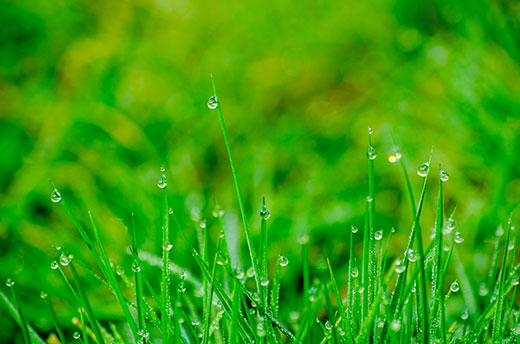
K-State researchers have determined best practices for irrigating home lawns during periods of drought or when cities impose water restrictions.
K-State researchers study water needs of tall fescue, Kentucky bluegrass
Their findings could help determine best practices for maintaining Kansas lawns during drought
June 22, 2020
MANHATTAN, Kan. – Kansas State University researchers have completed a study that could help determine the best practices for irrigating home lawns during periods of drought or when cities or other agencies impose water restrictions.
Their work took an extensive look at two of Kansas’ most popular types of grasses, tall fescue and Kentucky bluegrass, to determine how each could survive during periods of extended drought. They tested each species for two consecutive growing seasons.
“Our research indicated that even when exposed to severe drought in the first summer after fall sodding, tall fescue recovered well after an 83-day drought with negligible water,” said Dale Bremer, a professor of turfgrass science in the Department of Horticulture and Natural Resources.
In fact, even after 30-39 days of receiving no water, tall fescue “maintained minimally acceptable performance, and recovered after 60-83 dry days in both years,” added Mu Hong, a doctoral student in the department.
Their findings are likely to put tall fescue in even greater favor in Kansas. It’s already a popular species for the state, especially in areas where soils are deep. Tall fescue is known to grow in bunches and is appropriate for lawns with shady areas.
The outlook for Kentucky bluegrass during prolonged drought in the first summer after fall sodding is not as good.
“If a homeowner lives in a semi-arid climate, such as central and western Kansas where drought and water restrictions are more likely, sodding Kentucky bluegrass may not be the best option,” Bremer said.
Kentucky bluegrass that was sodded in the fall did not survive prolonged drought in either of the following summers when it was tested. In one test, the researchers provided 50% of the recommended water needed to maintain good visual quality, but Kentucky bluegrass still failed to recover.
In a previous study, K-State researchers determined that fall seeding of Kentucky bluegrass results in good drought tolerance in the following summer. Bremer said that because sodding is much more expensive than seeding, homeowners who prefer the slower-growing Kentucky bluegrass may instead choose to establish their lawn by seeding it in the fall.
“We have initiated a new study to investigate methods that hopefully will ensure the survival of sodded Kentucky bluegrass during severe drought in the first summer,” Bremer said. “This includes testing different watering amounts, frequencies of irrigation and drought durations that could affect its survivability.”
Hong noted that the K-State researchers’ work is significant because city water restrictions are rarely science-based. By understanding the minimum irrigation requirements for popular Kansas turfgrasses, city planners and homeowners can make appropriate adjustments to preserve lawns while saving money and water.
“For instance,” Hong said, “when we irrigated tall fescue at 50% of its estimated water needs, it maintained minimal acceptable quality 15 to 43 days longer than if we provided no water, and it recovered about 18 days faster.
“Furthermore, watering at 50% of its estimated needs reduced water inputs by 38% compared to watering at 80% of the need, which is usually what is recommended for well-watered cool-season grasses such as tall fescue and Kentucky bluegrass. This translates to saving about 3.8 inches of water during the two summer months.”
The current study did not look at other turfgrass species such as bermuda, zoysia or buffalo grass, which are more common in some southern and western parts of Kansas. The researchers did conduct a companion study on the minimal water requirements of zoysiagrass during drought, which will be published this summer in a report from the Kansas Agricultural Experiment Station.
The researchers will publish their findings on tall fescue and Kentucky bluegrass in the journal, Crop Science, which is expected to be out in 2021.