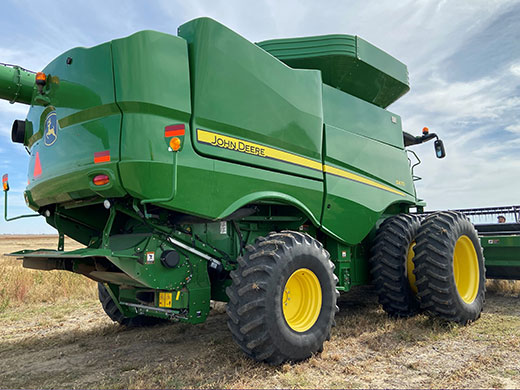
A roller cage mill, shown attached to the back of a John Deere S Series combine, is being tested for its ability to crush weed seeds. | Download this photo.
Summer break: K-State grad student advances weed destruction technology
Study may help farmers apply fewer chemicals, make more money
Aug. 21, 2023
By Shelby Spreier, K-State Research and Extension news service
MANHATTAN, Kan. – Soon it will be back to school, but oh what a summer it has been for Alec Adam.
Adam, a graduate student in Kansas State University’s Department of Agronomy, has spent his break studying site-specific spraying and weed seed destruction, a project he says will help farmers use fewer chemicals on cropland and – ultimately – make more money.
His project focuses on analyzing a commercial ‘See & Spray’ system and harvest weed seed destruction using a seed destructor, which is a cage mill that is mounted to the back of a combine. The research, Adam says, is done on farmer-owned fields in Moundridge and Garden City.
“We're basically looking at the viability of the weed seed (and) answering the question of how well does this cage mill destroy the weed seeds,” Adam said.
The project also takes a look at what happens to the machine’s components, such as whether the cage mill slows the combine and if it adds wear to the machinery.
“There are multiple parts that play into more of an economic piece for the farmers,” he said.
Adam grew up on a farm in northeast Missouri, primarily producing corn and soybeans. His interest in technology sparked while working on his family farm.
“I kind of fell in love with the technology piece, looking at how new technology can really propel (small) farmers, and how well we can manage our ground with this technology,” Adam said.
Adam notes that ‘See & Spray’ systems may also have a positive impact on smaller scale farmers.
“Being able to target weeds in a field and spray only emerged weeds can drastically reduce the use of herbicides across the board,” he said. “It's cheaper for farmers and safer for the environment. It puts less risk and exposure on pets, family members and farmers themselves. Being able to take some of that risk out is huge.”
‘See & Spray’ systems may also help speed up the time spent on chemical applications.
“It's a more accurate and precise targeting of weeds,” Adam said. “Ultimately, that's money back in Kansas farmers’ pockets and that's more time for a lot of people to continue advancing their own farm and their future.”
Other researchers have studied the viability of seed destruction and spot spraying, but Adam said there is little research combining the two approaches or assessing the economics. Sarah Lancaster, a weed science specialist with K-State Research and Extension, calls Adam’s project, “a unique approach.”
“There are scientists evaluating weed seed destructors, but not a lot of them have good data over time in different cropping systems,” she said. “And not a lot of them have done a thorough analysis of efficiency and economics for the farmer.”
“I think it's a neat opportunity for Alec to help us move technology forward and to answer the questions that farmers are asking about the different technologies and how to use them.”
Adam started his research in January, 2023 and expects to finish by December, 2024. To help fund some of his research, Adam received a grant from the North Central Sustainable Agriculture Research and Education (SARE).
“As an advisor it's a cool thing for me to see a brand-new master's student come in and have a good enough grasp on his project to receive this kind of grant,” Lancaster said.