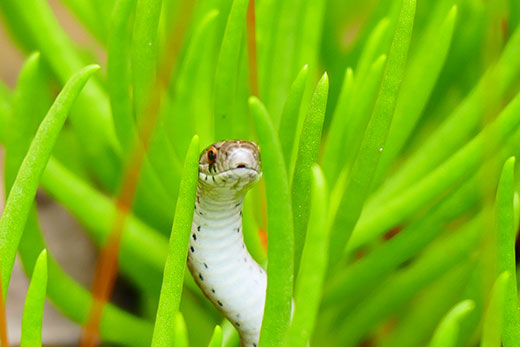
Most snakes help to manage mice and rats, and are generally beneficial to an ecosystem, says K-State fisheries and aquatics specialist Joe Gerken.
K-State expert makes case for snakes
Gerken says many snakes help to improve an ecosystem
Aug. 4, 2023
By Bailee Farmer, K-State Research and Extension news service
MANHATTAN, Kan. -- Snakes often get a bad rap around home properties, perhaps because of their sharp fangs and their scaly bodies, but a Kansas State University expert says snakes aren't always as mischievous as we think.
In fact, K-State fisheries and aquatics extension specialist Joe Gerken said snakes help the environment and are beneficial to the ecosystem.
Most snakes, he said, help manage animals such as mice and rats, which eat plant seeds in abundance.. He said that when rodent populations get out of control, a lack of seeds may impact plant growth and the surrounding environment.
Snakes also help to manage fish. People often worry that snakes will eat all of the fish in a pond, but Gerken said that's not always the case.
“Most of the fish that they are eating are sick, diseased, dying or recently dead, so you're not going to have a problem with fish that you want to keep,” he said
Listen to an interview by Shelby Varner with Joe Gerken on the weekday radio podcast, Agriculture Today
Gerken cited research indicating that snakes living in or around ponds and other bodies of water increase fish growth rates. He said the increase in growth rate relates to snakes preventing over-populations.
“If you have too many mouths to feed in your pond, and not enough food, the fish will stay small. If we get some of those fish out, whether it's by fishing or having snakes, that helps the growth rate of our fish,” Gerken said.
According to Gerken, snakes can also benefit ecosystems by feeding other wildlife such as hawks and owls, and he advises not to kill snakes for this reason.
“There is a lot of benefits when (the snake) is dead, but let’s keep the killing of the snakes to the owls and wildlife and learn to live with them,” he said.
Gerken acknowledged that snakes can be intimidating, but there are ways to keep them at distance.
“They're going to be more scared of you than you are of them,” he said. “So there's definitely benefits of having them there, but doing things like keeping your grass mowed down, cleaning up rock piles or log piles, especially around your pond will keep snakes away,” he said.
More information on managing wildlife is available online from K-State’s Department of Horticulture and Natural Resources.