
Commerce Launches New Chapter of Kansas Community Empowerment Program
Released July 3, 2025
TOPEKA – Lieutenant Governor and Secretary of Commerce David Toland today announced the Kansas Department of Commerce has assumed the administration of the Kansas Community Empowerment (KCE) program as of July 1. Previously administered by K-State Research and Extension, the program is a long-standing cornerstone of Kansas’ community development efforts.
“Bringing Kansas Community Empowerment to Commerce strengthens our commitment to volunteer-led community development, revitalization and long-term investment in communities,” Lieutenant Governor and Secretary of Commerce David Toland said. “This transition ensures the program continues to flourish while streamlining partnerships that empower local leaders and sustain vibrant, resilient communities.”
The transition highlights Commerce’s core commitment to promote and work alongside communities to inspire growth and preserve local identity.
“Over the years, the Kansas Department of Commerce has been a strong partner in the development and delivery of the Kansas Community Empowerment program across the state,” Assistant Vice President and Director for Extension at Kansas State University Gregg Hadley said, “and we look forward to seeing the results of their work in the future.”
The program will be housed within the Quality Places Division (QPD), home to several other critical rural initiatives, including the Office of Rural Prosperity, Office of Broadband Development, Kansas Main Street and Community Development Block Grants. QPD also works on issues related to housing, placemaking and childcare. By integrating KCE into this ecosystem, the agency aims to accelerate community momentum across the state.
“The transition is more than continuing an existing program. It’s about building on the decades of hard work and expanding the efforts of the program to create great impacts across the state,” Assistant Secretary of Quality Places Matthew Godinez said. “We are honored to carry on this legacy, and we look forward to partnering with communities to help them achieve their visions and goals.”
This new phase will involve a community certification process, providing a clear pathway for communities to set strategic goals, demonstrate progress and increase their eligibility for funding and investments. Certified communities will be recognized as leaders in local development and receive enhanced access to grant opportunities. Communities will receive additional points on applicable Commerce grants, helping amplify local efforts with state-level support.
KCE communities can also expect a dynamic slate of engagement opportunities, including an annual statewide summit to bring together local leaders from across Kansas to network, learn and share success stories. Opportunities for training and leadership development will support capacity-building at the local level, assisting communities in moving from vision to reality. Additional resources and training opportunities will be announced over the coming months.
For more information about the Kansas Community Empowerment program and how to get involved, visit the webpage here or contact Sara Bloom at Sara.Bloom@ks.gov or (785) 506-9278.
Board Excellence Newsletter, July 2025
- From the Director for Extension: Change in our reporting structure is our opportunity to grow.
- Regional Director Search Updates.
- Kansas Community Empowerment Program Transition.
- K-State Increases Appropriation to Local Units.
- Risk Management at County Fairs.
- Recruiting Board and PDC Members.
- Save the Date: August 14 at noon.

From the Director for Extension:
Change in our reporting structure is our opportunity to grow
During the June 6 Extension Update, we announced that the budgetary authority of the state’s extension service would transition to Marshall Stewart, executive vice president for External Engagement and chief of staff for President Richard Linton. Previously, budgetary authority was with the dean of the College of Agriculture. This change was effective July 1.
With this announcement, K-State Extension now reports to the Office of External Engagement. Assistant Vice President and Director for Extension Gregg Hadley now reports directly to Dr. Stewart.
This is in alignment with the promises we’ve made of elevating extension in Kansas, and elevating extension and engagement at the university. Based on a needs assessment of Kansas residents, we believe we can better address the needs of the state by having extension at the university level. This will allow us to pool resources across all K-State colleges and use them to address critical issues reported by the state’s residents.
Combining the university’s engagement office and extension is foundational in K-State’s efforts to positively impact Kansans’ lives with programming and education to help our communities thrive.
There are many examples that highlight the value of elevating extension work to the university level. Two that I can think of off-hand are housing and behavioral health. Extension has some expertise and provides support in both areas, but we can provide even greater service by involving other campus departments and programs.
This transition does not change job responsibilities for extension faculty and staff; instead, it adds campus resources to their efforts. Extension professionals will continue to do the work the Kansas Cooperative Extension Service has done throughout its entire history.
Extension employees and units have always served Kansans’ needs. This may be most evident in agriculture, but we serve the public through many channels. We will continue to do so. This announcement is about a reporting change at the university level—not a service or focus area change.
I believe that this change in organizational structure fully acknowledges the potential of extension and what extension can do in Kansas. It’s a great opportunity to be able to offer more services throughout our 105 offices. I am excited to see how we will grow in the years to come.
More information about this transition can be found on the Elevating Our Engagement webpage.
 Regional Director Search Updates:
Brantley accepts south region extension director role
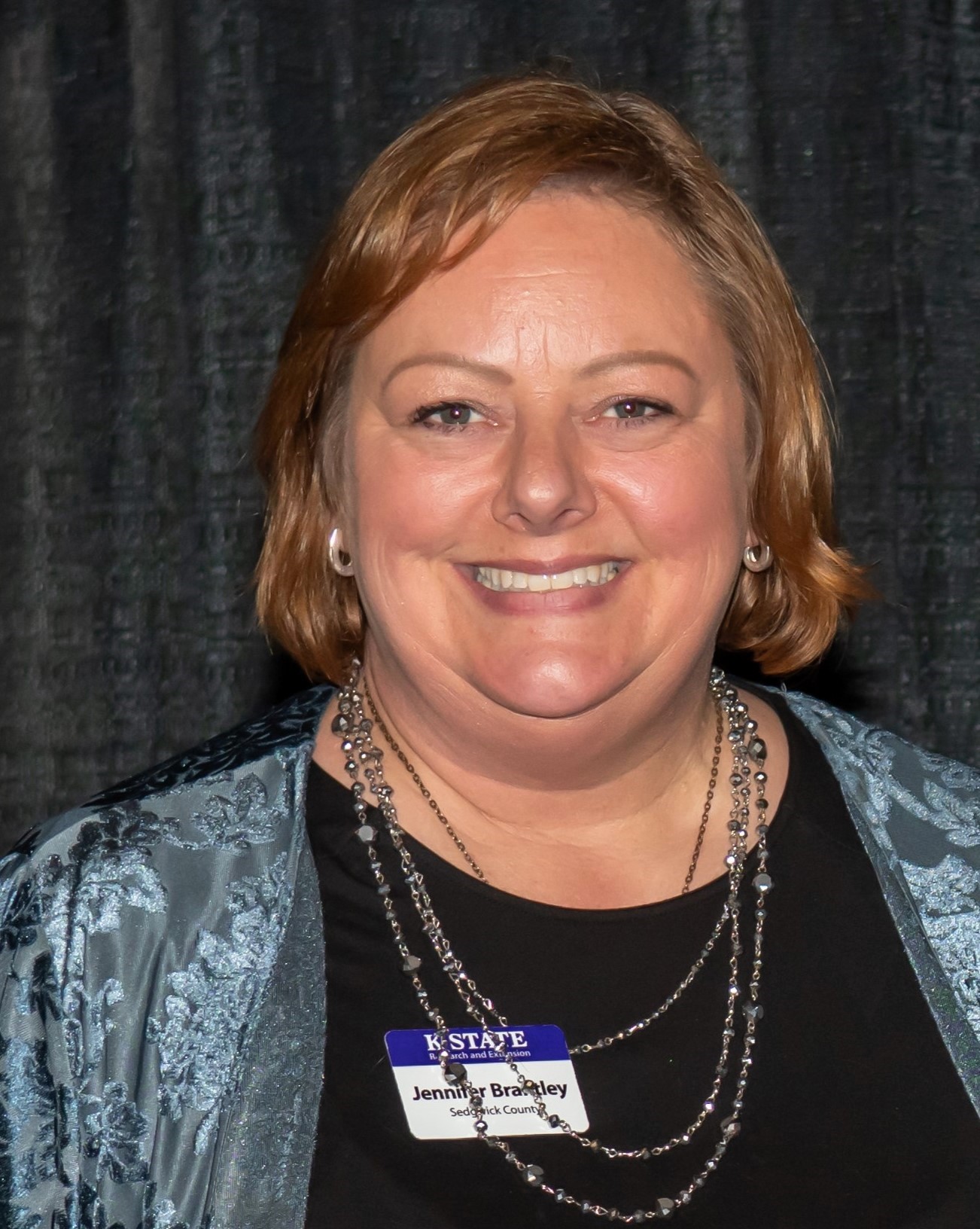
Dr. Jennifer Brantley will begin her new duties as south region director at the beginning of August. She currently serves as the local unit extension director for Sedgwick County, where she has been since January 2019.
In 2024, Brantley and her team were recognized as K-State Extension’s Outstanding Local Unit. This was a significant accomplishment for the largest-staffed local unit in the state.
Brantley has additional valuable leadership experience with the Envision Foundation as its public education and outreach manager, as the assistant director of the Standardized Patient Center at KU School of Medicine–Wichita, and as the assistant director of employer relations for Kansas State University’s Career and Employment Services. Prior to that, she was a middle school teacher and worked as a biomedical technician.
Brantley has developed multiple organizational partnerships over the years, resulting in recognition awards like the 2024 Outstanding Local Unit award for Sedgwick County and being a Wichita Business Journal Women in Business Awardee and Health Care Hero Awardee for community outreach. Additionally, she has been recognized through the Wichita Health Alliance for her contributions.
We are excited for Brantley to join the field operations team, where she will work with agents, specialists and administration. Her diverse set of skills and experiences will benefit the overall K-State Extension system.
I’m sure she would appreciate a welcoming message, so please reach out to her if you have a minute. You can reach Brantley at brantley@ksu.edu.
North region director delay
The search for a north region director will be suspended for a couple of months, after which the committee will resume the search to fill that position.
Kansas Community Empowerment Program Transition
At the beginning of July, the Kansas Department of Commerce announced that it assumed administration of Kansas Community Empowerment (KCE). KCE was previously administered by K-State Research and Extension since 1970.
Since its founding, the Kansas Department of Economic Development, and then Commerce, played a key role in governing KCE. They have always been a close and trusted partner and when this transition was discussed, doing so in 2025 made sense.
We want to thank Jaime Menon and Jan Steen for their tireless efforts over the years on behalf of KCE and Kansans. Because of their work and many others, Commerce recognizes that KCE can be an ongoing cornerstone of their statewide community development efforts for years to come.
For more information, please refer to the press release from Commerce below.

K-State Increases Appropriation to Local Units
K-State Extension administration is pleased to announce a 2.6% increase to the state’s salary contribution rates for local units.
For the first two positions in each county (or corresponding number of counties in a district), the value of the state’s contribution has increased to $20,280.
Additional positions appropriated to local units will receive $12,532 per agent.
Agent positions that are fully funded by the local unit will continue to receive $1,500 per agent.
The new contribution rates begin in July 2025, so the funds will accumulate in local units' accounts until raises are given, normally in the next calendar year. These figures can be used to build 2026 budgets.
Contact Chris Onstad, associate director for extension field operations, with questions.
 Risk Management at County Fairs
Risk management is important in all activities. Each of us has an obligation to protect our clients from unreasonable risks. Discussing risk management ahead of time helps us affirm that events are being conducted in the safest manner possible.
A risk management plan ensures that the risks have been identified and evaluated, and that a plan is in place to mitigate them. When incidents do occur, a good plan can help minimize their impact.
Does your team have a risk management plan for your county fair and, if so, do you know the plan?
Having a risk management discussion prior to the fair is an excellent idea. All extension staff, board members, and fair board members should understand the plan and all be on the same page.
 Recruiting Board and PDC Members
Building a good board is about more than just filling slots. It is about finding leaders who have skill sets and perspectives that align with our organization’s mission.
Now is a great time to think about potential turnover on your board and program development committees and who might be qualified to fill those slots. An important factor in the sustainability and efficiency of your local unit is getting highly qualified and enthusiastic volunteers to serve on the board and program development committees (PDC).
Overwhelmingly, people want to serve on boards of organizations that make a difference. Identifying the right leaders to serve is essential for success.
The Recruiting Board and PDC Members module is a great tool to help your board explore characteristics of high-quality board members and where you might find them in your community. When boards and PDCs are representative of the community, they are more likely to offer and design extension programs that meet the needs of all community members. Having boards and PDCs that reflect the demographics of the local community is a vital part of civil rights compliance.
As you recruit new members, be clear about the role of the board and what the expectations of being a board member are. Refer to the Extension Board Member Position Description (PDF), which provides a comprehensive set of expectations, qualifications and time commitment necessary for the position.