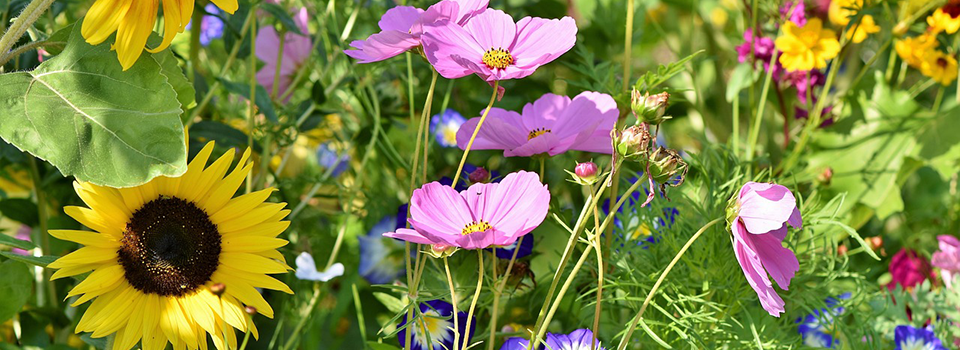
Wildlfowers are a good option for brightening up home landscapes, says K-State horticulture expert Cynthia Domenghini.
Wildflowers bring bursts of color to home landscapes
K-State horticulture expert suggests planting a blend of grasses and wildflowers
At a glance: Prairie flowers can add eye appeal around homeowner's yards. K-State horticulture expert Cynthia Domenghini says flowers should be seeded between April 1 and May 15.
More information: Cynthia Domenghini, Cdom@ksu.edu
Related: K-State Horticulture Newsletter
March 18, 2024
K-State Research and Extension news service
MANHATTAN, Kan. – Wildflowers offer variety and color to a home landscape. In addition to eye appeal, they can survive in soils containing a wide range of chemistry pH and with varying numbers of sunny days, adding variety to garden areas.
To establish a wildflower area, Kansas State University horticulture expert Cynthia Domenghini recommends using a regional seed blend from Sharp Brothers, Stock Seed or Wildseed Farms.
“It is better to choose a blend of grasses and wildflowers rather than a single species,” Domenghini said.
When building a wildflower area, first remove existing vegetation to help wildflowers take root and grow.
Domenghini recommends:
- Control perennial weeds by using a product containing glyphosate.
- Before planting, adjust pH and fertilize according to results of a soil test.
- Eradicate weeds. This can be done through cultivation, occultation or chemical methods, if necessary.
- The seedbed should be firm so that the boot heel sinks in no more than ½ inch. The goal is good seed/soil contact.
- Mix seed with damp sand (4:1 sand/seed) for more uniform coverage with a drop seeder or whirlybird spreader.
- Rake seed in about ¼ inch deep. It is best if the seedbed is firmed up by using a roller or driving over the area with a riding lawn mower. Don’t mulch.
- Keep seed moist while the seed is germinating (3-4 times per week, if possible). Slowly back off watering as plants develop.
“Warm-season grasses and most prairie flowers should be seeded between April 1 and May 15,” Domenghini said. “During the first year of establishment, regularly monitor and control the weed re-growth.”
Seeds will germinate best when the soil temperature is at least 60 degrees F, Domenghini said. Soil thermometers are available in most garden centers, hardware stores and auto stores.
“Hand weeding can help but must be done with care to avoid uprooting small prairie flowers. Mow as high as possible to help control fast growing weeds while preserving most of the foliage on the prairie flower,” Domenghini said.
Domenghini and her colleagues in K-State's Department of Horticulture and Natural Resources produce a weekly Horticulture Newsletter with tips for maintaining home landscapes and gardens. The newsletter is available to view online or can be delivered by email each week.
Interested persons can also send their garden and yard-related questions to Domenghini at cdom@ksu.edu, or contact your local K-State Research and Extension office.
***

K‑State Research and Extension is a short name for the Kansas State University Agricultural Experiment Station and Cooperative Extension Service, a program designed to generate and distribute useful knowledge for the well‑being of Kansans. Supported by county, state, federal and private funds, the program has county extension offices, experiment fields, area extension offices and regional research centers statewide. Its headquarters is on the K‑State campus in Manhattan. For more information, visit www.ksre.ksu.edu. K-State Research and Extension is an equal opportunity provider and employer.