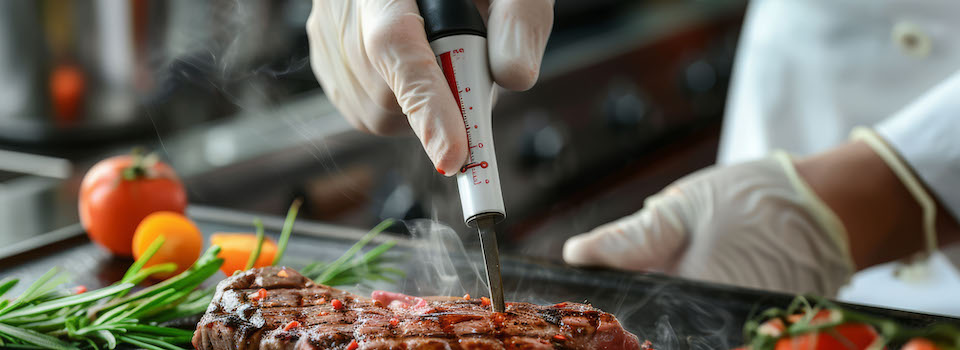
Food Safety Education Month: Food thermometers are a kitchen must-have
K-State food scientist urges consumers to buy – or update – their food thermometer
At a glance: K-State food scientist Karen Blakeslee reminds at-home chefs that food thermometers are essential for maintaining the safety of the people eating their meals.
More information: Karen Blakeslee, 785-532-1673, kblakesl@ksu.edu
Related: The Food Safety Zone
Released Aug. 28, 2024
K-State Research and Extension news service
MANHATTAN, Kan. – Where food safety is concerned, a food thermometer is kind of like the swiss army knife. It’s a must-have, multi-use tool in the kitchen.
“It is one of the most important tools consumers can use to know when food is cooked properly for safe consumption,” said Kansas State University food scientist Karen Blakeslee. “It’s useful for meat items, casseroles and even baked goods. Using a subjective method – such as ground meat color – can be misleading and lead to foodborne illness.
“Also, it can help with (assuring) the quality of a food item and reduce over-cooking.”
Blakeslee is urging consumers to buy a food thermometer – or calibrate their current thermometer – during Food Safety Education Month in September. The month is recognized in the United States to promote safe food handling and educate consumers about ways to prevent foodborne illness.
For consumers who need to buy a food thermometer, Blakeslee recommends the digital type.
“Digital food thermometers read the temperature at the tip of the temperature probe,” Blakeslee said. “They also read temperature quickly, and come in a simple handheld design or with other features, such as the ability to insert the probe into the food and leave it in during cooking. You can set the thermometer to indicate when the final temperature has been reached.”
Some digital thermometers can even connect to a mobile device. More information about the types of food thermometers available is available online from the U.S. Food Safety and Inspection Service.
Consumers who already own a food thermometer can calibrate them routinely to make sure they are still giving accurate readings.
“The best method is to calibrate your thermometer using ice water and boiling water to check cold and hot readings,” Blakeslee said. “Dial faced thermometers can be adjusted if needed. Digital thermometers should be replaced unless it came with instructions on how to adjust.”
A guide on adjusting food thermometers is available online here.
“Along with food thermometers, place an appliance thermometer inside your refrigerator and freezer to monitor temperatures in those appliances,” Blakeslee said. “These can be helpful during a power outage to determine the safety of your food. Another suggestion is an oven thermometer to know if your oven is heating properly.”
More information on appliance thermometers also is available online from the FSIS.
Blakeslee, who also is coordinator of K-State’s Rapid Response Center for food science, publishes a monthly newsletter called You Asked It! that provides numerous tips on being safe and healthy. More information is also available from local extension offices in Kansas.
***

K‑State Research and Extension is a short name for the Kansas State University Agricultural Experiment Station and Cooperative Extension Service, a program designed to generate and distribute useful knowledge for the well‑being of Kansans. Supported by county, state, federal and private funds, the program has county extension offices, experiment fields, area extension offices and regional research centers statewide. Its headquarters is on the K‑State campus in Manhattan. For more information, visit www.ksre.ksu.edu. K-State Research and Extension is an equal opportunity provider and employer.