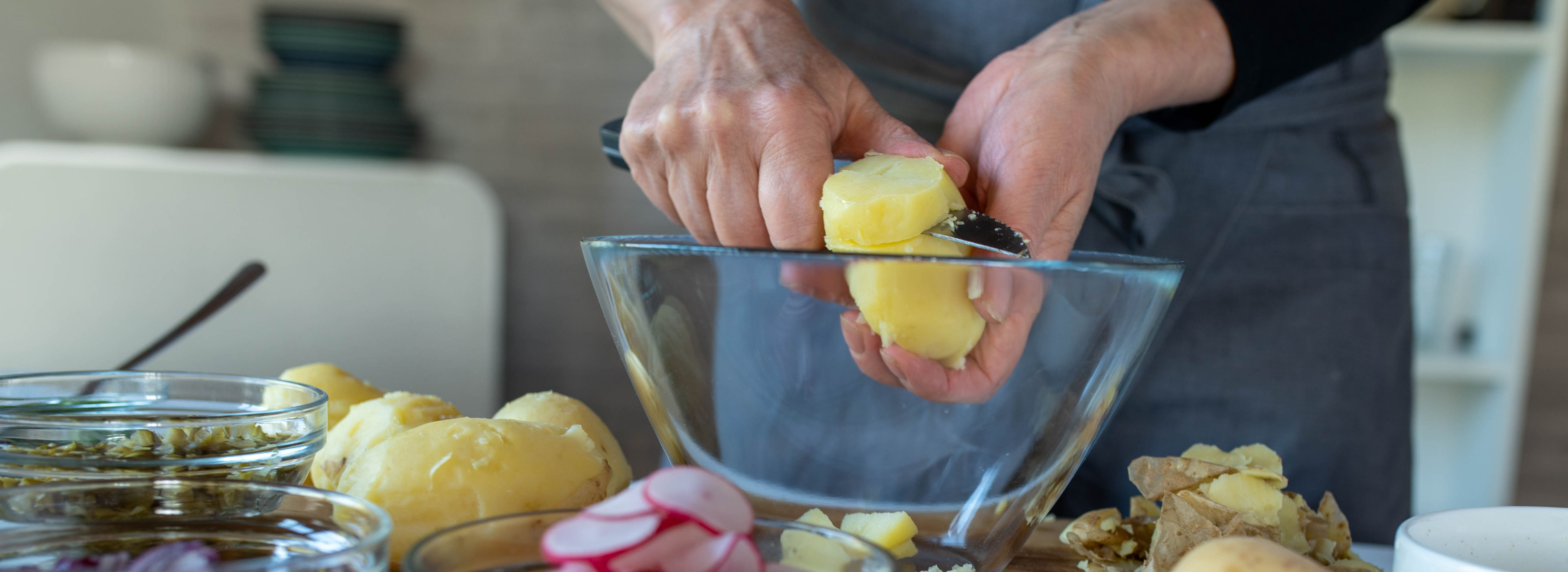
Cutting vegetables opens the cell structure to allow natural sugars and proteins to interact with heat, says K-State food scientist Karen Blakeslee.
Vegetable prep affects flavor, texture
K-State’s Blakeslee explains science behind food preparation
At a glance: K-State food scientist Karen Blakeslee explains how cutting vegetables before roasting or baking can enhance flavor and improve eating experience.
More information: Karen Blakeslee, 785-532-1673, kblakesl@ksu.edu
Related: Mix and Match Your Fruits and Veggies
Sept. 16, 2024
K-State Research and Extension news service
MANHATTAN, Kan. – A potato is a potato is a potato…right?
Maybe not, says Kansas State University food scientist Karen Blakeslee.
“If you taste a whole vegetable, such as a baked sweet potato, compared to slices of sweet potato that are baked, you’ll have two different foods,” said Blakeslee, who is also coordinator of the university’s Rapid Response Center for food science.
“Cutting the vegetable opens up the cell structure to allow the natural sugars and proteins to interact with the heat,” she said. “Taste the sweet potatoes side-by-side and you will pick up different flavor compounds.”
Cutting vegetables to roast or bake can “take flavor to another level,” according to Blakeslee, because of a concept known as the Maillard reaction.
“The Maillard reaction is a non-enzymatic reaction between amino acids (that make up proteins) and reducing sugars (such as glucose and fructose) in the presence of heat,” Blakeslee said.
“In some cases, it is a desirable reaction, such as browning meat or baked bread, or roasted coffee beans. But in other cases, it is detrimental – such as in dry milk powder if it is stored improperly. It’s not the same as caramelization, which is a thermal decomposition of certain sugars in food (such as making caramel candy).”
Vegetables can be tasty regardless of the way consumers prepare them, Blakeslee said; it’s just a matter of preference.
“Try different ways to prepare and cook vegetables,” she said. “From baking, roasting, sauteéing and more, the preparation can add a lot of variety to any meal.”
She adds: “Using different preparation methods can take a once-hated vegetable to a favorite vegetable.” For example, brussels sprouts taste very different when roasted, instead of steamed or boiled. Some find them much more pleasing to eat. Shred fresh brussels sprouts to use in a cole slaw instead of cabbage.
Blakeslee publishes a monthly newsletter called You Asked It! that provides numerous tips on being safe and healthy. More information is also available from local extension offices in Kansas.
# # #
Sidebar
Safe kitchen tips
Kansas State University food scientist Karen Blakeslee says cooking in the kitchen is a great learning experience for all ages. To avoid accidents, she has some reminders about safety in the kitchen:
- Stoves are hot. Turn pans with long handles away from other burners and from small helping hands.
- Because of a lot of hot, wet food and liquid, keep potholders dry, or use silicone rubber potholders for extra safety.
- While removing lids from hot pans and canners, tilt the lid away from your face so steam doesn’t burn your skin.
- Keep knives sharp for safest use.
- Keep a fire extinguisher in the kitchen in case of fire.
***

K‑State Research and Extension is a short name for the Kansas State University Agricultural Experiment Station and Cooperative Extension Service, a program designed to generate and distribute useful knowledge for the well‑being of Kansans. Supported by county, state, federal and private funds, the program has county extension offices, experiment fields, area extension offices and regional research centers statewide. Its headquarters is on the K‑State campus in Manhattan. For more information, visit www.ksre.ksu.edu. K-State Research and Extension is an equal opportunity provider and employer.