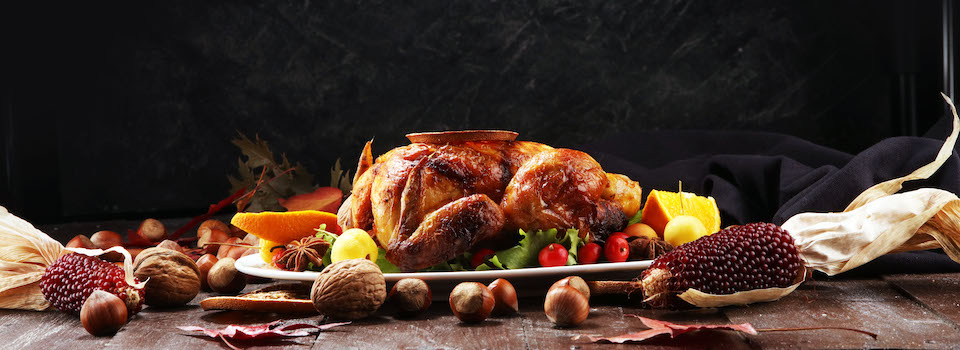
The turkey is usually the centerpiece of the Thanksgiving meal. K-State food scientist Karen Blakeslee says it's important to follow food safety steps to help ensure an enjoyable meal.
Preparing the Thanksgiving feast safely
K-State food scientist shares tips for turkey food safety
At a glance: K-State food scientist Karen Blakeslee says turkey should be cooked to a minimum internal temperature of 165 degrees Fahrenheit.
More information: Karen Blakeslee, 785-532-1673, kblakesl@k-state.edu
Related: K-State’s Rapid Response Center for Food Science
Nov. 13, 2024
K-State Research and Extension news service
MANHATTAN, Kan. – Nobody wants the gift of foodborne illness during the holidays. Kansas State University food scientist Karen Blakeslee says food safety begins with a decision on whether to purchase a fresh or frozen turkey.
“If you choose fresh, be sure to place an order with your grocer or butcher shop and pick it up 1-2 days before the meal, then store it in the refrigerator,” Blakeslee said. “Frozen turkeys can be purchased any time and stored in the freezer.”
Frozen turkeys are best thawed in the refrigerator or in cold water, Blakeslee adds. In the refrigerator, plan on at least 5-7 days for a 20-pound turkey. In cold water, allow about 30 minutes per pound of turkey. Make sure your refrigerator temperature is set between 35-38 degrees Fahrenheit.
“When cooking the turkey, remember that 325 F is the lowest oven temperature to safely cook turkey,” Blakeslee said. “Use a food thermometer to be sure it reaches a minimum internal temperature of 165 F.”
If you only have one oven, use a slow cooker for hot dishes. A tabletop roaster oven can be used like a regular oven for many items. Even electric pressure cookers can prepare dishes safely.
Two Turkeys, One Oven
When cooking two turkeys at the same time, make sure there is enough oven space for proper heat circulation. The cooking time is determined by the weight of one bird -- not the combined weight, Blakeslee said.
Use the weight of the smaller bird to determine cooking time. Use a food thermometer to check the internal temperature of the smaller bird first and then check the second bird. The internal temperature should be a minimum of 165 F.
“Check the internal temperature in the innermost part of the thigh and wing and the thickest part of the breast,” Blakeslee said.
Blakeslee, who also is coordinator of K-State’s Rapid Response Center for Food Science, publishes a monthly newsletter called You Asked It! that provides numerous tips on food safety.
More information is also available from local extension offices in Kansas.
***

K‑State Research and Extension is a short name for the Kansas State University Agricultural Experiment Station and Cooperative Extension Service, a program designed to generate and distribute useful knowledge for the well‑being of Kansans. Supported by county, state, federal and private funds, the program has county extension offices, experiment fields, area extension offices and regional research centers statewide. Its headquarters is on the K‑State campus in Manhattan. For more information, visit www.ksre.ksu.edu. K-State Research and Extension is an equal opportunity provider and employer.