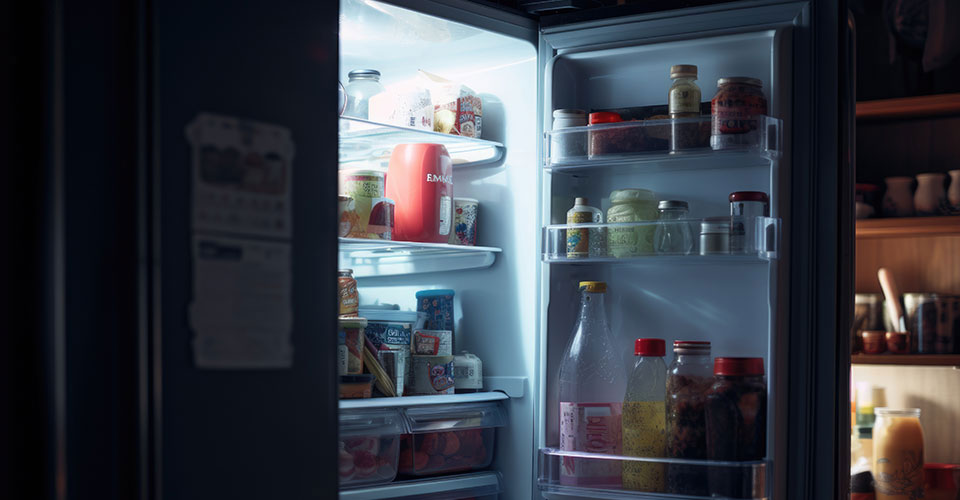
Keep a thermometer in the kitchen's refrigerator to monitor temperature before a power outage.
Power out? Here’s how to keep food safe
K-State's food safety expert gives guidelines on food storage during bad weather
At a glance: Keeping food safe during a power outage begins well before winter storms hit, Kansas State University food scientist Karen Blakeslee said, who shares tips on how to store food in an emergency.
More information: Karen Blakeslee, 785-532-1673, kblakesl@ksu.edu
Related: Food Safety During a Power Outage | K-State Rapid Response Center for Food Science | You Asked It! newsletter
Dec. 3, 2024
K-State Research and Extension news service
MANHATTAN, Kan. — Keeping food safe during a power outage begins well before winter storms hit, Kansas State University food scientist Karen Blakeslee said.
Before the power goes out, Blakeslee advised keeping an appliance thermometer in the refrigerator and freezer. According to guidelines from the U.S. Food and Drug Administration, the temperature inside the refrigerator should be 40 degrees Fahrenheit or lower, and the freezer at 0 F or below.
Blakeslee, who also is coordinator of K-State’s Rapid Response Center for food safety, said having a thermometer in place before the power goes out helps to assure the appliance temperature does not stray outside the recommended range.
It may also be a good idea to stock up on canned and non-perishable goods.
“Dried foods, such as fruit, jerky and crackers, are great for snacks,” Blakeslee said. “Keep foods that family members enjoy, but also healthful foods to provide nutrient-dense nourishment.”
Other options include high energy foods such as nut butter, snack bars or trail mix, ready-to-eat canned foods such as fruit, vegetables or meat, and food for infants, elderly persons or those with special diets.
Blakeslee suggests including a can opener, scissors or knife to open containers and other utensils to consume foods and store safely. “It is also a good idea to include bottled water for drinking and rehydrating any dried foods to consume,” she said.
Blakeslee recommends storing pantry foods in a cool, dry, dark location.
When power is first lost, leave the door of the refrigerator and freezer closed to preserve cold temperatures as long as possible. If the power stays out for a longer period of time and the refrigerator is not staying cold, Blakeslee has some additional ideas for protecting food.
“Coolers filled with ice are very helpful in an emergency,” she said. “Make sure ice surrounds the food for the best chilling effect.”
For food in the freezer, dry ice can be used if available – but thick gloves should always be worn when handling dry ice to prevent skin damage. Dry ice should then be kept in a ventilated area.
If the power outage is lengthy, you may not be able to avoid spoiled food. Some signs that may indicate foodborne bacteria include:
- Color changes.
- Unusual odors.
- Texture changes.
The most susceptible foods are meat, dairy, eggs and cut fruits and vegetables. Extra care should be taken when examining these food items.
“Don’t taste any questionable food that has thawed out,” Blakeslee said. “When in doubt, throw it out. Also, don’t feed pets or other animals spoiled food.”
If a power outage lasts more than four hours at temperatures greater than 40 F, refrigerated or frozen food kept without another cold source should be thrown out.
To help determine what foods can be saved or what should be tossed, see Food Safety During Power Outage from FoodSafety.gov.
Blakeslee publishes a monthly newsletter called You Asked It! that provides numerous tips on being safe and healthy. More information is also available from local extension offices in Kansas.
***

K‑State Research and Extension is a short name for the Kansas State University Agricultural Experiment Station and Cooperative Extension Service, a program designed to generate and distribute useful knowledge for the well‑being of Kansans. Supported by county, state, federal and private funds, the program has county extension offices, experiment fields, area extension offices and regional research centers statewide. Its headquarters is on the K‑State campus in Manhattan. For more information, visit www.ksre.ksu.edu. K-State Research and Extension is an equal opportunity provider and employer.