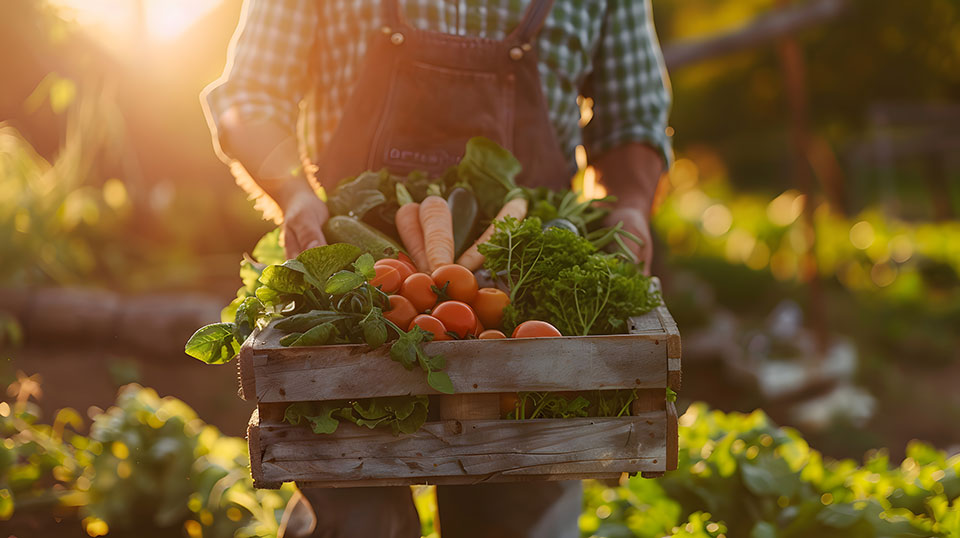
The U.S. Census of Agriculture indicates that 1,764 Kansas farms sell food at such places as the farmers market, an on-farm stand or even directly to their neighbor.
Kansas Local Food Producer workshops kick off Jan. 31
Organizers announce schedule for six workshops across the state
At a glance: The Kansas Local Food Systems program – administered by K-State Research and Extension – has joined with the Kansas Department of Agriculture to offer a series of workshops for local food producers, beginning Jan. 31.
More information:
Amanda Lindahl, 913-730-6689, alindahl@ksu.edu
Rebecca McMahon, 316-361-6779, rmcmahon@ksu.edu
Related: Kansas Local Foods Systems | Local Food Producer workshops (information and registration) | Kansas Garden Guide | Kansas Local Food Community Roundtable Findings (2024, full report)
Jan. 14, 2025
By Pat Melgares, K-State Research and Extension news service
MANHATTAN, Kan. – In 2022, the U.S. Census of Agriculture reported an estimated 116,617 farms accounting for more than $3.26 billion in food sales directly to consumers – a 16% increase over the census taken five years prior.
In Kansas, local food sales has increased at an even greater clip, as much as 185% more between 2017 and 2022, according to Amanda Lindahl, the program coordinator with Kansas Local Food Systems.
In raw numbers, that’s 1,764 Kansas farms selling food at such places as the local farmers market, an on-farm stand or even directly to a neighbor.
“But this is still only 3.2% of total Kansas farms in 2022,” Lindahl said, “so we have much more room for growth in direct-to-consumer sales.”
The Kansas Local Food Systems program – administered by K-State Research and Extension – has joined with the Kansas Department of Agriculture to offer a series of workshops for local food producers, beginning Jan. 31.
Registration is now available online for each of the six workshops, which cost $25. The list of upcoming workshops includes:
- Jan. 31: Manhattan – Pottorf Hall, Riley County Fairgrounds.
- Feb. 1: Wichita – Sedgwick County Extension Education Center.
- Feb. 7: Olathe – K-State Olathe.
- Feb. 21: Chanute – Neosho County Community College.
- Feb. 28: Hays – K-State Agricultural Research Center.
- March 28: Garden City – Southwest Research-Extension Center.
Each workshop begins at 9 a.m. and is open to all interested. The Feb. 7 workshop in Olathe also is available by livestream for $5, and includes options for Spanish or English.
“One of the things we learned from a series of community roundtables we held last year is that there is a great need to support local food entrepreneurs, especially when it comes to navigating regulations, increasing their marketing skills and reaching new markets for their products,” said Rebecca McMahon, administrator of the Kansas Local Food System program.
“These workshops are a great way to reach a range of farmers and small food businesses around the state that want to sell their products directly to consumers.”
Lindahl notes that the workshop also help local food producers build a network of other food producers in Kansas.
“I believe that the direct-to-consumer market provides opportunities for farmers and ranchers to capture more value for their products, ultimately making more profitable operations for Kansas producers,” Lindahl said.
The topics planned for each workshop include:
- Marketing.
- Food safety.
- Regulations on selling meat, eggs and poultry.
- Sales tax for vendors.
- Kansas Senior Farmers Market nutrition training.
This year’s workshops are funded in part by the Kansas Center for Sustainable Agriculture and Alternative Crops, and the Kansas Sustainable Agriculture Research and Education program.
More information and registration is available at https://www.ksre.k-state.edu/kansaslocalfoods/get-involved/workshops.html.
***

K‑State Research and Extension is a short name for the Kansas State University Agricultural Experiment Station and Cooperative Extension Service, a program designed to generate and distribute useful knowledge for the well‑being of Kansans. Supported by county, state, federal and private funds, the program has county extension offices, experiment fields, area extension offices and regional research centers statewide. Its headquarters is on the K‑State campus in Manhattan. For more information, visit www.ksre.ksu.edu. K-State Research and Extension is an equal opportunity provider and employer.