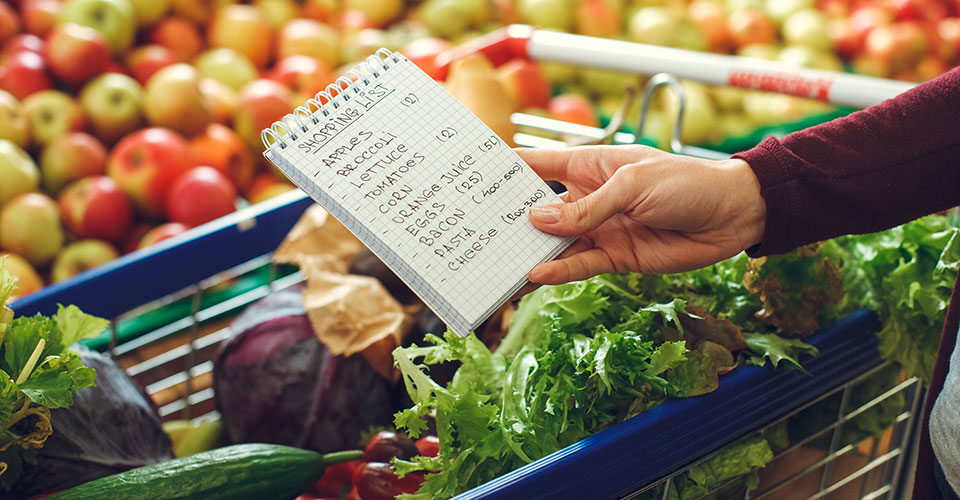
Shopping with a grocery list will help you avoid impulse purchases, says K-State family and consumer sciences specialist Sharolyn Jackson.
K-State expert offers tips for reducing food waste, saving money
Jackson says meal planning, shopping with a list are key steps
At a glance: K-State family and consumer sciences specialist Sharolyn Jackson encourages consumers to plan their food purchases in advance to reduce food waste and save money in the family's budget.
More information: Sharolyn Jackson, 785-532-5833, sharolyn@ksu.edu
Related: Sound Living | Essential Living Skills: Money Management | Spend Some, Save Some, Share Some: Family Budgeting | Buying Guide for Kansas Grown Fruits and Vegetables | Working Together to Reduce Food Waste
April 28, 2025
By Pat Melgares, K-State Research and Extension news service
MANHATTAN, Kan. – On average, between 30-40% of the food in the United States goes uneaten.
“That is food that is either discarded, or just gets thrown out and ends up in landfills or down the drain in the sewer system, or about 4% of it is composted,” said Sharolyn Jackson, a family and consumer sciences specialist with K-State Research and Extension’s northeast area office.
Thought of another way, uneaten food is also wasted money. Jackson said that an average family of four spends about $3,000 per year on food that’s not eaten.
“That’s a huge number,” she said. “It’s about $56 a week that your family of four could save, and I can think of a lot of things to do with an extra $56.”
Listen to an interview by Jeff Wichman with Sharolyn Jackson on the weekly K-State radio program, Sound Living
Jackson said consumers should plan their food purchases more closely in order to reduce food waste.
“Sometimes we see a sale at the store and we stock up, but then our plans for that food change,” she said. “Or you have food sitting at home that never was part of a meal plan. Or our schedules are unpredictable at times. There are a lot of things that go into using our food.”
“But really,” she adds, “it starts with planning. You can start by shopping your pantry, refrigerator and freezer before you go to the store. We often hear the joke that we could probably eat for a couple of weeks without having to go to the store because we forget about the things we already have in storage.”
Knowing what foods are on hand forms the basis for a shopping list, Jackson said.
“Use the food items that have been in there the longest…and then plan your meals around some of those items,” she said. “And then plan for leftovers. Freeze those foods individually so that you can just grab and go when you don’t have time to make a meal. We call those ‘planned-overs.’”
Jackson shared some additional tips to save money on food costs:
- Shop with a list. “It’s pretty easy to buy on impulse, but you need to stick to your list,” Jackson said. If certain meats are higher priced currently, look for alternative meats that would substitute well in planned meals. Planning your meals for the week forms the basis for your grocery list.
- Think about portion size. Jackson said consumers often think of restaurant meals as a guideline for portion size, but in reality, many prefer smaller portions. Consider the portion sizes that you and your family prefer when buying foods at the store.
- Re-purpose foods for additional meals. “Sometimes you’ll have maybe just a spoonful of veggies that is left after a meal,” Jackson said. “You can keep a container in your freezer when you accumulate those small portions and make a soup once you have enough of those.” Leftover broth from chicken or turkey is also an ingredient that can be frozen and used later.
- When buying fresh, consider its shelf life. Fruits and vegetables are in abundance in spring and summer, but Jackson cautions consumers to buy only what they can use in a realistic timeframe. Freezing or canning certain foods is an option.
When storing food is not an option, Jackson encourages consumers to consider donating food to a local food pantry. She notes the success of one such effort through a local Food and Farm Council in Riley County, where she lives.
“In the past year, we’ve rescued more than 35,000 pounds of food,” she said, noting that most food donations come from caterers and restaurants, but also from individuals and local farmers at the farmers market.
“We have a pretty sophisticated system in place to capture that food before it gets to a landfill, and it helps people in need.”
Jackson recently spoke at length on the topic of saving money by reducing food waste on K-State Research and Extension’s weekly radio program, Sound Living, available online.
More information on saving money and eating healthfully is available at local extension offices in Kansas.
***

K‑State Research and Extension is a short name for the Kansas State University Agricultural Experiment Station and Cooperative Extension Service, a program designed to generate and distribute useful knowledge for the well‑being of Kansans. Supported by county, state, federal and private funds, the program has county extension offices, experiment fields, area extension offices and regional research centers statewide. Its headquarters is on the K‑State campus in Manhattan. For more information, visit www.ksre.ksu.edu. K-State Research and Extension is an equal opportunity provider and employer.