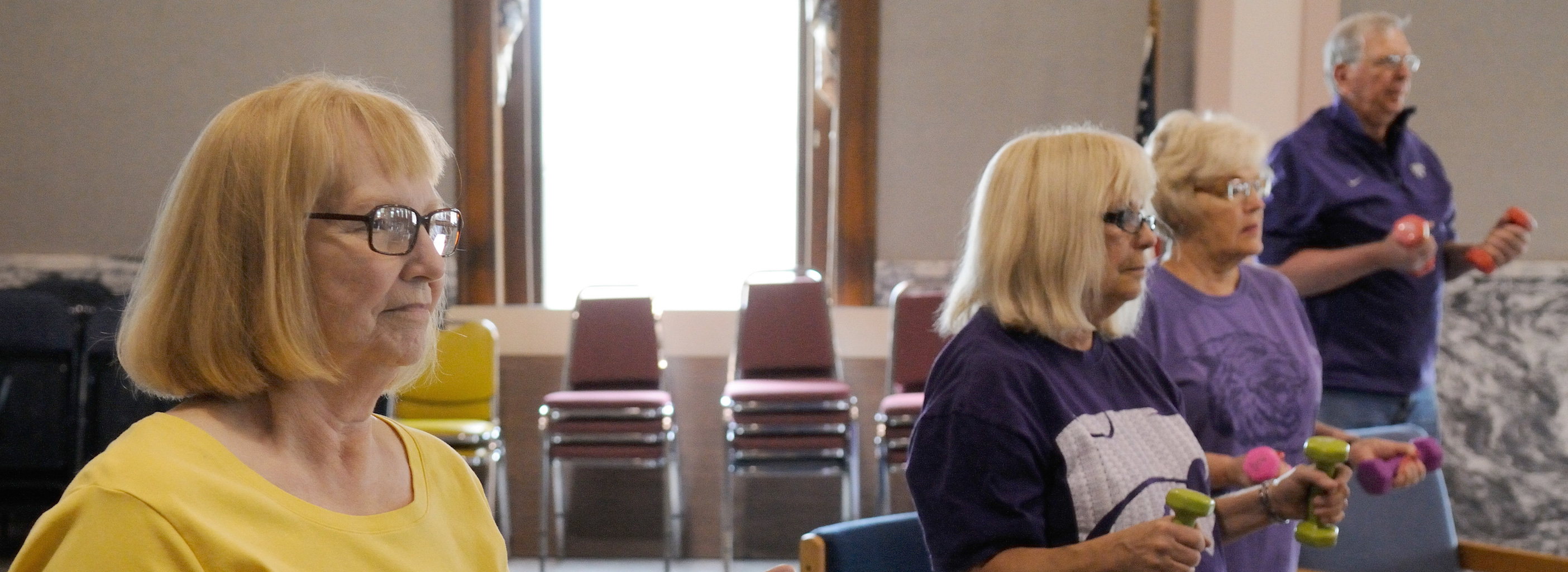
Eight-week program encourages adults to build strength and balance. | Download photo
Stay Strong, Stay Healthy: Class helps adults with quality of life
Kansas extension agents promote strengthening exercises
At a glance: The eight-week Stay Strong, Stay Healthy program encourages adults of all ages to meet twice weekly, working through eight exercises that build strength and promote balance.
More information: Name, phone number, email
Related:
Sharolyn Jackson, sharolyn@ksu.edu
Ashley Svaty, asvaty@ksu.edu
Aug. 14, 2025
K-State Research and Extension news service
MANHATTAN, Kan. – Some daily tasks – putting on socks, tying shoes, tucking a handkerchief in a back pocket – are normally pretty simple.
But for many Americans, those become a greater challenge with age or inactivity. The ability to flex, bend, tug and pull diminishes if the muscles aren’t routinely exercised.
“Roughly, only 15% of older adults are getting the recommended amount of daily physical activity, which means that 85% are not,” said Sharolyn Jackson, K-State Research and Extension’s northeast area family and consumer sciences specialist.
The Physical Activity Guidelines for Americans recommend at least 150-300 minutes of moderate intensity exercise – or 75-150 minutes of vigorous intensity – per week.
“But also in those guidelines is a recommendation for 2-3 days of exercises to build muscle strength per week,” Jackson said.
Jackson and Ashley Svaty, the northwest region family and consumer sciences specialist, are state coordinators and certified master trainers of the popular Stay Strong, Stay Healthy program that is offered through extension offices in Kansas. The eight-week program encourages adults of all ages to meet twice weekly, working through eight targeted exercises to build strength and improve balance.
“The classes meet two times a week, but we recommend the participants do these exercises a third day on their own,” said Svaty, who notes each class includes stretching, strengthening with or without weights and deep breathing exercises. “Throughout the eight weeks, participants see themselves grow stronger and become more steady, which turns out to be really fun and motivating for them.”
Svaty notes one example of an exercise that helps in daily living: wide leg squats.
“One of the things we see as we age is that it gets harder to get in and out of a seat,” she said. “So, wide leg squats really help with lower body strength.”
Other exercises include those that build upper body strength and promote balance, Svaty said.
“The feedback from some of the participants about what is important to them and what motivates them is interesting,” Jackson said. “One man used to keep his handkerchief in his front pocket because he did not have the flexibility to reach around to his back pocket. By the end of his class, he was able to put his handkerchief in his back pocket. Others note they can navigate steps on bleachers to watch their grandchildren play sports.”
Some additional comments from participants in the past year include:
- “This program increased my flexibility and strength. I began looking forward to each session.”
- “I feel my energy level increased and I have accomplished more around my home.”
- “I cancelled my back surgery because I’m feeling a lot less pain.”
“What we’ve found is that one thing leads to another, and often participants have more confidence to do other activities, or even just perform their daily activities or remain independent in their own home longer,” Svaty said. “Those are all things that we strive to help them achieve.”
Stay Strong, Stay Healthy costs $20 for the eight-week class. More information is available at local extensions offices in Kansas, or online at https://www.k-state.edu/staystrong.
***

K‑State Research and Extension is a short name for the Kansas State University Agricultural Experiment Station and Cooperative Extension Service, a program designed to generate and distribute useful knowledge for the well‑being of Kansans. Supported by county, state, federal and private funds, the program has county extension offices, experiment fields, area extension offices and regional research centers statewide. Its headquarters is on the K‑State campus in Manhattan. For more information, visit www.ksre.ksu.edu. K-State Research and Extension is an equal opportunity provider and employer.